
Government Presents Lunar New Year Parade to Promote Tolerance and Creative Economy
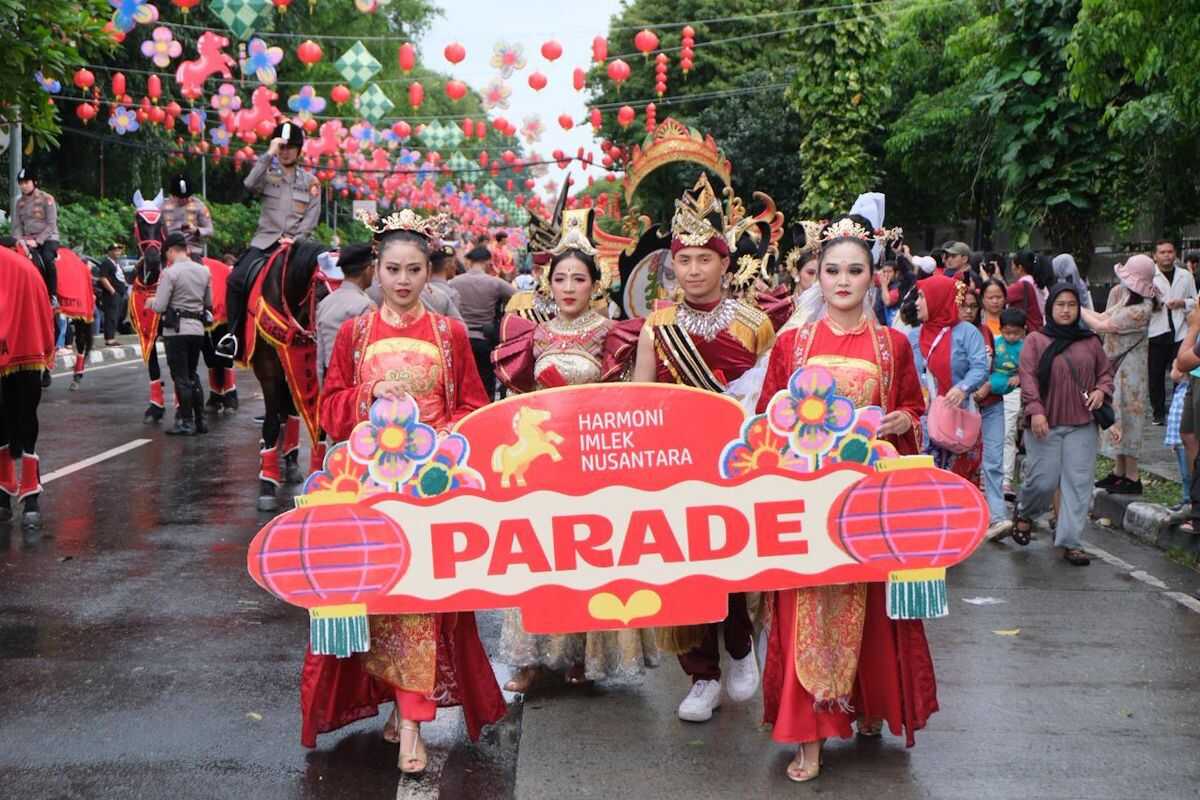
Jakarta — The Indonesian government presented the 2026 Nusantara Lunar New Year Parade as a platform for cross-cultural tolerance and creative economy growth through collaboration between government, communities, and the private sector.
“Indonesia is the most inclusive nation because diversity is not merely spoken of, but demonstrated and felt every day,” said Deputy Minister of Creative Economy and Deputy Head of the Creative Economy Agency Irene Umar whilst opening the 2026 Nusantara Lunar New Year Parade at Lapangan Banteng.
The parade marked the culmination of the National Lunar New Year Festival activities running from 22 February to 1 March 2026, serving as a space for cross-cultural interaction reflecting the spirit of unity and diversity in Indonesia.
Irene noted that the Lunar New Year parade, coinciding with the month of Ramadhan, reflected the values of national unity and inclusivity through cross-sectoral collaboration involving government, communities, the private sector, religious leaders, and the public.
“This Lunar New Year celebration does not belong to one group alone, but to all Indonesian society, regardless of ethnic, religious, or racial background,” Irene stated.
The Nusantara Lunar New Year Parade featured cultural processions blending Chinese and Nusantara traditions, including mounted police and female police officers, decorated vehicles and art troupes, lion dances and barongsai, drum bands, Jakarta Koko Cici performers, Bedug Yudha Asri, wushu and pencak silat demonstrations, jaran kepang, and ondel-ondel.
The parade began with a Long March from Jakarta Cathedral to Lapangan Banteng and was symbolically opened through drum strikes by representatives from various sectors.
Various regions, including Pontianak, Surakarta, Medan, and Semarang, actively participated as parade participants, showcasing Chinese art performances collaboratively presented with local Nusantara culture throughout the parade route.
Irene, as Chairwoman of the National Lunar New Year Festival, emphasised that the choice of parade location between Istiqlal Mosque and Jakarta Cathedral symbolised strong harmony and tolerance, whilst affirming that diversity constituted the foundation of national life in Indonesia.
Deputy Minister of Higher Education, Science, and Technology and Deputy Chair of the National Lunar New Year Festival Stella Christie stressed the importance of cultural spaces as public education platforms for understanding the history of diversity and cross-cultural contributions to Indonesia’s national journey.
“Indonesian national identity was shaped together through a lengthy acculturation process. Many cultural elements known today emerged from encounters between various cultures, including contributions from the Chinese community in history, language, cuisine, and the national struggle,” Stella explained.
Through the 2026 Nusantara Lunar New Year Parade, the government reaffirmed its commitment to making cultural celebrations not only spaces for unity and strengthening diversity values, but also as an ecosystem fostering creative economy growth based on collaboration, mutual cooperation, and diversity.
Several national officials and figures witnessed the 2026 Nusantara Lunar New Year Parade, including Minister of Religion Nasaruddin Umar, Deputy Minister of Women’s Empowerment and Child Protection Veronica Tan, North Maluku Governor Sherly Tjoanda, Semarang Mayor Agustina Wilujeng Pramestuti, and Executive Chair of the National Lunar New Year Festival Jago Anggara.
The 2026 Nusantara Lunar New Year Parade celebration served as an important moment for the government to affirm its commitment to making culture a unifying space for the nation.
Beyond ceremonial significance, the event was designed as a strategic ecosystem fostering creative economy growth based on collaboration, mutual cooperation, and diversity.
Artha Graha Peduli (AGP) and the Artha Graha Network, through their business unit Bank Artha Graha Internasional (BAGI), provided full support through concrete initiatives addressing environmental and economic empowerment aspects.
As corporate social responsibility, AGP conducted Saber activities (community cleanliness initiatives). This initiative aimed to ensure the parade celebration maintained environmental cleanliness.
With a spirit of mutual cooperation, the AGP team ensured every activity area remained free of waste, establishing new standards for environmentally friendly cultural festival implementation in Indonesia.
On the economic front, Bank Artha Graha Internasional (BAGI) played a vital role in enhancing the capacity of small and medium enterprises participating in the parade. Through QRIS payment processing, BAGI promoted digital transformation in every transaction.
To boost visitor enthusiasm and merchant income, BAGI introduced special cashback programmes, expected to increase sales volumes whilst accelerating digital financial literacy for small business operators.
“This collaboration represents genuine private sector synergy in supporting the national agenda. We want this cultural celebration to be not only visually beautiful, but also environmentally clean and economically strong for small and medium enterprise operators,” said Hanna Liles, representing Artha Graha Peduli management.
Through integration of cultural preservation, environmental responsibility by AGP, and digital economy strengthening by Bank Artha Graha Internasional, the 2026 Nusantara Lunar New Year Parade is expected to become a benchmark for sustainable cross-sectoral collaboration for national advancement.