
Government Issues Risk-Based Business Licensing Regulation PP 28/2025
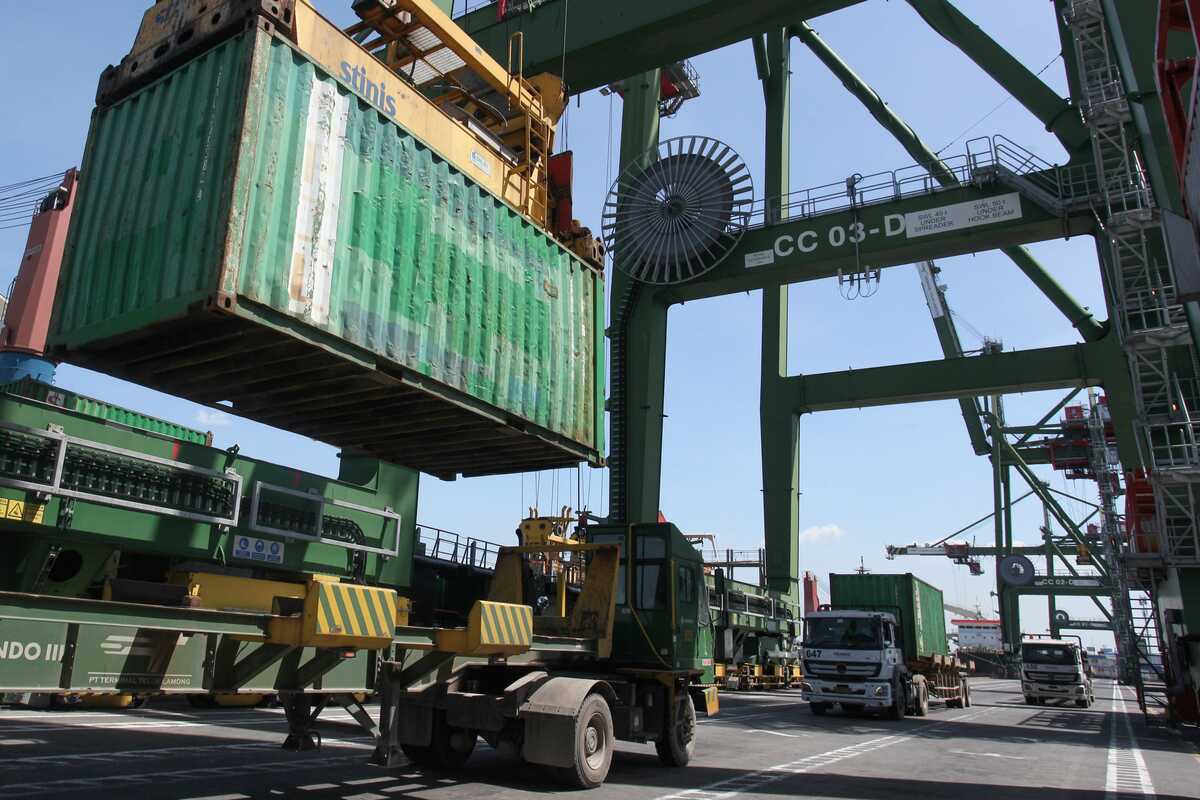
A crane operator moves containers from a cargo vessel to a truck at Teluk Lamong Terminal, Surabaya, East Java. (ANTARA/Didik Suhartono)
The government has issued Government Regulation (PP) No. 28/2025 on the Implementation of Risk-Based Business Licensing (PBBR). The regulation was signed by President Prabowo Subianto on 5 June 2025 and took effect upon its promulgation.
The regulation is a refinement of PP No. 5/2021 as part of the implementation of Law No. 11/2020 on Job Creation. It aims to facilitate ease of doing business through a risk-based approach, simplify licensing procedures, and enhance legal certainty for business operators.
The regulation governs a number of PBBR-related sectors as stipulated in Article 5, including maritime affairs, agriculture, energy, industry, trade, health, transport, education, tourism, the environment, defence, and the creative economy.
Under PP No. 28/2025, all licensing is processed through the Online Single Submission (OSS) system, including data integration from ministries, agencies and regional governments. The OSS manages the workflow from fulfilment of basic requirements and application submission through to permit issuance, either automatically or manually as circumstances require.
The regulation also classifies businesses according to risk level: low, medium-low, medium-high, and high. For low-risk micro enterprises, a self-declaration via OSS is sufficient. For high-risk businesses, licensing requirements and supervisory oversight become increasingly complex.
PBBR implementation is carried out by the central government, regional governments, and specialised bodies such as the Special Economic Zone (KEK) Administrator and the Free Trade Zone and Free Port Authority (KPBPB). Each body holds licensing authority within its respective jurisdiction.
Additionally, PP No. 28/2025 regulates tax facilities available to business operators, as set out in Article 235. These tax facilities comprise: first, import duty exemptions on machinery, goods and materials for industrial development or expansion in the context of capital investment; second, import duty exemptions on capital goods for public electricity generation; third, import duty exemptions or reductions on imported goods under contracts of work or coal mining exploitation agreements; fourth, corporate income tax reductions; fifth, income tax facilities for investment in specified sectors or regions; sixth, gross income deductions for work placements, apprenticeships and learning programmes; seventh, gross income deductions for certain research and development activities in Indonesia; and eighth, net income deductions for new investment or business expansion in labour-intensive industries.