
Government Issues Joint Ministerial Decree on AI in Education
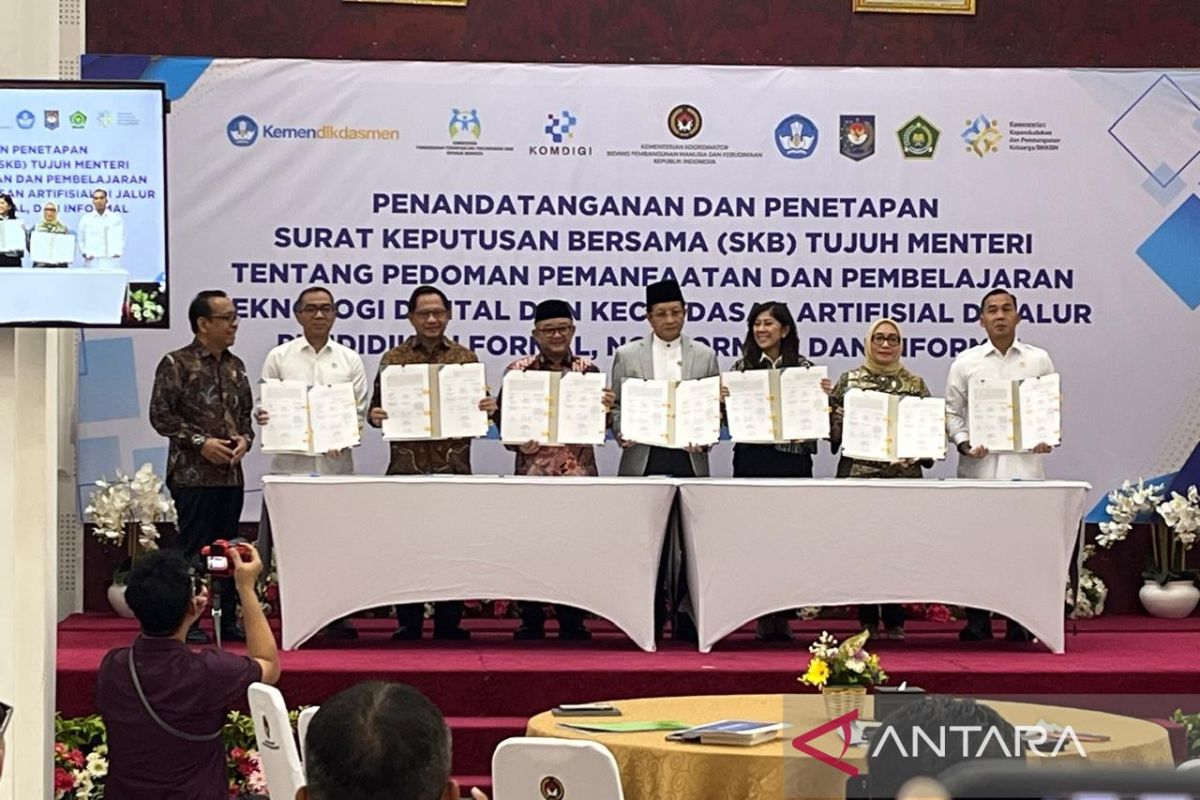
Jakarta — The Indonesian government has issued a Joint Ministerial Decree (SKB) from seven ministers establishing guidelines for the utilisation and learning of digital technology and artificial intelligence (AI) in education, spanning from early childhood education through to higher education.
The Coordinating Minister for Human Development and Culture, Pratikno, explained that the Coordinating Ministry facilitated and coordinated seven ministries in drafting the joint decree concerning the use of digital technology and artificial intelligence for formal education from early childhood education (PAUD) through higher education, as well as informal education including family settings. The announcement was made at the office of the Coordinating Ministry in Jakarta on Thursday.
The Joint Ministerial Decree was signed by the Minister of Home Affairs Tito Karnavian, Minister of Religious Affairs Nasaruddin Umar, and Minister of Primary and Secondary Education Abdul Mu’ti. It was also signed by the Minister of Higher Education, Science and Technology Brian Yuliarto, Minister of Digital Communication Meutya Hafid, Minister of Population and Family Development Wihaji, and Minister for the Empowerment of Women and Child Protection Arifah Fauzi.
Pratikno emphasised that the policy stresses the importance of using digital technology and artificial intelligence responsibly, taking into account children’s developmental readiness, which is closely linked to age. The decree establishes provisions regarding the appropriate age for using digital technology and AI, the types of usage permitted, and the duration of use adjusted to each education level.
According to Pratikno, as education levels increase, the use of technology becomes progressively less restricted, as users are deemed to have greater developmental readiness. Conversely, at early childhood and primary education levels, technology use will be more carefully controlled in terms of both duration and content.
“The lower the education level, the more controlled it becomes. It is not only controlled in terms of duration, but also in terms of content,” Pratikno stated.
The policy involves various ministries responsible for education delivery, including those managing primary and secondary education, higher education, and religious education. The role of local governments is also considered essential in implementing the policy, alongside support from the ministry handling family education and the digital technology industry.
Pratikno provided an example that at primary and secondary education levels, students are not permitted to use instant AI systems that directly provide answers to user questions. However, AI use remains permissible if the technology is specifically designed for learning needs.
“For instance, robotic simulation for primary education could use AI, but it must be specifically designed for educational purposes,” he explained.
Pratikno hopes that through this decree, the use of digital technology and AI for Indonesian children will provide positive benefits whilst minimising various negative risks.