
Government, Industry Players, and Greenvolt Power Indonesia Highlight Urgency of Accelerating Solar Energy Adoption
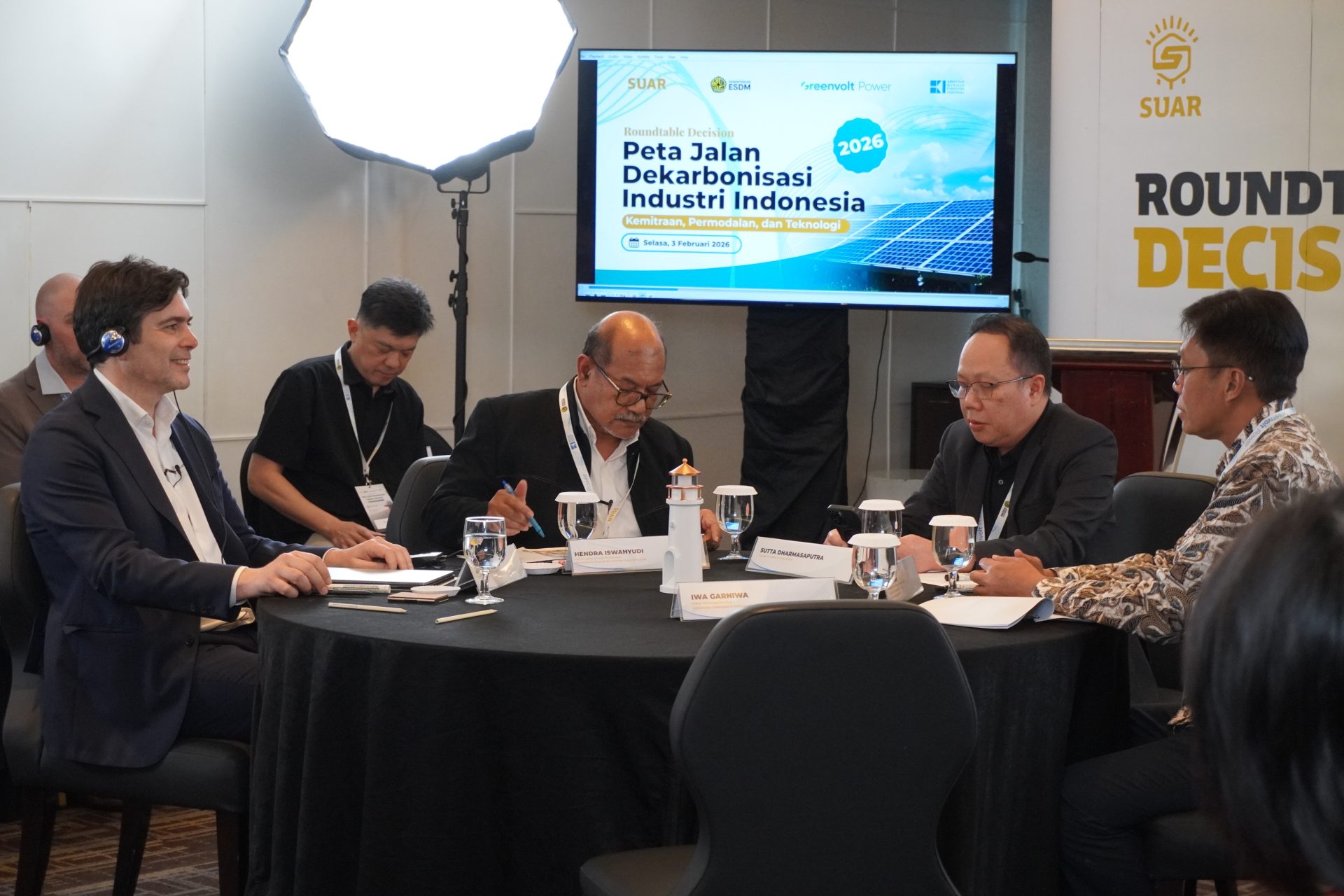
JAKARTA – The Ministry of Energy and Mineral Resources (ESDM), the Union of Industrial Estates (HKI), Greenvolt Power Indonesia, and other stakeholders in the renewable energy sector have agreed that strengthened partnerships, financing support, and proven technology are necessary to increase the utilisation of solar power as a renewable energy source to achieve net-zero emissions targets by 2060.
This consensus emerged during a stakeholder discussion titled “Indonesia’s Industry Decarbonisation Roadmap 2026: Partnership, Capital, and Technology” held in Jakarta. Speakers emphasised that 2026 must be a crucial momentum for realising national climate ambitions through large-scale operational capacity development.
The government has reiterated its commitment to expanding new renewable energy capacity through the 2025-2034 Electricity Supply Business Plan. The plan sets a target for additional solar energy capacity of 17.06 GW, with approximately 87 per cent, or 14.8 GW, expected to be built by the private sector. “The largest source of investment for energy transition is actually available in business entities, both state-owned and private enterprises,” said Deputy Minister of Energy and Mineral Resources Yuliot Tanjung.
He added that given the government’s fiscal capacity limitations, decarbonisation efforts cannot rely solely on state investment. “Without providing ease and involving private business entities, the government cannot conduct massive investment for decarbonisation. For this reason, we need to invite all stakeholders to move together,” said Yuliot.
Responding to this ambition, Greenvolt Power Indonesia expressed its optimism as an integrated renewable energy partner to support the national decarbonisation agenda. The company is part of Greenvolt Group, a KKR portfolio entity that operates a renewable energy network in over 20 countries with a total project pipeline of 14.1 GW and more than 1.1 GW of distributed generation capacity already developed for the commercial and industrial segments. With this background, Greenvolt Power Indonesia possesses the stability, financial strength, and technical expertise to drive solar energy adoption in Indonesia.
Greenvolt Power Indonesia, previously operating as Emerging Solar Indonesia, has undergone transformation with the expansion of the company’s role and capacity. The company is targeting the development of solar power plants with a capacity of approximately 310 MW by 2031 in Indonesia to support industrial needs, supported by long-term global investment commitments. To reduce barriers to renewable energy adoption, Greenvolt Power Indonesia implements a zero-capital expenditure and zero-operating-expenditure (zero-CapEx and zero-OpEx) business model that makes it easier for industry players to transition to solar energy.
This approach is designed to encourage Indonesia’s industrial ecosystem to achieve net-zero emissions more rapidly by reducing the financial and operational barriers that have historically limited large-scale solar energy adoption.
“Indonesia has significant opportunities to transform its natural potential into reliable renewable energy, whilst driving industrial competitiveness and long-term growth,” said André Fraga, Commissioner of Greenvolt Power Indonesia.
He added that by combining the strength of global capital, proven execution capabilities, and deep understanding of local context, Greenvolt Power wants to provide the long-term certainty needed by Indonesia’s national industry.
The Ministry of ESDM’s performance report shows that total renewable energy capacity achieved throughout 2025 reached 15,630 MW. Of this total, solar power contributed nearly 10 per cent (1,494 MW). ESDM data also shows that the target renewable energy generation capacity for 2026 is 16,695 MW (16.4 per cent of Indonesia’s total national electricity generation capacity).
Iwa Garniwa, energy expert from Universitas Indonesia and PLN Technology Institute, highlighted the energy disparity experienced by Indonesia, including in accessing renewable energy. “In this regard, technology, knowledge, and the importance of large-scale capital access are needed,” he said.
Indonesia’s industrial sector, which accounts for 30–35 per cent of greenhouse gas emissions, represents one of the main opportunities for accelerating decarbonisation. Deputy Chair of the Environment and Sustainable Governance Division at HKI, Irwansyah, emphasised the important role of solar power for the industrial sector in moving towards decarbonisation. “For new and renewable energy, the most feasible option for industry players and industrial estate managers currently is solar power. There are other sources such as wind, geothermal, or hydroelectric, but these cannot all be applied in industrial estates. Currently, what we can concretely do is the development of solar power plants,” said Irwansyah.
However, he acknowledged that solar power adoption in the industrial sector still faces several challenges. “The challenges are not only in technology, but also in land availability and, particularly, the initial investment cost that remains relatively high,” he concluded.
Given the early-year momentum, the discussion concluded that the success of accelerating solar power adoption depends not only on the magnitude of its potential. To optimise this clean energy, coordinated action from government, private sector, and academia is needed to align policy, capital, technology, and partnerships. This step is crucial to creating tangible, measurable, and long-term impact for Indonesia’s future energy and economy.