
Government Eyes Steel Industry as Key Driver of Economic Growth and Downstream Industrialisation
Amid the Indonesian government’s efforts to strengthen downstream processing across major sectors such as nickel, copper and palm oil, the steel industry is emerging as a crucial pillar in accelerating national economic growth.
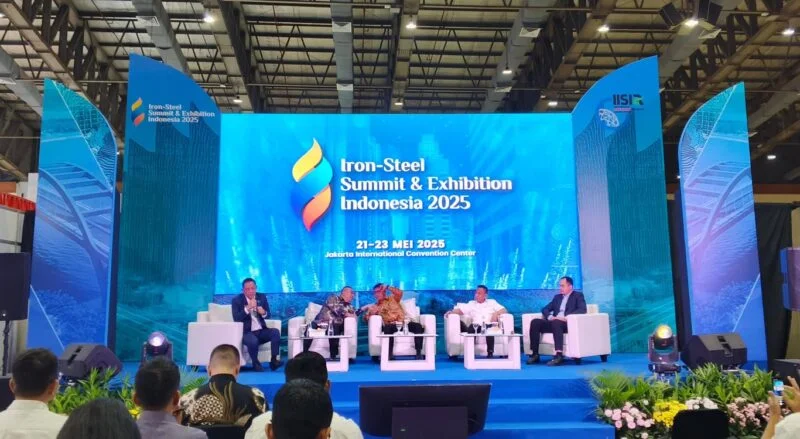
At the Indonesia Steel Summit & Exhibition Indonesia (ISSEI) 2025, Dedi Latip, Deputy for Investment Planning at the Ministry of Investment and Downstream Industries/BKPM, outlined the government’s strategy to position the iron and steel industry as a primary driver of productivity gains and high-value-added exports.
Investment in the steel sector has shown significant growth, in line with government policies steering economic transformation from primary sectors towards higher-value downstream industries. Data indicates that investment in basic metals, including steel, surged by 152 per cent, from Rp94.6 trillion in 2020 to Rp238.4 trillion in 2024.
Dedi emphasised that iron and steel are not merely construction materials but a vital foundation for national industrialisation. In pursuit of the 8 per cent annual economic growth target set by President Prabowo Subianto for the 2025–2029 period, the government estimates that investment needs will reach Rp13,032 trillion, with the majority coming from the private sector.
BKPM projects the basic metals sector, including steel, as one of the main pillars, with national steel consumption expected to rise to 100 million tonnes per year by 2045.
Under the steel downstream roadmap for 2023–2029 drawn up by BKPM, production capacity targets span upstream products such as billets and slabs through to downstream products including steel plate, Hot Rolled Coil (HRC), pipes and wire mesh. Several production achievements have already exceeded first-phase targets — steel plate reached 312.8 per cent, steel slab 215 per cent, and steel HRC 391 per cent. However, downstream products such as wire mesh and coated steel still require further investment.
To address licensing obstacles that frequently impede progress, the government has introduced the Fictive Positive regulation through Law No. 6/2023 and Government Regulation 5/2021, under which permits not processed within a specified timeframe are automatically deemed legally approved. The risk-based Online Single Submission (OSS) system facilitates permit processing, with BKPM authorised to issue permits across 16 priority sectors, including the steel industry.
Additionally, BKPM offers various fiscal incentives such as tax holidays and tax allowances, whilst promoting the development of Special Economic Zones (KEK) and industrial estates throughout Indonesia as steel investment distribution centres, particularly outside Java.
The government is also actively promoting investment potential at international forums to attract global partners with advanced technology capable of collaborating with state-owned enterprises and local industry players.
Despite rising production capacity and investment, Indonesia’s steel trade balance remains in deficit. Exports in 2023 reached US$2.99 billion, whilst imports stood at US$9.19 billion. Dedi highlighted the need for support from steel-consuming sectors such as automotive, maritime and defence to maximise the use of domestic products.
Cross-sector collaboration through platforms such as ISSEI is key to driving sustainable and competitive steel industry growth at both regional and global levels. As a major player, PT Krakatau Steel (Persero) Tbk continues to strengthen its production capacity and product quality whilst developing supporting infrastructure to build an integrated and superior steel industry ecosystem, in support of the Golden Indonesia 2045 vision.