
Government Explains Limitations and Criteria for Criminal Penalties Against Hoax News Spreaders in Constitutional Court Hearing
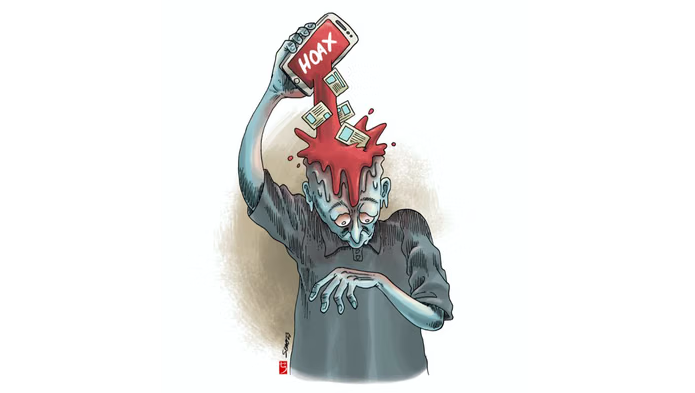
The Government has affirmed that the criminal regulations regarding the spread of false information in the new law are designed to clarify legal boundaries whilst protecting freedom of expression. This explanation was presented by the government during a constitutional review hearing at the Constitutional Court on Monday, 9 March.
Deputy Minister of Law Edward Omar Sharif Hiariej stated that Article 263 of Law Number 1 of 2026 on Criminal Code Adjustment was drafted with stricter limitations to prevent misuse. According to him, the article only applies to those who knowingly spread information they know to be false.
“Article 263 provides a more certain measure. If someone knows a piece of information is false and still spreads it, then there is malicious intent and they can be prosecuted. However, if they do not know the information is false, they cannot be prosecuted under this article,” said Eddy before the Constitutional Court judges.
Eddy explained that this provision differs from Article 14 of Law Number 1 of 1946, which previously regulated the broadcasting of false information. Under the old regulation, a person could be prosecuted without proof that they knew the information was false, which was considered difficult to prove and potentially created legal uncertainty.
Additionally, Article 263 also requires a tangible consequence in the form of public unrest before a person can be prosecuted. The Government cited several Constitutional Court decisions that defined unrest as occurring in physical space and involving violence against persons or property.
“To be prosecuted under Article 263, three elements must be present simultaneously: spreading information, knowing the information is false, and the consequence being public unrest,” said Eddy.
“If false information is spread but does not cause unrest, then that person cannot be prosecuted,” he added.
Previously, the constitutional review was initiated by four law students: Rianjani Pajar Salusih, Muhammad Amyusril Baramirdin, Devina Futriyani, and Bernita Matondang. They argued that certain phrases in the regulation remained ambiguous and could potentially lead to criminalisation, particularly of academic activities and information dissemination in public spaces.
The petitioners expressed concern that the use of terms such as “uncertain information,” “excessive,” or “incomplete” could be interpreted broadly by law enforcement officials. They contended that such conditions could threaten academic freedom and the public’s right to obtain and disseminate information.
The hearing on case number 26/PUU-XXIV/2026 was chaired by Constitutional Court Chairman Suhartoyo and will continue with sessions to hear statements from relevant parties before the judges issue their decision.