
Government Establishes Joint Ministerial Decree Governing AI Use in Education
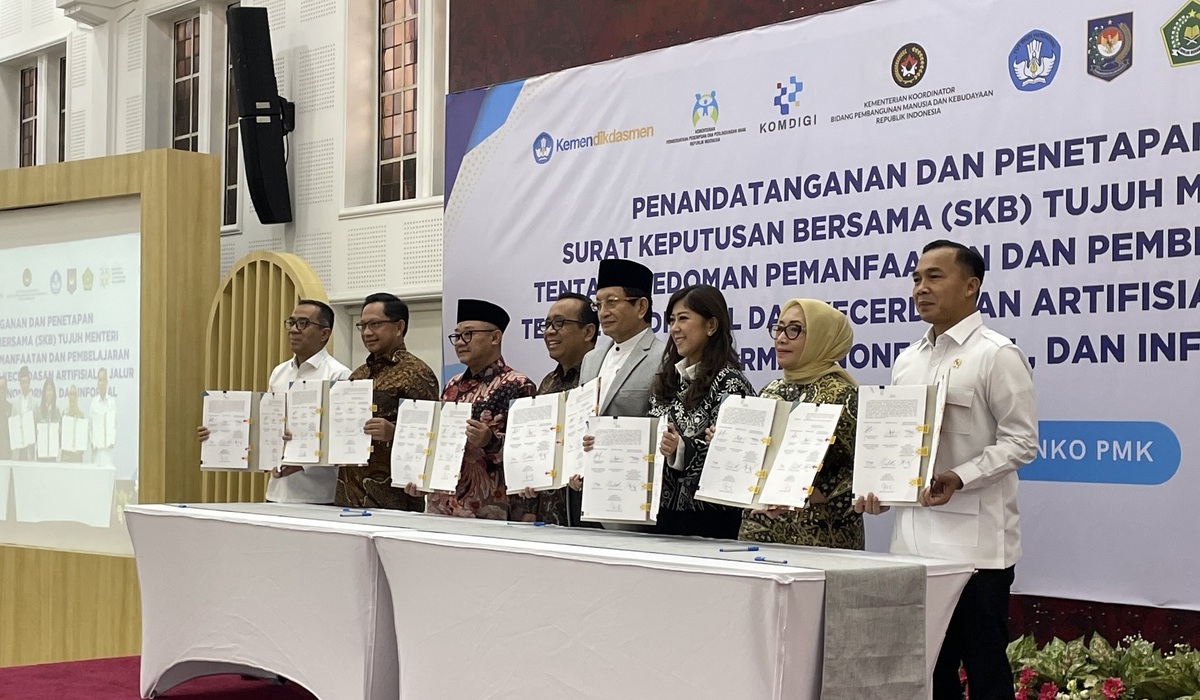
Seven ministries have signed and established a Joint Ministerial Decree (SKB) on Guidelines for the Use and Learning of Digital Technology and Artificial Intelligence (AI). This policy was developed as a comprehensive guide for regulating the use of AI and digital technology in education whilst mitigating various risks that may affect children and young people.
Coordinating Minister for Human Development and Culture Pratikno emphasised that the decree is not intended to hinder technological development, but rather to ensure its use occurs safely, wisely, and benefits student development.
“So this decree does not obstruct, but rather regulates to mitigate risks on one hand whilst enabling digital technology and artificial intelligence to empower our children,” said Pratikno on Thursday 12 March.
The seven ministers involved are Minister of Research, Technology and Higher Education Brian Yuliarto, Interior Minister Tito Karnavian, Minister of Education and Culture Abdul Mu’ti, Religious Affairs Minister Nasaruddin Umar, Minister of Communication and Digital Meutya Hafid, Minister of Women’s Empowerment and Child Protection Arifah Fauzi, and Minister of Population and Population Control/Head of BKKBN Wihaji.
According to Pratikno, digital technology development certainly brings considerable convenience to human life. However, like transportation systems which require safety mechanisms, technology use also requires proper risk management so its benefits can be realised optimally.
“All technology certainly simplifies our work. It is as if we cannot travel far without flying. But to keep the aeroplane safe, we must properly manage its risks. We need navigation, we need seatbelts so risks remain low and we reach our destination quickly,” he explained.
Pratikno also highlighted the high exposure to digital technology among children and young people. He noted that children’s average device usage or screen time has exceeded seven hours daily, impacting reduced physical activity and direct interaction.
“Exposure to digital technology is already high, with screen time at 7.5 hours. This means green time is becoming smaller,” he said.
He added that various academic studies show that uncontrolled digital technology use can trigger various problems, including mental health disorders among adolescents.
“Adolescents experiencing mental health disorders are increasing and continuing to rise. One suspected and academically proven trigger is uncontrolled, unmanaged, and unmitigated digital technology use,” he stated.
Additionally, excessive technology use is seen as potentially triggering fear of missing out (FOMO) phenomena, social media showing off behaviour, and cyberbullying. Even in education, technology dependence could weaken students’ critical and cognitive thinking abilities.
“The impact on education is also quite concerning, for example weakening brain activity due to dependence on digital technology tools, and reducing critical thinking and cognitive and reflective abilities,” he said.
Through the decree, the government has established guidelines for digital technology and AI use based on children’s age and readiness. At primary and secondary education levels, AI use is limited only to systems specifically designed for learning.
This step was taken to ensure technology use does not weaken students’ thinking abilities, whilst encouraging innovative learning models such as project-based learning.
Meanwhile, at higher education level, AI technology use will be more open as student maturity increases. However, transparency in technology use remains mandatory to maintain academic integrity.
“Greater openness, but transparency in AI use is mandatory to maintain academic integrity,” said Pratikno.
Furthermore, he emphasised that monitoring technology use is not solely schools’ responsibility, but also families as the child’s first environment.
Therefore, parental roles are crucial in guiding children to use technology wisely. Monitoring is not merely control, but also active guidance so children understand the benefits and risks of technology use.
“Parents are not only monitors but also active companions and mentors in using technology wisely,” he said.
The decree represents the result of inter-ministerial work over more than four months. The guidelines apply to all educational pathways, from early childhood education (PAUD), primary and secondary education, higher education, to non-formal and informal education, including the family environment.
With these guidelines, the government hopes that digital technology and artificial intelligence use can provide positive benefits whilst minimising negative risks for young people.
“Let us use this momentum to ensure Indonesian children grow resilient, innovative, and of good character. A generation capable of utilising technology, not controlled by it,” he concluded.