
Government Ensures Control of Food Prices and Inflation to Mitigate Crises
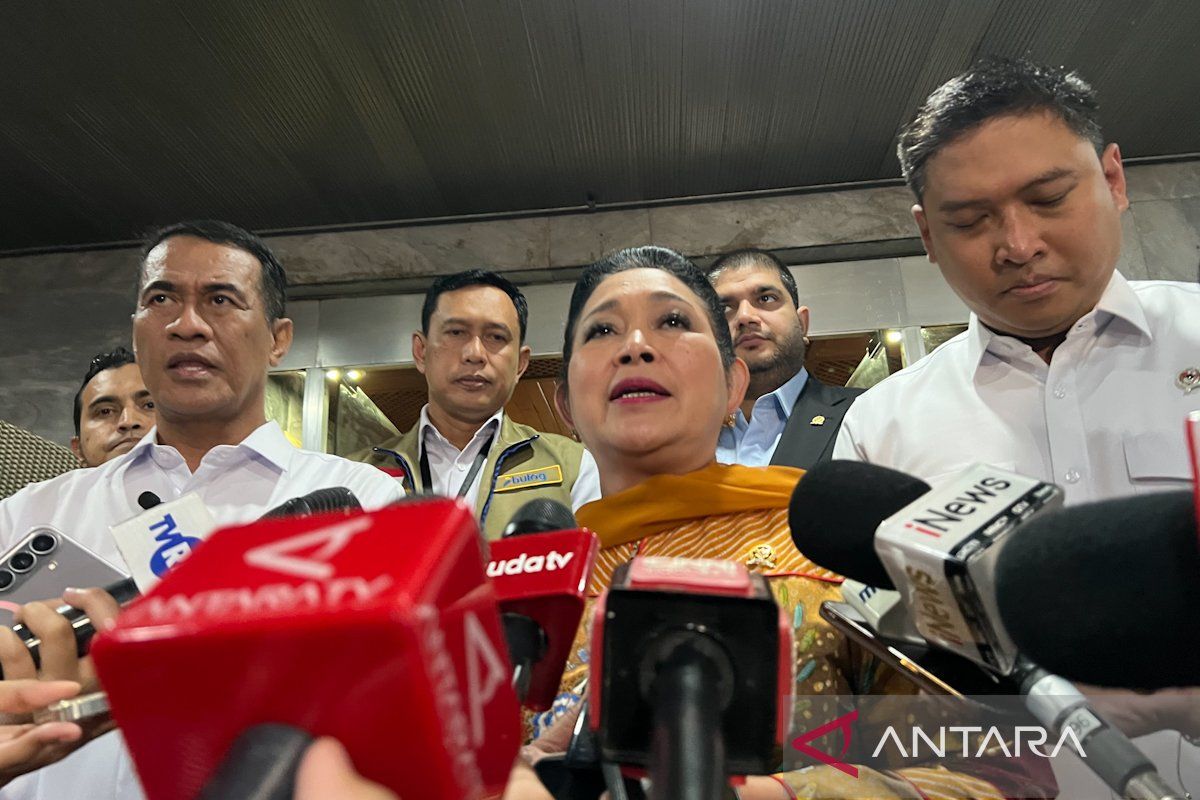
Jakarta (ANTARA) - The Head of the National Food Agency (Bapanas) and Agriculture Minister Andi Amran Sulaiman has emphasised that the government is continuously safeguarding food prices and inflation to mitigate potential crises arising from global dynamics and climate change.
Amran stated that several government interventions to maintain food prices include field monitoring to ensure compliance with the highest retail price (HET) and reference selling price (HAP), as well as distributing food assistance to 33.2 million beneficiary families (KPM).
Additionally, the government is distributing rice and corn through the government-subsidised Stabilisation of Food Supply and Price (SPHP) programme, the cheap food movement (GPM), and facilitating the distribution of food from surplus areas (excess supply) to deficit areas (short supply).
“The way (to maintain food price stability) is through food assistance and SPHP,” said Amran when met after the Working Meeting of Commission IV of the House of Representatives in Jakarta on Tuesday.
The government is keeping fluctuations in staple food prices within reasonable bounds from producer to consumer levels.
The government ensures that the inflation rate of volatile price components, or food inflation, remains stable, indicating that public purchasing power is also positively maintained.
Amran explained the need to refer to strong reference data. According to him, data from the Central Statistics Agency (BPS) can serve as a benchmark.
“When talking about prices, we use data. Don’t use feelings, because many price increases occur only at one point (but) that is taken as a national reference. According to BPS, we follow BPS. If we talk village by village, it’s difficult. BPS shows that food inflation has dropped from 2.50 percent to 1.58 percent this month,” clarified Amran.
In the last three years, Amran continued, the post-Eid al-Fitr period has usually been followed by food deflation. In 2024, monthly food inflation in March was recorded at 2.16 percent, but it turned into deflation of 0.31 percent in April. In 2025, food inflation of 1.96 percent in March changed to a slight deflation of 0.04 percent in the following month.
However, in 2026, the food inflation trend was successfully kept as a positive movement. Food inflation remained stable at a positive and reasonable level of 1.58 percent after the previous month’s 2.50 percent. This reflects more controlled supply and price stability, with public purchasing power still maintained.
Looking at this food inflation trend, the government is optimistic about mitigating crises that may occur as implications of geopolitical conflicts and the El Niño phenomenon. Rice, as the primary consumption choice for the public, is ensured to be sufficiently available.
“The point is, the crises we faced in the past and those to come, we will handle. Today, our rice reserve stock reaches 4.6 million tonnes, the highest in our stock history. That’s the food sector,” he said.
“In the last two years under President Prabowo Subianto’s administration, rice has not been the main contributor to inflation up to now. What does that mean? Our rice is sufficient,” added Amran.
Bapanas records that rice has a monthly inflation rate that is quite controlled. Since June 2024, the monthly rice inflation level has never exceeded the 2 percent index.
The latest monthly rice inflation in March 2026 is at 0.65 percent, slightly increasing from February 2026’s 0.43 percent.
Meanwhile, the latest annual rice inflation in March 2026 is at 3.71 percent. This is still much lower compared to the very high annual rice inflation in March 2024 at 20.07 percent and also lower than the highest point of rice inflation in 2025 at 4.24 percent in August.
One of the efforts to maintain national rice price volatility, the government is pursuing various programmes, both directly targeting the public and post-harvest infrastructure development. This is a direct instruction from President Prabowo Subianto.
In addition to food assistance interventions and the SPHP rice and corn programme, the government is also preparing to build warehouses in areas without rice production, such as East Nusa Tenggara (NTT) and West Nusa Tenggara (NTB).
“Including Ambon, where rice is sometimes scarce, we will build (storage warehouses). The budget is Rp 5 trillion and the President has approved,” explained Amran.
According to Bapanas records, the realisation of rice food assistance distribution, packaged with cooking oil, as of 7 April has reached 36.4 million kilograms (kg) of rice and 125.7 liters of cooking oil. Meanwhile, the realisation of SPHP rice sales from March to 7 April has reached 82.2 thousand tonnes.