
Government Encourages Asia-Oceania Collaboration for Digital Economy
As the nation with Southeast Asia’s largest digital economy, Indonesia has demonstrated significant growth in recent years. Indonesia’s digital economy value is projected to exceed USD 130 billion by 2026, with internet penetration reaching approximately 79.5% of the total population.
Growth in digital transactions continues to rise, including digital payments surpassing 4.7 billion transactions in January 2026, growing nearly 40% year-on-year.
“This development positions Indonesia as one of the primary digital investment destinations in Southeast Asia, with increasing investment flows in technology and digital infrastructure sectors,” stated Ali Murtopo Simbolon, Deputy for Commerce Coordination and Digital Economy at the Coordinating Ministry for Economic Affairs (Kemenko Perekonomian), in a written statement on Monday (16 March 2026).
“To ensure digital transformation and the utilisation of Artificial Intelligence (AI) deliver optimal impact for the national economy, the government continues to strengthen digital human resources (HR) development as the fundamental foundation of the future economy,” he added.
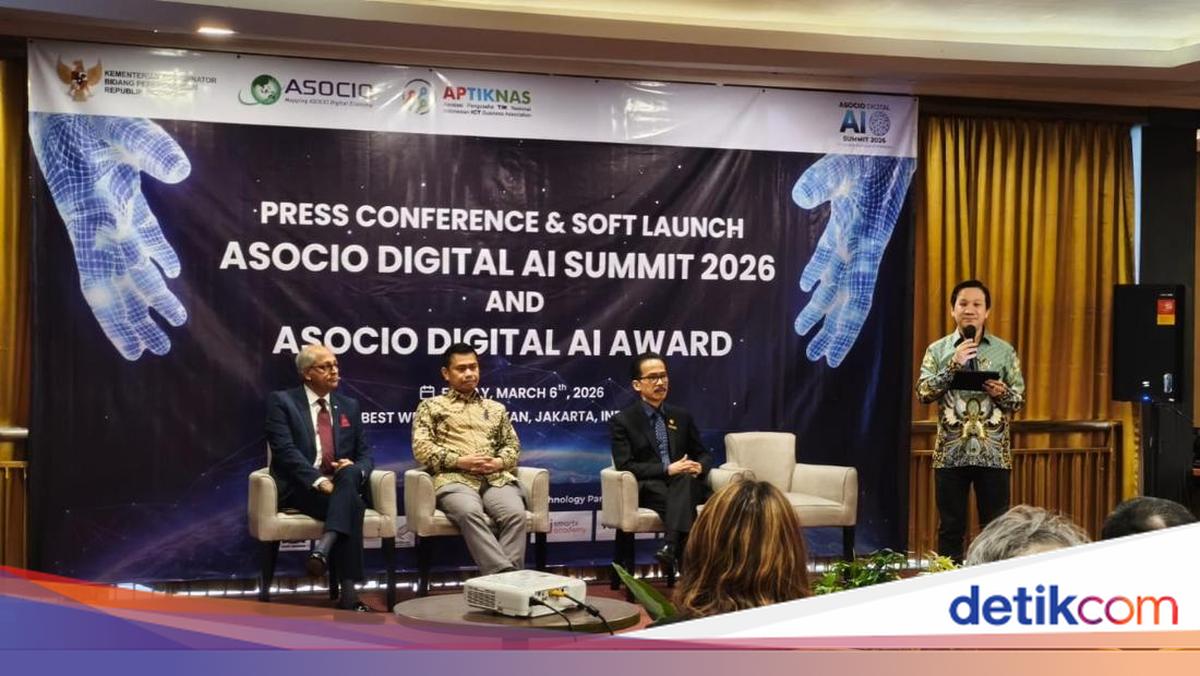
He conveyed this during the soft launch event of the Asian Oceanian Computing Industry Organization (ASOCIO) Digital AI Summit 2026 and ASOCIO Digital Award.
Strengthening digital economy and advanced technology development such as AI has become a critical factor in driving productivity improvements, industrial efficiency, and national economic competitiveness at the global level.
Within this framework, AI is positioned as part of the ‘new engine of growth’ that will accelerate transformation across various economic sectors.
AI technology will not only drive operational efficiency and innovation in business, but also create opportunities for new business models, increased industrial value addition, and development of a more dynamic and sustainable digital economic ecosystem.
Therefore, the Indonesian Government, through the Coordinating Ministry for Economic Affairs, in collaboration with ASOCIO, will host the ASOCIO Digital AI Summit 2026 on 29-31 July 2026 in Jakarta.
This event will serve as the primary forum for government agencies, technology industry players, academics, and innovators to strengthen regional collaboration in artificial intelligence development and digital economy in the Asia-Pacific region.
Under the theme ‘Hybrid Intelligence Unbound: Reimagining Innovation, Infrastructure and Regional Sovereignty’, the ASOCIO Digital AI Summit 2026 will focus on several strategic agendas, including digital transformation and AI adoption for national and regional development; strengthening AI governance standards and technology ethics; building inclusive and resilient digital infrastructure; increasing involvement of SMEs in the digital ecosystem; and strengthening technology investment and new market opportunities in the region.
In the regional context, hosting the ASOCIO Digital AI Summit 2026 in Indonesia is expected to serve as a strategic platform to strengthen inter-country collaboration in the Asia-Pacific region in digital technology development, AI innovation, and strengthening the technology talent ecosystem.
The forum is also expected to expand digital investment opportunities, enhance cross-border business connectivity, and promote the use of AI technology to support social inclusion, industrial efficiency, and improvement in public service delivery.
“As host of the ASOCIO Digital AI Summit 2026, Indonesia aims to make this forum a foundation for future AI development. The government hopes that AI utilisation can drive faster economic growth through a new growth engine based on three main pillars: digital economy, semiconductor industry, and advanced technology utilisation to enhance national industrial competitiveness,” said Ali.
For information, the event was attended by the Chairman of the National ICT Entrepreneurs Association (APTIKNAS) Soegiharto Santoso, ASOCIO Chairman Stan Singh-Jit, Organising Committee Chairman Karim Taslim, representatives from the Ministry of Communication and Digital Affairs (Komdigi), technology information and communications business practitioners, and national media representatives.