
Government Continues to Expand Digitalisation of Education
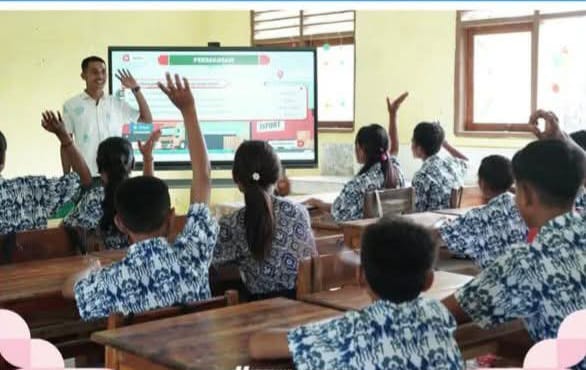
DIGITALISATION of learning continues to be expanded by the government. After Java Island, including West Java, the focus is now directed towards 3T (disadvantaged, frontier, and outermost) regions. One example is located in Nusa Tenggara Timur Province (NTT). Digitalisation from the Ministry of Basic and Secondary Education (Kemendikdasmen) has successfully attracted attention and achieved improvements in student evaluation scores. Theobaldus Banafanu, an IPS teacher at SMPN Wederok in Weliman Subdistrict, Malaka Regency, said that the presence of the Rumah Pendidikan super app, Digital Interactive Board (PID), and Starlink access since the beginning of this year has sparked enthusiasm in the teaching and learning process for 139 students at his school. The Rumah Pendidikan super app is provided by the Pusdatin of Kemendikdasmen, while the PID and internet access are through the Directorate of Secondary Schools, Directorate General of Early Childhood Education, Basic Education, and Secondary Education. “Previously, textbooks were limited. So if they held a book, students couldn’t see what it looked like. Now with the PID since January 2026, teachers can simply browse to show the actual appearance of what’s being discussed. In essence, we teachers and students are facilitated in everything in the classroom,” he said. As a result, said the teacher who has been teaching since 2019, his students’ weekly exam results have started to show an increase. If previously the class average was around 60, now it has reached an average of 75-80 because students better understand the teaching material. This is considered reasonable because it aligns with the digital native character of the students. Even though they come from 3T areas, with the majority of parents being corn, rice, and copra farmers, most are already familiar with smartphones. Head of the Data and Information Technology Centre of the Ministry of Basic and Secondary Education (Pusdatin Kemendikdasmen) Yudhistira Nugraha said that the example in NTT is proof of the spirit of the current Kemendikdasmen paradigm, which aims to change the concept of schooling to learning. “This mindset change makes learning no longer limited to the classroom, but can take place anywhere and anytime. With the learning approach, the learning process can be done anywhere and anytime,” he added in Bandung on Thursday (19/3). According to him, after the mindset change, ongoing collaboration is needed next. Because the number of learning technology developers in Indonesia reaches nearly 3,000 people spread across various ministries and institutions, thus forming an ecosystem if they know and strengthen each other.