
Government, Business Leaders and Parliament Discuss 2026 Work and Budget Plans and Current Mining Industry Conditions
Indonesia’s mining industry currently stands at a critical juncture amid pressure from domestic policy changes and global economic dynamics.
Domestically, the government’s planned adjustments to approval procedures for 2026 Work and Budget Plans (RKAB) in the minerals and coal sector have raised concerns among industry players. Mining companies have already developed long-term plans with substantial investments to drive production. External pressures stem from geopolitical threats and a slowdown in global economies, particularly China.
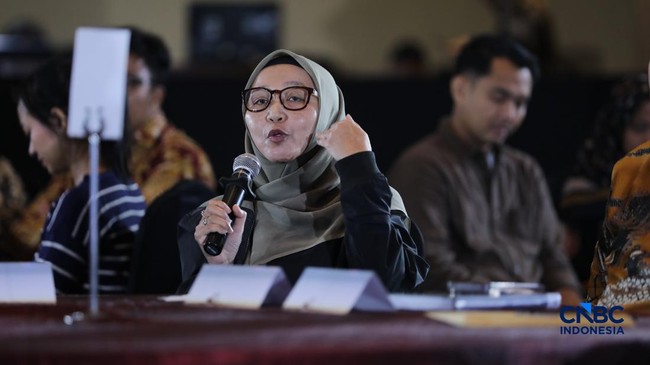
Indonesia’s mining challenges, from RKAB planning to global turmoil, were comprehensively discussed at the CNBC Indonesia Mining Forum 2026, themed “How’s Indonesia’s Mining Industry Doing?”, which brought together regulators, policymakers, industry leaders, and stakeholders on Friday, 6 March 2026.
The discussions featured Indonesia Mining Association (IMA) Vice Chair for Legal and Tax Ezra Sibarani and Indonesia Mining Institute (IMI) Chairman Irwandy Arif, along with Indonesian Coal Mining Association (APBI) Executive Director Gita Mahyarani, Indonesian Mining Experts Association (Perhapi) Chair Sudirman Widhy, and Indonesia Private Power Producer Association (ASPINDO) Deputy General Chair Ahmad Kharis. Government representatives included Ministry of Energy and Mineral Resources (ESDM) Directorate General of Minerals and Coal Secretary Siti Sumilah Rita Susilawati, Deputy Assistant for Mineral and Coal Development at the Coordinating Ministry for Economic Affairs Herry Permana, Parliament’s Commission XII Chair Bambang Patijaya, and Indonesian Private Power Producers Association (APLSI) Primary Energy Value Chain Committee Vice Chair Ferry Dwi Nugraha.
Mining Sector at Critical Juncture
Indonesia Mining Institute Chairman Irwandy Arif assessed that the mining sector stands at a crossroads between consolidation momentum or crisis, depending on the government’s future policy direction. Irwandy explained that the industry faces short-term pressures from various factors, including domestic policies perceived as sudden and global geopolitical tensions, including conflicts involving Iran, Israel, and the United States.
“The mining industry currently faces short-term pressure and global conditions. There are sudden domestic policies, plus tensions between Iran, Israel, and the US that could increase operational costs,” Irwandy said during the CNBC Indonesia Mining Forum 2026 on Friday, 6 March 2026.
Irwandy stressed that the minerals and coal sector needs transparent policies based on structural strengthening to navigate short-term pressures.
“If policies are implemented transparently and in a structured manner, this could become a consolidation momentum. But if not, the mining sector risks entering a transitional phase toward crisis,” he said.
He argued that these conditions should become an opportunity for consolidating the national mining sector. However, if policies are not transparent and implemented suddenly, the sector risks entering a crisis phase.
“If policies are based on structural strengthening and transparency, this could become consolidation momentum. But if the opposite occurs, we could head toward crisis, especially if policies are sudden and lack transparency,” he emphasised.
Scrutiny on Minerals and Coal Production Cuts
Irwandy also highlighted the government’s plan to reduce coal and nickel production targets in the 2026 RKAB. According to him, the policy has strategic objectives: safeguarding national reserves and controlling resource extraction rates.
Nevertheless, he stressed the importance of transparency in setting such policies.
The 2026 RKAB sets coal production at approximately 600 million tonnes whilst nickel production targets 260-270 million tonnes. The coal production target falls significantly short of 2025’s realisation of 790 million tonnes.
“Production cuts can be implemented to preserve coal and nickel reserves for greater sustainability and to control extraction rates. However, this policy requires transparency and government support for nickel and coal companies,” Irwandy explained.
He added that coal has different characteristics from nickel. Coal relates more to global price cycle stability and its contribution to state revenue.
“Coal issues relate more to price cycle stability and government revenue. Therefore, policies must be long-term based, not sudden, fair, and transparent,” he said.
Miners Shocked by Production Cuts
Meanwhile, Indonesia Mining Association Vice Chair for Legal and Tax Ezra Sibarani said production cuts in the 2026 RKAB represent one of the most scrutinised issues by mining operators.
According to Ezra, the coal production target reduction came as a surprise to businesses due to its scale and unclear criteria for setting targets.
“Coal production cuts shocked miners because the reduction is substantial and the criteria are unknown,” he said.
Yet many companies have already prepared investments to increase production capacity and meet customer contract commitments. If production targets are significantly reduced, this could disrupt business plans and cause losses for companies.
Amid these pressures, industry players hope the government’s future policies will be more consistent and transparent so the mining sector remains a pillar of the national economy.
Indonesian Mining Experts Association (Perhapi) Chair Sudirman Widhy said the mining industry fundamentally needs policy certainty because of the large-scale, long-term nature of its investments.
“The mining industry has long-term planning that requires policy certainty,” he stated.