
Government assures action to protect chilli farmers' prices and stabilise consumer costs
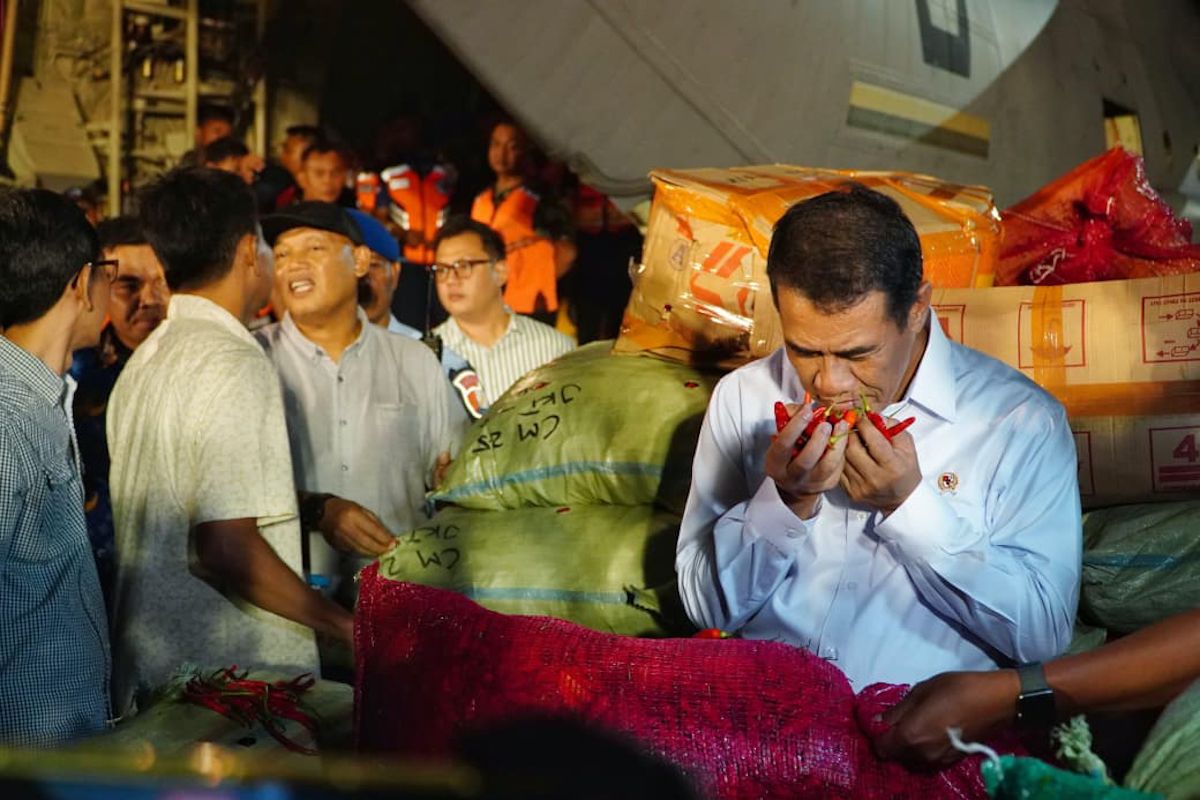
The National Food Agency (Bapanas) has assured that the government is continuously working to keep chilli prices profitable at the farm level whilst simultaneously stabilising consumer prices through strengthened distribution, supply management, and measured market intervention.
Head of Bapanas and Minister of Agriculture Andi Amran Sulaiman urged the public to understand the conditions faced by horticultural farmers, noting that chilli prices are volatile and can at times plummet sharply at the producer level.
“Take chillies, prices might be somewhat high due to distribution issues. But remember, chillies can sometimes cost Rp80,000 to Rp100,000, yet at other times the price crashes. So perhaps give chilli farmers a chance to recover and recoup their capital,” Amran stated in Jakarta on Thursday.
Amran made these remarks during a Coordination Meeting on Chilli Supply and Price Stabilisation (SPHP) held by Bapanas alongside the Ministry of Agriculture and various associations.
One of them, the Indonesian Chilli Champions Association (ACCI), reported that the price of Curly Red Chilli (CMK) in the Special Region of Yogyakarta (DIY) remains below the Purchase Reference Price (HAP) in some areas. Farmers in DIY are reportedly entering a peak harvest for CMK and are receiving prices around Rp20,000 to Rp25,000 per kilogramme (kg). Meanwhile, the HAP for CMK at the farm level has been set by the government within a range of Rp22,000 to Rp29,600 per kg.
Responding to the price dynamics of chillies and shallots, Bapanas Deputy for Food Availability and Stabilisation I Gusti Ketut Astawa stressed that the government is continuously striving to stabilise prices at both the producer and consumer levels.
According to Ketut, price stabilisation is not solely aimed at keeping costs affordable for the public, but also at ensuring farmers earn a decent level of profit from their efforts. He explained that the current supply conditions for chillies and shallots are relatively stable, providing an important foundation for the government to maintain price balance in the market without harming farming enterprises.
Therefore, the government is working to encourage horticultural commodity prices to remain at a reasonable level and not fall too low, especially when production increases in agricultural centres. Ketut added that if farm-gate prices fall below the Purchase Reference Price (HAP), the government will undertake various handling measures so that prices return to near or above the reference level, preventing farmers from incurring losses and keeping them motivated to boost production.
“We are striving for price stabilisation. This means don’t let prices be too cheap; we agree on moving towards a reasonable level, so prices are comfortable for farmers,” said Ketut. “For those below the HAP, we must help. Certainly, we must push to get close to the HAP or at least slightly above it, so farmers are not disadvantaged. So, let’s not ask for prices to keep falling only to find productivity is low. We pity our farmers. So we must make things fair,” added Ketut.
One stabilisation measure involves mobilising chilli stocks from surplus regions experiencing a harvest and directing them to areas where chilli prices are fluctuating. The government continues to build such demand connectivity in an integrated manner.
Ketut noted that in Papua, South Papua, North Maluku, North Kalimantan, Central Papua, West Kalimantan and Central Kalimantan, including Maluku, then the Riau Islands, Gorontalo, West Papua, and Southeast Sulawesi, farm-gate chilli prices are still above the HAP. “These are certainly potential destinations where we can channel curly red chilli harvests,” Ketut revealed.
Meanwhile, for Red Bird’s Eye Chilli (CRM), there has indeed been a drop in productivity due to weather anomalies and pest or disease attacks. However, there is potential for prices to decrease owing to a gradual increase in production. “With current conditions, and hopefully with information from fellow champion farmers who continue producing, hopefully going forward, prices will start to decline relatively slightly,” Ketut remarked.
He also confirmed the condition of horticultural supplies at the Keramat Jati Wholesale Market (PIKJ). He is optimistic that price decreases can begin to occur this month of June. “Supplies at PIKJ, both shallots and all types of chillies, are relatively still good. Admittedly, prices are still somewhat above the HAP, but hopefully during June they can start to drop,” Ketut added.
In the National Food Balance Projections, national CRM production for June is estimated to reach 113,800 tonnes. It is then expected to increase in July, with estimates reaching up to 144,700 tonnes.