
Government Assurances on Fuel Stock Must Be Accompanied by Data Transparency
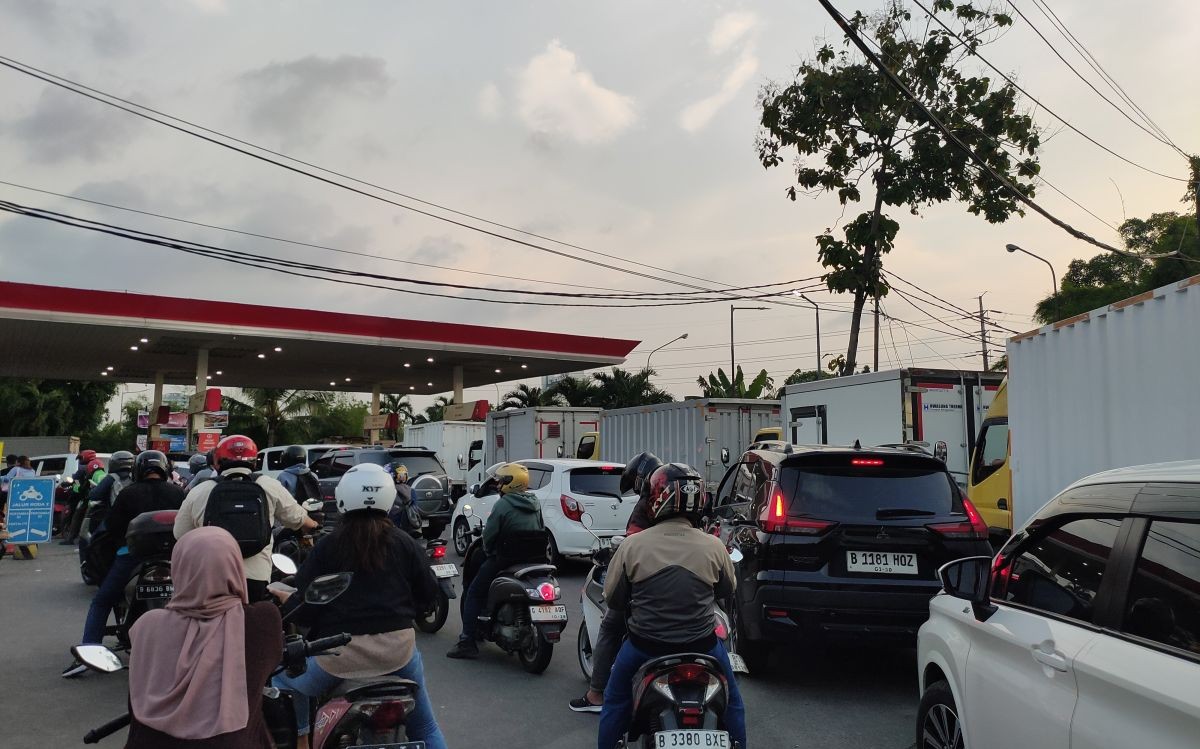
The Institute for Essential Services Reform (IESR) views the government’s assurance of fuel availability as appropriate to dampen panic buying. This was conveyed by the Minister of Energy and Mineral Resources (ESDM), Bahlil Lahadalia, during a press conference on Tuesday (31/3). On that occasion, Bahlil stated that Indonesia has identified sources of fossil energy supply from other countries to secure supplies. He also mentioned that Indonesia’s current energy reserves (BBM and gas) are above the national minimum standard.
However, IESR Chief Executive Officer Fabby Tumiwa stated that public trust can only be maintained if the government regularly and honestly opens up data on energy supplies and regarding anticipatory steps against crises.
“The public is currently very sensitive to the gap between official claims and the reality on the ground. Therefore, open communication regarding the real stock conditions of LPG and BBM is key to preventing harmful speculation and increasing public trust,” said Fabby in a statement received on Wednesday (1/4).
In addition, he continued, amid the surge in Brent oil prices reaching US$115/barrel, the Indonesian government must be very careful in promising to maintain subsidies without clear limits. This is considering that every US$1 increase per barrel causes a state budget deficit of up to Rp6.7 trillion.
“IESR simulations show the risk of subsidy budget swelling to Rp460 trillion this year if the average price is held at US$94/barrel, a figure that could cripple the health of the state budget,” explained Fabby.
According to him, the policy narrative must start managing public expectations that fiscal space has limits, especially since the ICP assumption of US$70/barrel in the state budget is no longer relevant to the current global market turmoil.
Fabby also stated that energy subsidies must immediately be shifted from commodity-based subsidies to targeted direct subsidies for poor households. The aim is to stop inefficient budget leakages.
“IESR suggests that the roadmap for this reform begins gradually in 2027, prioritising the electricity sector first to minimise direct shocks to inflation and people’s purchasing power. This step is not just about budget efficiency, but a structural transformation so that national energy resilience is not continuously held hostage by world commodity price volatility,” he explained.
In addition to the oil price increase, there is a rise in BBM procurement costs originating from increases in insurance premiums and transportation costs due to procurement of oil from the United States (US), Brazil, and Russia as alternatives to the Middle East.
“The public needs to know the consequences of the oil price increase and the rise in BBM procurement costs due to the ongoing supply disruptions because they too will bear those costs indirectly,” he concluded.
Business circles are asking the government to ensure clarity in the implementation of subsidised BBM purchase restriction policies so as not to disrupt distribution activities and business operations.
Restrictions on subsidised BBM are seen not merely as a technical step to control consumption, but as an early signal from the government in facing potential global energy supply pressures.
Pertamina, through Pertamina Patra Niaga, emphasised that in accordance with government directives, there will be no adjustments to fuel oil (BBM) prices, either non-subsidised or subsidised BBM.
Baron conveyed that Pertamina’s top priority at this time is to provide energy and optimise the supply chain to distribute energy to every corner of the country.
PT Pertamina Patra Niaga, the Downstream Subholding, ensures the reliability of national energy distribution by paying attention to community needs dynamics as well as geopolitical developments.
Pertamina, through Pertamina Patra Niaga, reaffirmed that in line with government instructions, there will be no price adjustments for fuel oil (BBM), either non-subsidised or subsidised BBM.
The Chairman of Hiswanamigas Priangan Timur emphasised that the issue of BBM price increases starting 1 April 2026 circulating on WhatsApp has not yet been officially announced.