
Godzilla El Niño Phenomenon Threatens Food Production, Farmers at Risk of Crop Failure
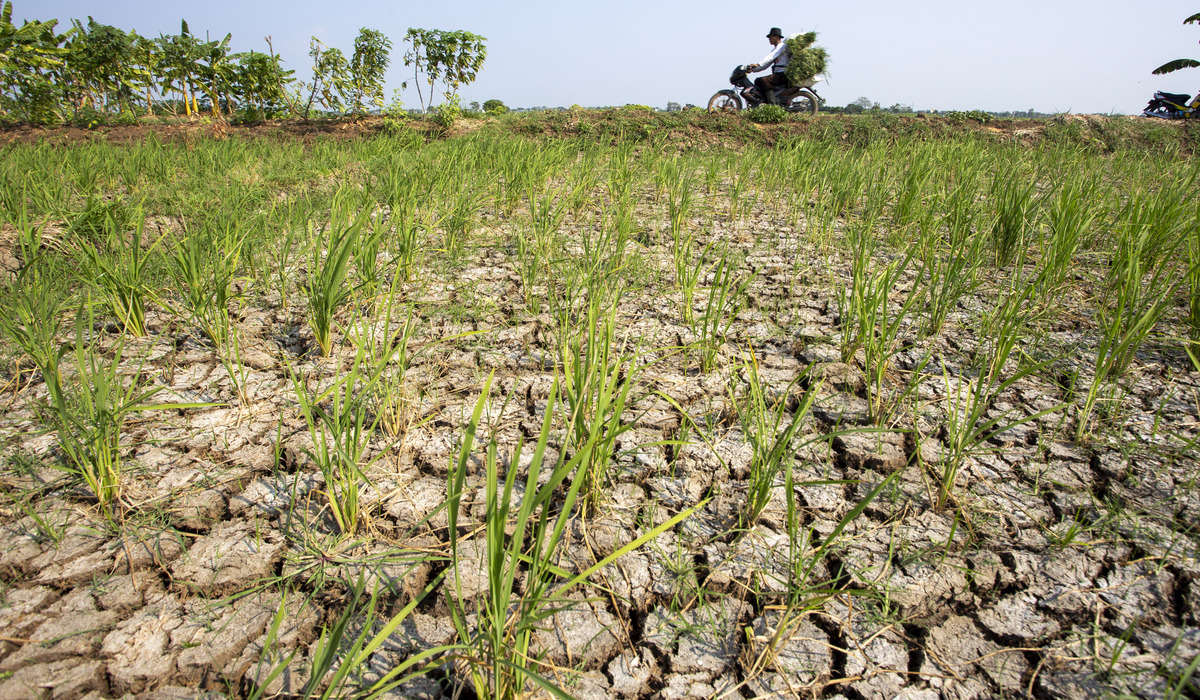
The Godzilla El Niño phenomenon has the potential to suppress national agricultural production due to prolonged droughts. Experts from Gadjah Mada University (UGM) warn that this condition could increase the risk of crop failure and disrupt Indonesia’s food security.
Professor of Agrometeorology at UGM, Bayu Dwi Apri Nugroho, explained that El Niño is a natural cycle that is now increasingly difficult to predict due to global climate change. He noted that the term Godzilla El Niño is used to describe the phenomenon’s intensity, which is far stronger than usual.
“El Niño is actually a natural cycle that has occurred for a long time. But now its pattern feels faster due to global warming. If the intensity is very strong, the impact will certainly be felt in agriculture, especially in terms of production,” he said on Thursday (3/4).
According to Bayu, the most significant impact of Godzilla El Niño is felt on major food commodities like rice and maize, which heavily depend on water availability. A reduction in water supply will hinder plant growth and could even cause permanent damage.
“Rice and maize are the most affected because they require a lot of water. If water is insufficient, growth is disrupted, and it can lead to crop failure,” he stated.
This situation directly impacts farmers. Drought occurring after planting risks causing major losses because production costs are not recouped.
“If drought happens after planting, farmers could face crop failure. That means the costs already incurred are not recovered and become losses,” he continued.
To reduce risks, Bayu emphasised the importance of mitigation measures at the farmer level, particularly through strengthened communication with agricultural extension officers. Access to weather information and selection of crop varieties are key to decision-making in the field.
“The key lies in communication between farmers and extension officers. If the information is clear, farmers can make more accurate decisions in the field,” he explained.
He added that Indonesia has experience dealing with El Niño, including through pump irrigation programmes, water-saving irrigation, and the development of drought-resistant varieties. However, their effectiveness depends on farmers’ ability to adapt.
In terms of policy, Bayu urged strengthening early warning systems by the Meteorology, Climatology, and Geophysics Agency down to the village level. Additionally, agricultural technology innovations need to be continuously developed by universities.
“The government through BMKG needs to provide accurate early warnings down to the village level, while universities must be encouraged to produce innovations in drought-resistant varieties so that the impact of El Niño can be minimised,” he concluded.
The government is strengthening the Government Food Reserves (CPP) as a pre-emptive measure against the potential El Niño phenomenon expected to begin in May 2026.
Minister of Agriculture Andi Amran Sulaiman is accelerating mitigation efforts against the potential El Niño through the implementation of five main strategies in the field.
As many as 815 villages in 26 sub-districts in East Java are at risk of drought due to this year’s prolonged dry season, predicted to experience Godzilla El Niño.
Regents have also requested that damaged irrigation be repaired immediately and existing weirs be optimally functioned to ensure water supply continues to flow to agricultural lands.
PTPN IV PalmCo has declared a state of alert in facing the potential dry season this year, in line with predictions of the possible emergence of the El Niño phenomenon.
Floods in Grobogan have inundated 1,842 hectares of rice fields and affected 9,736 families. The Central Java Provincial Government is facilitating crop insurance claims (AUTP) for farmers facing crop failure.
Most residents who cultivate agricultural land around the landslide area have experienced crop failure due to access roads to gardens being blocked by landslide material.
Recent extreme weather has triggered high rainfall, increasing the potential for crop failure. Local governments are beginning to prepare to anticipate this potential.
Minister of Agriculture Andi Amran Sulaiman revealed that 4,000 hectares of rice fields have been affected by crop failure due to disasters on Sumatra Island.
Hundreds of hectares of rice fields in Fajar Indah Village, Pulau Besar Sub-district, South Bangka Regency, Bangka Belitung Province, have again been flooded.