
Godzilla El Niño Emerges, But These Indonesian Regions Will Be Lashed by Heavy Rain
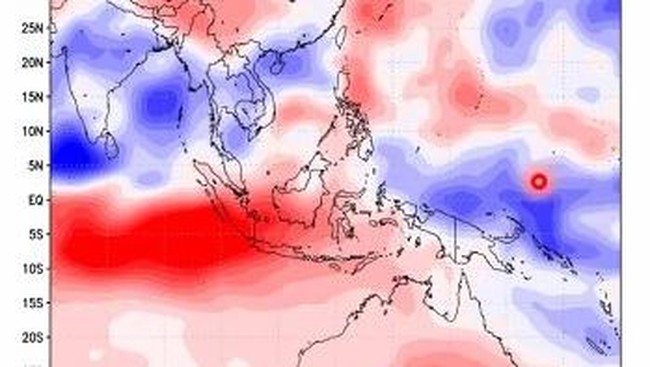
Jakarta, CNBC Indonesia - The National Research and Innovation Agency (BRIN) predicts the arrival of ‘Godzilla’ El Niño in April 2026. This phenomenon will be strengthened by a positive Indian Ocean Dipole (IOD).
The effects could cause a longer and drier dry season in Indonesia, with rainfall becoming increasingly scarce. However, some regions of Indonesia will also be hit by heavy rain.
Quoting BRIN’s statement on Sunday (22/3/2026), El Niño will occur from April 2026 to October 2026. Cloud and rain formation will be concentrated over the Pacific Ocean. In contrast, Indonesia will experience minimal clouds and rain.
Meanwhile, the positive IOD phenomenon in the Indian Ocean is indicated by cooling sea surface temperatures near Sumatra and Java. This will cause a significant reduction in rainfall in Indonesia.
For the impacts of El Niño-positive IOD from April to July 2026, data from BRIN’s seasonal prediction model shows dry conditions in most of Java to East Nusa Tenggara. Conversely, regions in Sulawesi and Maluku, including Halmahera and most of Maluku, will still experience high rainfall.
BRIN also states that government mitigation is needed for:
Drought impacts in southern Indonesia that could threaten the national rice granary, especially in northern Java (Pantura Jawa)
Flood impacts in eastern Indonesia due to high rainfall during the dry season (Sulawesi, Halmahera, Maluku)
Forest and land fire (Karhutla) impacts in parts of Sumatra and Kalimantan, although the northern parts of both islands will still experience high rain
Optimising salt production to achieve salt self-sufficiency in 2026-2027, especially in southern Indonesia
“Therefore, the government needs to be wary of drought impacts that could threaten the national food granary in the northern Java region, in addition to mitigating Karhutla impacts in Kalimantan and Sumatra. However, at the same time, the government should also prepare strategies to handle excess rainfall in Sulawesi, Halmahera, Maluku or its impacts on floods and landslides,” said Erma Yulihastin, Researcher at the Centre for Climate and Atmospheric Research, BRIN.