
GMNI Central Board Holds Public Discussion on Ministry Function Disorientation
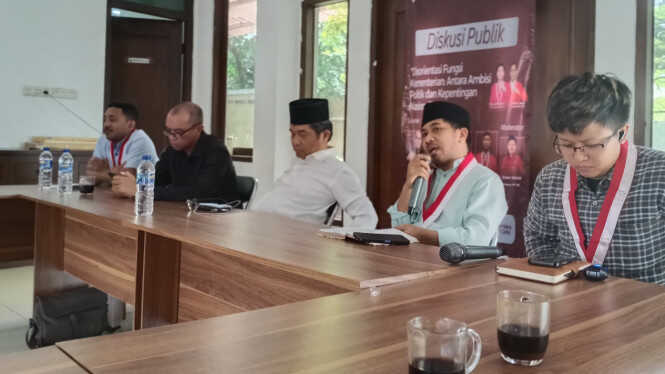
Jakarta — The Central Board of the Indonesian National Student Movement (DPP GMNI) held a public discussion entitled “Ministry Function Disorientation: Between Political Ambition and National Interest” in Jakarta on Wednesday, 18 February 2026.
The discussion aimed to ensure that ministries remain focused on implementing their planned work programmes, rather than serving merely as stepping stones for political power ambitions.
The discussion, moderated by Ainun Samidah, Head of the Sarinah Movement Division at DPP GMNI, featured speakers including political analyst Ray Rangkuti, social analyst Hizkia Darmayana, Head of the Agriculture and Fisheries Division at DPP GMNI Ferdinando Saferi, and Head of Inter-Institutional Relations at DPP GMNI Adi Suherman Tebwaiyanan.
Ray Rangkuti stated that the relationship between ministers of the Merah Putih Cabinet and the people is governed by the constitution (the 1945 Constitution).
In the Islamic context, there is Fiqh Siyasah, which regulates the intricacies of state governance based on Islamic sharia principles to achieve public welfare. Among the matters governed by fiqh siyasah is the relationship between leaders and the people.
“In this regard, the relationship that should be built is one of total service from the government to the people as its master, because in a democracy the people hold the highest sovereignty,” said Ray in a statement quoted on Saturday, 21 February 2026.
Social analyst Hizkia Darmayana stated that ministry disorientation is caused by a clash between ethical-ideological perspectives and practical-realist perspectives among ministers.
This clash occurs because ministers’ political interests sometimes conflict with the ethical values contained in Pancasila and the 1945 Constitution.
“This clash becomes apparent when there are policies or statements by ministers that are not aligned with the ethical values in Pancasila and the 1945 Constitution, as the foundation and constitution of our nation,” said Hizkia.
On the same occasion, Head of the Agriculture and Fisheries Division at DPP GMNI Ferdinando Saferi noted that ministerial problems have existed for a long time.
These problems typically emerge when ministers’ policies fail to deliver welfare for the people.
“The issue is when these problems arise repeatedly from one era to the next, such as when there are unproductive ministers, causing ministries to experience functional disorientation. This is what we need to examine in this discussion,” he said.