
GlobalData Releases Official Report on Voice Service Evolution in the Age of AI
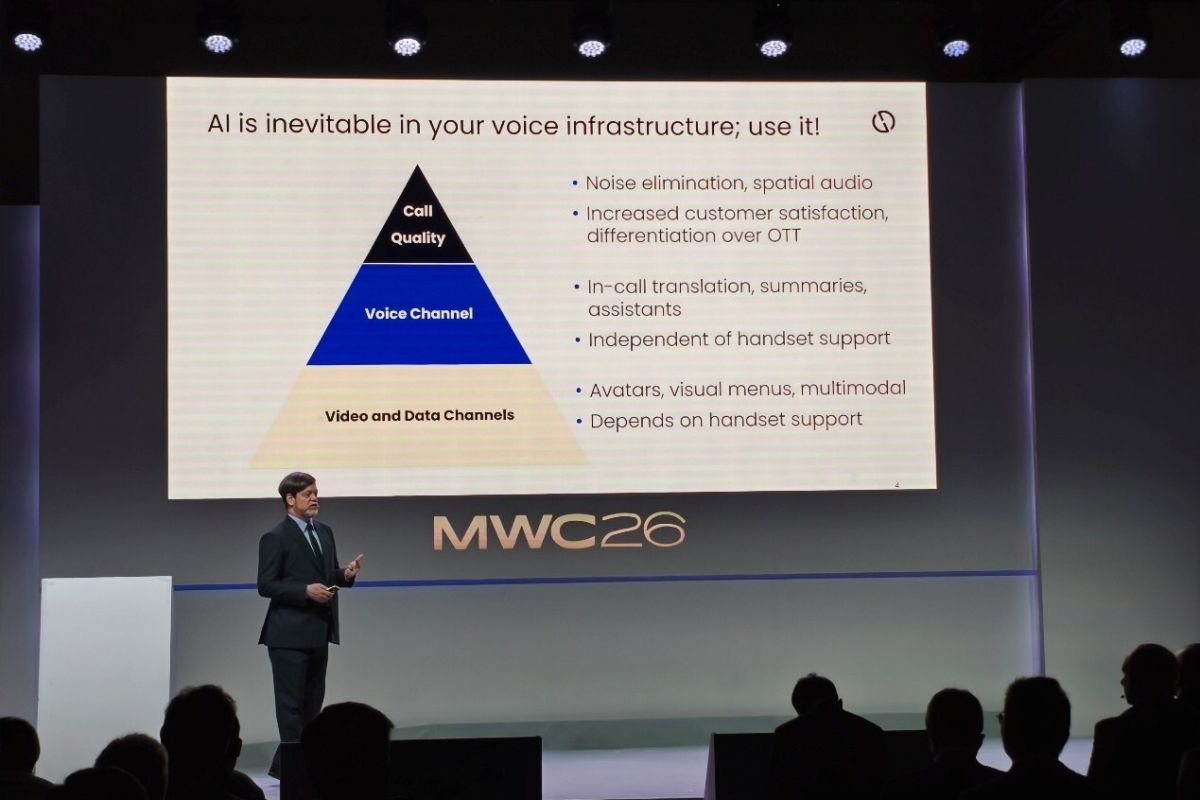
Barcelona, Spain — At MWC 2026, Andy Hicks, Senior Principal Analyst at GlobalData, launched an official white paper titled “Reinventing Voice: A Converged, AI-Enabled, and Multimodal Voice Core for the Next Generation of Telecommunications”. The white paper highlights that in the era of artificial intelligence, telecommunications operators can leverage fully integrated voice service networks to develop AI services and transform voice service value creation.
Integrated Voice Service Networks: An Ideal Solution for Multi-Generation Network Operators
With the rapid development of 5G-Advanced (5G-A), the evolution of global network standards remains uneven. While 2G and 3G networks are entering the end of their service life, some operators must still maintain both networks to support critical services such as M2M communication and international roaming. In such circumstances, fully integrated voice service networks capable of handling 2G, 3G, 4G, and 5G services become increasingly vital for operators. These networks address various operational challenges arising from network technology lifecycles whilst preparing the foundation for future network evolution.
Additionally, amid the global trend towards containerisation technology, integrated network architecture facilitates the transition from virtual machines (VMs) to containers. This approach helps operators reduce total cost of ownership (TCO) whilst maintaining continuous innovation and faster voice service updates.
AI Plus Voice Services: Transforming Voice Service Value Through Three Stages
The rapid advancement of AI opens new opportunities for voice service innovation. According to Andy Hicks, the deep integration between AI and voice services can be achieved through three main stages.
In the first stage, AI is used to enhance basic voice call experience and create advantages over OTT applications. Examples include intelligent noise suppression and more immersive spatial audio experience, making voice call communication higher quality.
In the second stage, AI is integrated into the audio channel to introduce innovative features such as real-time translation and automatic call summaries. These services do not require additional changes to user devices. Operators can therefore quickly implement this integration and gain an early advantage in AI-based voice service innovation.
In the third stage, AI is expanded to video and data channels, allowing voice service innovation to evolve from a single media type into multimodal services. This supports the emergence of new services such as interactive customer support and healthcare assistant services, and realises the Call-as-a-Service concept.
Andy Hicks emphasises that operators must capitalise on the opportunities presented by AI. By using integrated voice networks as a foundation, operators can drive service innovation whilst revitalising the core value of voice services through advances in 5G-A and AI technology.