
Global Military Spending Hits Record High, US Leads
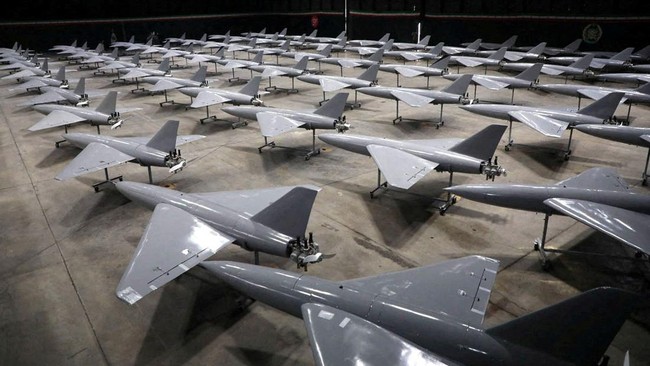
Global military spending has once again recorded a peak escalation, reaching $2.88 trillion in 2025. Data from the Stockholm International Peace Research Institute (SIPRI) report represents an annual increase of 2.9% (all in US dollars). If distributed evenly, this spending burden equates to $350 for every individual worldwide. This massive surge in defence budgets raises crucial macroeconomic challenges regarding a country’s fiscal space, particularly the government’s capacity to balance strategic funding for fundamental public sectors such as health and education. Global Defence Budget Dominance The world’s defence spending posture in 2025 appears highly concentrated, with the five major countries collectively contributing 58% of the total global expenditure. The United States leads absolutely with an allocation of $954 billion, followed by China at $336 billion, Russia at $190 billion, Germany at $114 billion, and India at $92 billion. The United States’ position represents a clear dominance that has persisted since the post-World War II era. The US’s $954 billion budget even exceeds the combined spending of the six countries immediately below it. Since 1949, the United States has spent at least $53.5 trillion, accounting for 51.5% of the total historical global military expenditure, currently estimated at over $100 trillion. Historical Trends in Military Spending The global defence budget cycle has a direct correlation with geopolitical volatility. After World War II, world military spending surged dramatically from $284 billion in 1950 to $788 billion in 1953 as a direct impact of the Korean War. Entering the 1960s, spending broke through $1 trillion, driven by the Vietnam War and the arms race of the Cold War era, reaching a peak of $1.7 trillion in 1988. The collapse of the Soviet Union temporarily eased the figure to $1.4 trillion in 1991. However, interventions in Afghanistan and Iraq propelled global spending past $2 trillion in 2009. In the last decade, tensions in Crimea in 2014 prompted NATO member countries to set a minimum spending target of 2% of GDP, driving a 173% increase in budgets in Eastern Europe. Cumulatively, spending in 2025 has risen 41% from $1.69 trillion in 2016. Surge in Per Capita Spending Defence budget escalation rates between countries show high disparities. A small group of countries spends between $2,000 and $5,000 per capita, while the majority of the world’s population is below $100 to $500 per capita. Qatar recorded the highest nominal per capita spending, surging 340% from $1,231 in 2006 to $5,428 in 2022. Israel ranks next with a 276% increase to $5,108 per capita, followed by Norway, which rose 181% to $3,040 per capita. Measured by percentage growth, Ukraine experienced the most extreme surge of 3,387%, moving dramatically from just $63 per capita in 2006 to $2,197 per capita in 2025 in response to the escalating military conflicts it faces. Major Global Arms Suppliers The global arms supply chain is tightly controlled by countries with integrated defence industrial complexes. The total value of arms exports worldwide reached $295 billion from 2016 to 2025. The United States secured 39% of the market share, valued at $115 billion. This dominance is strongly supported by internal government budget absorption, where private contractors secured $2.4 trillion from Pentagon contracts between 2020 and 2024. One-third of that funding, or about $771 billion, is concentrated in five major corporations: Lockheed Martin, RTX, Boeing, General Dynamics, and Northrop Grumman. Russia follows as the second exporter with a 13% market share worth $40 billion, followed by France at 9.3% worth $28 billion, and China and Germany each holding 5.5% worth $16 billion. Budget Priorities: Military, Health, and Education Unless governments are willing to expand budget deficits or find new revenue sources, high defence funding risks distorting other public funding allocations. Analysis of GDP structure in 137 countries proves polarisation in fiscal policy decisions. Data shows that 114 countries still allocate the highest spending portion to the health sector, 14 countries focus fully on education, while 9 countries channel their largest spending within GDP purely for military expansion.