
Glamping Project Near Goa Lawah Temple Confirmed to Lack Permits
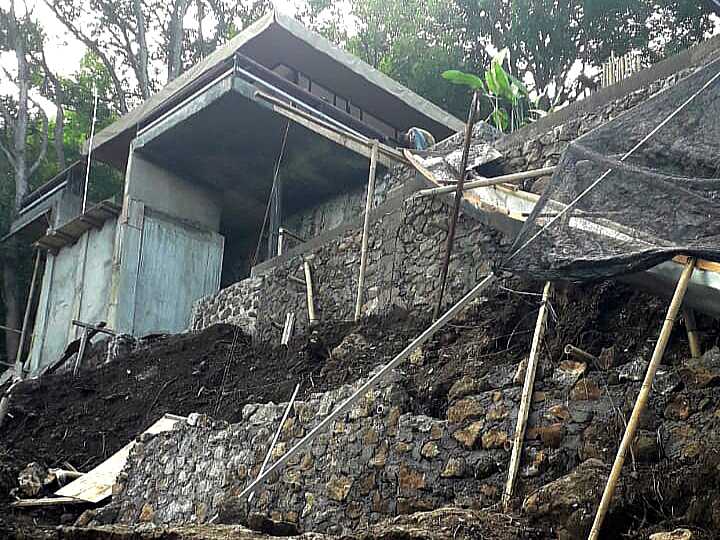
SEMARAPURA — Construction activity on a camping or glamping project at Bukit Tengah in Pesinggahan Village, located near Pura Goa Lawah in Klungkung, Bali, has been confirmed to be operating without the required permits.
After checking the Online Single Submission (OSS) system, the Klungkung Investment and One-Stop Integrated Services Agency found that the business operator identified as N. Fian Varian Jaya S has no registered business field in Klungkung Regency.
The Head of the Klungkung Investment and One-Stop Integrated Services Agency (PMPTSP), I Gede Sudiarkajaya, said on Wednesday (11 June) that his office had checked the permits for the Bumi Perkemahan project after it drew widespread public attention online. The project has come under scrutiny as it is considered to have been built close to or on top of Pura Goa Lawah temple.
Upon verifying the business operator’s identity on the OSS integrated electronic business licensing system, it was found that the operator, under Business Identification Number (NIB) 2602220006669, had no business field registered in Klungkung Regency. The registered business address was listed only at Jalan Raya Canggu 303, Tibubeneng Village, North Kuta District, Badung.
“They should not have started building there. If the construction does not match the spatial planning designation, it will only create greater difficulties for the business operator going forward. If the NIB is valid but the location does not match, the business must relocate to comply with the Indonesian Standard Industrial Classification (KBLI) under the NIB,” Sudiarkajaya explained.
He added that any investor wishing to operate a business must first register on the OSS system to match their business type with the appropriate KBLI code. Once this is confirmed, the NIB is issued. The operator must then submit an application through the Spatial Utilisation Activity Conformity Approval (PKKPR) to verify spatial planning compliance, allowing the construction site coordinates to be locked.
These coordinates are then entered into the Building Management Information System (SIMBG), which reveals the designated land use for that location. “If it does not match, the system will show that the spatial planning is incompatible. For example, if someone wants to build a hotel in Nusa Penida, they must lock the coordinates. If the coordinates show the area is designated as a tourism zone for hotels, then it is safe because it complies with the Regional Spatial Plan (RTRW),” he said.
Regarding the Bumi Perkemahan project, Sudiarkajaya reiterated that all licensing processes are conducted through the system. He stressed that coordinate reporting must be done honestly, warning against falsifying location data. While manipulated coordinates might pass the PKKPR stage, they would fail at the Building Permit (PBG) stage, as the actual construction location must match the registered coordinates.