
Glaciers on Puncak Jaya Predicted to Disappear by 2030 Due to Global Warming
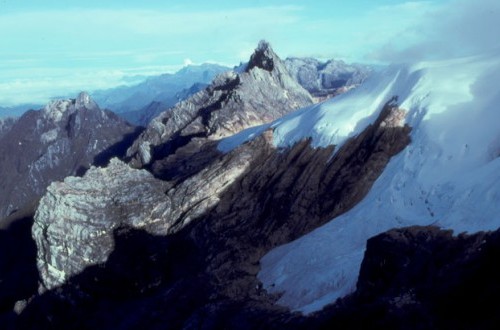
Scientists predict that the ice on Puncak Jaya in the Sudirman Range, Papua, will melt by 2030. With the disappearance of the last two glaciers—Carstensz and East Northwall Firn—Indonesia will join Venezuela and Slovakia as one of three countries to lose all its glaciers due to global warming.
Over the past 44 years, Puncak Jaya has lost 97% of its ice and four glaciers. Scientists state that global warming directly contributes to glacial melting worldwide.
In Indonesia, this process is exacerbated by the El Niño phenomenon. The El Niño Southern Oscillation (ENSO) is a global climate pattern alternating between La Niña and El Niño conditions, with varying impacts across regions. In Indonesia, El Niño triggers a significant increase in glacial melting.
“In Papua, conditions become drier and warmer during El Niño, meaning less snowfall at high altitudes and increased melting. Both factors could be a death knell, especially for smaller glaciers,” said Mike Kaplan, a geologist from the Lamont-Doherty Earth Observatory, cited from the Columbia Climate School’s official website on Wednesday, 27 May 2026.
Kaplan studies glacial, climatic, and historical landscape records. He said the 2015-2016 El Niño event had a significant impact on Indonesia’s glaciers.
Donaldi Permana, a climate researcher leading glacier monitoring at the Meteorology, Climatology, and Geophysical Agency (BMKG), said global warming has raised the freezing level, causing more rainfall than snowfall.
“This condition accelerates melting rather than adding to glacier mass,” Permana told GlacierHub.
Permana explained that the vertical thinning rate of glaciers increased from about one metre per year to 5.3 metres during the 2015-2016 El Niño—nearly five times faster. Permana and his team used a 32-metre ice core extracted in 2010 to trace regional climate variability over the past half-century. Ice core analysis revealed ENSO’s influence on Papua’s glacial changes.
The research team concluded that significant ice decline continues and worsens during El Niño periods. Based on this trend, they modelled future ice loss.
“Recent modelling and observations indicate terminal decline. Glacial area has shrunk from approximately 19.3 square kilometres in 1850 to just 0.16 to 0.23 square kilometres in 2022-2024,” Permana said.
This means glacial area has reduced from the equivalent of around 3,500 football pitches to just 40. He warned that some models suggest Indonesia’s glaciers could vanish within a year.
“With the increased likelihood of a strong El Niño in the second half of 2026, the disappearance of Indonesia’s glaciers may occur in 2026-2027,” he said.
Kaplan believes the fate of Papua’s glaciers is likely irreversible. He said that even if greenhouse gas emissions were miraculously stopped today, the climate system would still have a response lag.
“Temperatures will continue to rise for several years even if greenhouse gas levels stabilise, as the planet takes time to reach equilibrium,” Kaplan said.
He said in this hypothetical scenario, warming could persist until 2030. Even if carbon dioxide emissions were stabilised now, conditions would be too warm and dry for Papua’s glaciers to survive, particularly if a strong El Niño reoccurs.
The loss of Papua’s glaciers is not just an environmental issue but also a significant cultural loss. For many indigenous communities in Papua, glaciers hold sacred value.