
Ginandjar Kartasasmita: If Not Exercised with Integrity, Power Can Backfire on Oneself
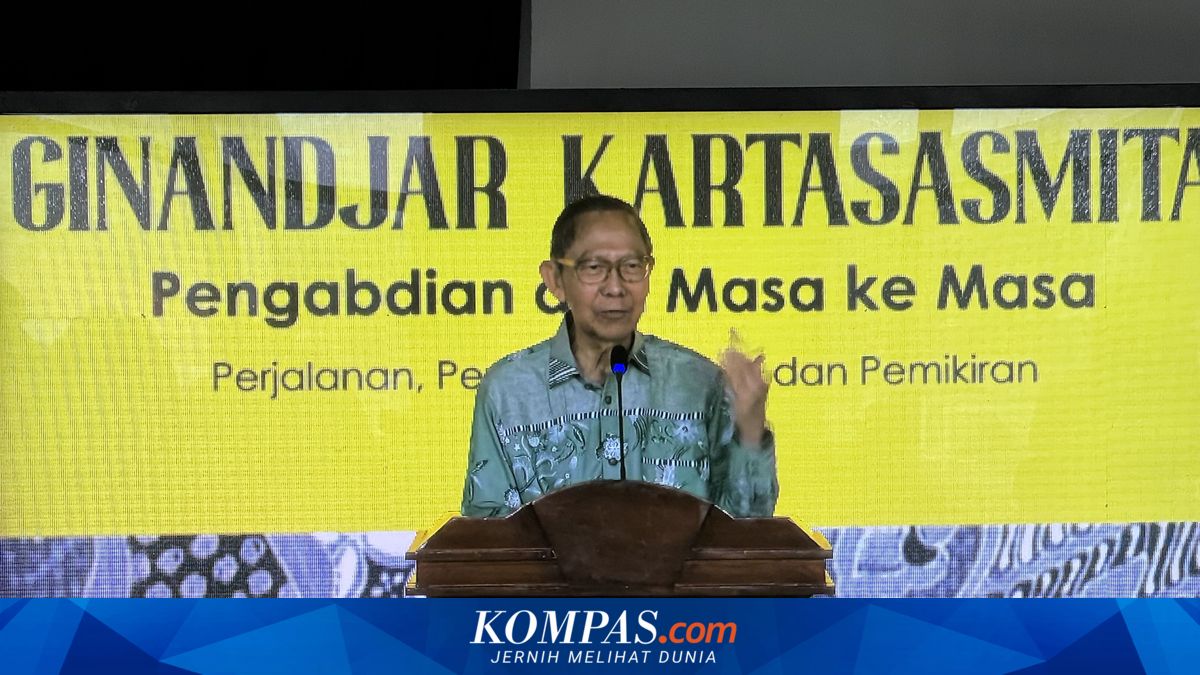
JAKARTA, KOMPAS.com – Ginandjar Kartasasmita is not only a witness but also a participant in Indonesia’s development history. He has a message about power.
Ginandjar’s journey spans the military, bureaucracy, and politics, making him one of the figures representing the continuity between experience, thought, and dedication to the state.
Ginandjar stressed that power must be used with integrity to avoid negative impacts, both on oneself and on society at large.
Ginandjar spoke during his address at the book discussion “Ginandjar Kartasasmita: Service Across Eras, Journey, Struggles, and Thoughts” held at the Kompas Tower building, Palmerah, Central Jakarta, on Thursday (9/4/2026).
“Power must be used to the best of one’s ability with integrity. Because if it is not used with integrity, power can run wild, backfire on oneself, and harm many people,” said Ginandjar.
According to him, the book is more intended as a record of experiences, both joys and sorrows, that can serve as a reference for future generations in understanding the nation’s journey.
“This book is not to glorify myself. That’s in the past. Perhaps my experiences can be beneficial for the young generation,” he said.
Interestingly, Ginandjar openly stated that the book was not written directly by him, but by a Kompas team led by Suhartono. He only provided the stories, while the writing, verification, and compilation process was handled by the journalistic team.
“The journalists did the writing. I just spoke and it was noted down, that’s it. So, the Kompas journalists, Mr Suhartono’s team, were assigned by Kompas to write the book,” he said.
He also expressed appreciation to Kompas for not only compiling the book but also facilitating a public discussion on the work.
In his presentation, Ginandjar touched on his long career journey that began as an officer in the Indonesian National Army Air Force (TNI AU).
Since holding the rank of captain, he had been assigned to various strategic institutions such as the Supreme Operations Command (KOTI) and the State Secretariat, which then opened the way to important roles in government.
His career encompassed various strategic positions, from Minister, Head of Bappenas, Head of BKPM, Deputy Chairman of the MPR, to Chairman of the DPD RI.
Ginandjar also expressed gratitude to Soeharto, whom he considered to have given him great trust from the beginning of his government career.
“It was he who appointed me from being an Air Force captain,” he said.
In the discussion, former Minister of National Development Planning/Head of Bappenas Sofyan Djalil assessed Ginandjar’s figure as a representation of the success of the meritocracy system, especially during Soeharto’s leadership era.
Although he had no personal closeness, Sofyan admitted to reading the book thoroughly and gaining a complete picture of Ginandjar’s career journey.
“I am very impressed with what you have done, and I understand how Mr Harto and the New Order prioritised meritocracy. It is meritocracy that allowed Mr Ginandjar to receive extraordinary mandates,” said Sofyan.