
Get Ready for Thinner Tempeh and Tofu: The New Victim of the Iran War?
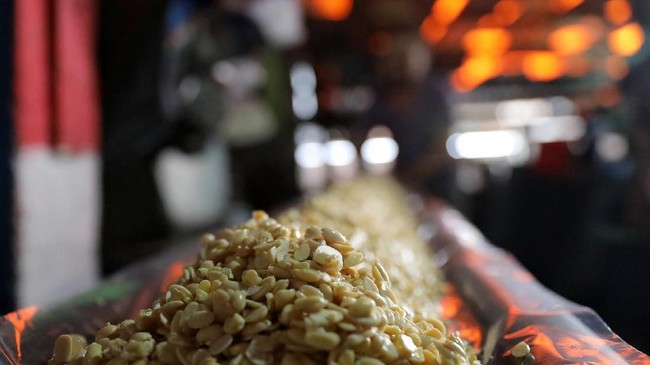
Jakarta, CNBC Indonesia - Soybean prices in Indonesia have risen at the tempeh and tofu artisan level. As of 18 March 2026, based on data managed by the Indonesian Tempeh and Tofu Producers Cooperative Union (Gakoptindo), soybean prices at the artisan cooperative level are recorded in the range of Rp9,700 to Rp12,000 per kg, with the majority in the Rp10,000–Rp10,800 per kg range.
For context, in West Java, soybean prices range from Rp10,100–Rp10,400 per kg, while in Jakarta they reach Rp10,400–Rp10,700 per kg. In some regions like West Sumatra, they even hit Rp12,000 per kg.
Gakoptindo’s General Secretary, Wibowo Nur Cahyo, acknowledged that this price increase trend has indeed occurred and could continue.
“Well, of course, in terms of the imported soybean price increase, that has indeed happened. The possibility of further price increases could happen. It could happen,” Wibowo told CNBC Indonesia on Wednesday (25/3/2026).
However, he emphasised that the current soybean price rise is not caused by the projected surge in China’s imports, estimated to rise by around 2 million tonnes in 2026–2027.
“In my estimation, (China’s soybean import surge) doesn’t disrupt it. It doesn’t disrupt if you ask me,” he said.
According to him, China’s additional imports are relatively small and will not disrupt global supply, especially since the US stock, as the source of soybean imports, is currently in surplus.
“Actually, right now, they (the US) are overstocked (with excess supply). America is overstocked at the moment,” he stated.
Citing World Grain, the US Department of Agriculture’s Foreign Agricultural Service (FAS) projects China’s soybean imports for 2026–2027 to reach 108 million tonnes, up by about 2 million tonnes from the previous period. This increase is driven by rising demand for soybean meal for animal feed, particularly from the poultry and aquaculture sectors.
FAS also noted that China has resumed active purchases of US soybeans following the trade agreement between US President Donald Trump and Chinese President Xi Jinping in October 2025. As of 26 February 2026, realisations have reached 10.8 million tonnes out of a total commitment of 12 million tonnes.
Nevertheless, Wibowo stressed that the main factor behind the domestic soybean price increase stems from a combination of other global factors.
“Because the soybean price increase is influenced by several factors. There’s the CBOT (Chicago Board of Trade) factor in America with its rise, then the rising dollar price, domestic political economy factors, foreign political economy factors, and finally the supply and demand,” he explained.
He highlighted the escalation of geopolitical conflicts as the primary trigger at present, particularly in the Middle East region.
“The most burdensome factor right now is this Israel, America, and Iran war. That’s the main factor,” Wibowo said.
According to him, this conflict directly impacts the rise in energy costs, which in turn drives up the distribution costs of soybeans to Indonesia.
“If it affects the oil price rise, yes. Whereas shipping from America to Indonesia naturally uses ships and requires quite high fuel oil. Of course, that’s it. The impact is there,” he clarified.
Although price pressures are starting to be felt, tempeh and tofu artisans assure that they will not yet raise selling prices to consumers. The strategy adopted is to reduce product size.
“So the tactic is just to adjust the thickness,” Wibowo said.
He explained that size adjustments are done gradually following the rise in raw material costs.
“Which might normally be 3 cm thick for tofu, maybe it becomes 2.8 cm, or 2.5 cm, or tempeh that was previously 2 cm thick could become 1.8 cm, that will definitely happen,” he detailed.
In terms of margins, artisans still have some room, though profits are starting to thin.
“If the soybean price rises, the profit that was Rp1,000 might become Rp800,” he said.
However, he warned that there is a tolerance limit for artisans. If soybean prices surge high, the option to request subsidies from the government will be reopened.
“But it’s different if soybeans reach prices above Rp12,000 per kg, then we will voice it, ask for subsidies and so on,” he asserted.
For now, he assessed that the situation is still far off.
“Still far, very far. The situation is still very far,” Wibowo concluded.