
Gaza's Alarming Conditions as Israel Moves to Seize Entire Territory
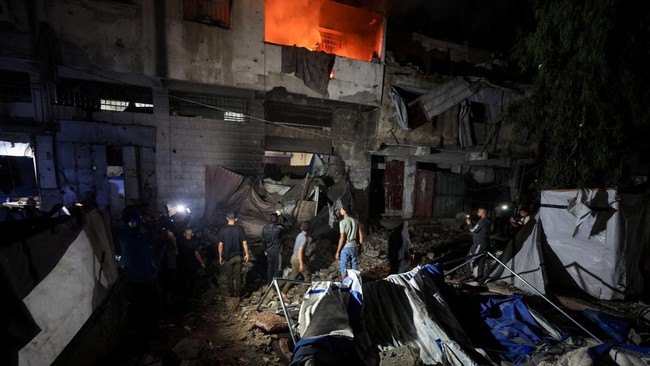
Jakarta, CNBC Indonesia - Israeli Prime Minister Benjamin Netanyahu has struck again, announcing Israel’s intention to expand its control in Gaza. This represents a dangerous escalation, with European nations and Palestinian residents voicing concerns over the plan.
According to the October 2025 ceasefire agreement, the Israeli military would maintain control of 53% of Gaza. However, Netanyahu stated on Friday (29 May) local time that they intend to initially expand this to 70%, without providing details or a timeline.
Palestinian militant group Hamas, which triggered a two-year war in Gaza with its 7 October 2023 attack on Israel, has described Netanyahu’s comments as an ethnic cleansing plan and forced displacement of Palestinians.
“Any attempt to impose a new occupation reality in Gaza is illegitimate,” said Ismail al-Thawabta, head of Hamas-run Gaza government media office, according to Reuters on Saturday (30 May 2026).
More than eight months after the ceasefire, with global attention focused on the Iran conflict, the core Gaza dispute remains unresolved, with ongoing Israeli strikes, minimal humanitarian aid reaching civilians, and a high risk of renewed violence.
Israel has already expanded its control in Gaza from the 53% behind the “yellow line” mapped in the ceasefire agreement to around 64%, with areas designated as prohibited zones in maps shared with aid groups.
Further reduction of space for Gaza’s over two million residents, mostly crowded into tents in the tiny Palestinian territory, risks worsening the already dire conditions there.
“Where can we go? To the sea? There’s no space,” said 72-year-old Mohammed al-Shagra in Khan Younis.
Last year’s agreement, brokered by US President Donald Trump, established a Peace Council to oversee phased ceasefire implementation, ratified by the UN Security Council.
However, most contentious issues—including Hamas disarmament, full Israeli withdrawal, and Gaza governance—have been deferred to later stages. Peace Council negotiators have been discussing disarmament with both sides.
Israel and Hamas have repeatedly accused each other of ceasefire violations. Israeli strikes in Gaza have killed over 900 Palestinians since the ceasefire began, while Palestinian militant attacks have killed four Israeli soldiers.
The Israeli military and prime minister’s office did not immediately respond to Reuters’ requests for additional information and comments on Netanyahu’s statements.
A Peace Council spokesperson said they would not comment on Netanyahu’s remarks.
A UK Foreign Office spokesperson stated that further Israeli control expansion in Gaza is unacceptable and risks worsening the dire humanitarian situation.
Other UN Security Council permanent members, France, did not immediately respond to comment requests.
A German Foreign Office spokesperson said Germany is concerned about Israel’s plan to take more Gaza territory and opposes any permanent division of Palestinian land.
Netanyahu’s Political Maneuvering
Facing this year’s general election and pressure over Israel’s failure to secure strategic objectives in the Iran and Lebanon conflicts, Netanyahu may be attempting to bolster his standing with voters.
“He is determined to appear tough before voters and is blamed by opponents for fighting on seven fronts but winning none,” said Max Rodenbeck, Director of the Israel-Palestine Project at the International Crisis Group.
“Unless there is some resistance from the Trump administration, this is truly at risk of reverting to something very bloody,” he added.
Israel has intensified pressure on Hamas, including continued aid restrictions to Gaza and targeted strikes against Hamas figures.
For those inside Gaza, where nearly all residents have had to leave their homes during the war and most remain in tents or temporary shelters, the prospect of increased Israeli military pressure is deeply alarming.
“We see no ceasefire or anything; they keep advancing beyond the yellow line. How long will the world stay silent?” said Mohammed al-Jundi, a refugee in Gaza City.
In Israel, renewed harsh military pressure is seen by hardline security supporters as the only way to force Hamas to disarm and achieve a long-term agreement.
“It seems we’re taking steps toward another clash. But I believe this time it will be much shorter and might pave the way for a new future,” said Kobi Michael, a researcher at the Israel National Security Institute and former official in the country’s strategic affairs ministry.