
Gambir Station Porters Complain Some Passengers Still Pay Arbitrarily Despite E-Porter System
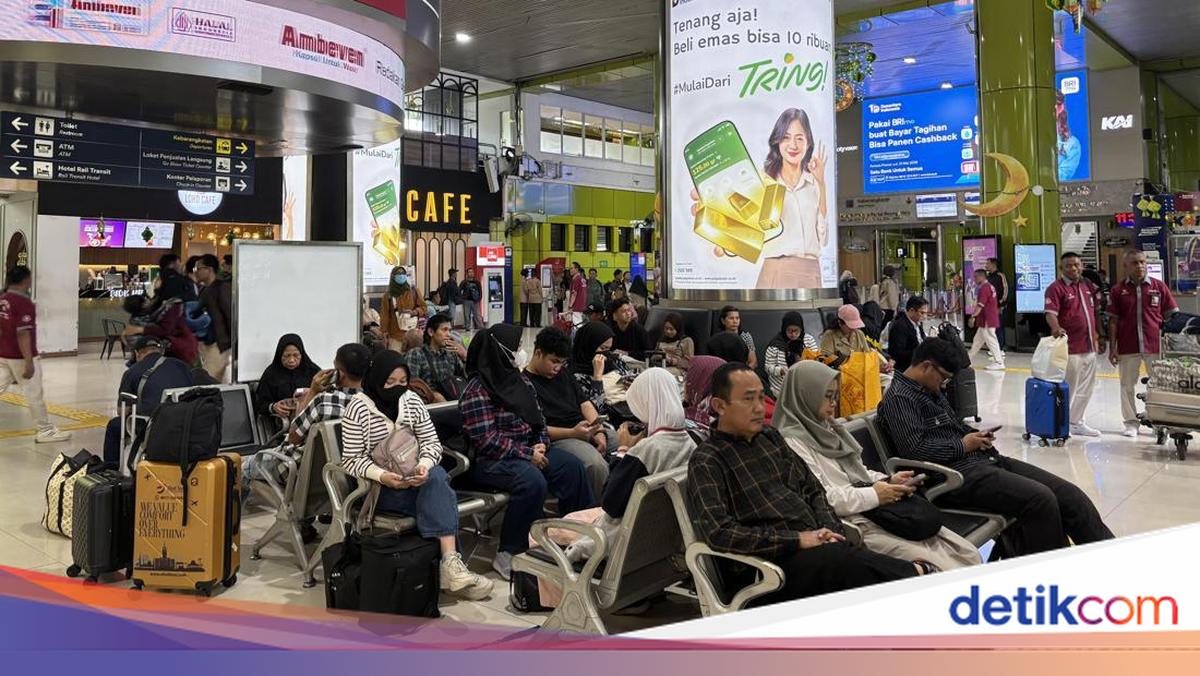
The Eid holiday exodus at Gambir Station has begun showing significant increases in passenger numbers. To anticipate the surge and facilitate smooth travel for holiday-goers, a total of 240 porters have been deployed around the clock.
“We have two shifts. Each shift has 120 porters, so a total of 240 porters divided between red and blue teams,” said Warsito (36), a porter at Gambir Station, to detikcom on Monday (16 March 2026).
Warsito explained that porter work shifts are organised on a 12-hour system. The first shift runs from 08:00 to 20:00 WIB, followed by the next shift extending into the morning.
“We work in 12-hour shifts. But we don’t work continuously the entire time, because trains have intervals, so we can use that time to rest,” he added.
Warsito noted that passenger congestion for the homecoming journey at Gambir Station has already begun intensifying seven days before Eid. He described the Idul Fitri period as the busiest time for porter services compared to other major holidays.
“Usually there’s an increase starting a week before Eid. I’ve already carried luggage five times today. It’s likely to be even busier tomorrow since the work holiday period has started,” he said.
Regarding service charges, Warsito explained that porter management has become more modern with the introduction of the E-Porter application. The tariffs applied have a set minimum standard to make it easier for passengers.
“The minimum standard tariff is Rp38,000 for two large items. But if there’s more luggage, it’s typically charged double,” he explained.
Despite the existence of official tariffs, Warsito admitted he frequently encounters situations where passengers are unaware that porter services are chargeable. Some give whatever amount they feel like or pay voluntarily.
“Some give Rp20,000 or Rp25,000 because they don’t know there’s an app tariff, so we still accept it—we can’t force them. There are even those who just say thank you because they think we’re already getting a fixed salary from the station. In those cases, we explain politely so they won’t be surprised when they reach their destination,” he said.
Porter services at the station, according to Warsito, extend beyond simply carrying passengers’ luggage. He recounted how porters often act as guides for confused passengers and help special categories of travellers.
“(Porter duties are) varied—sometimes we escort small children to the train door, help elderly passengers travelling alone, assist friends with disabilities or the visually impaired and guide them along their route. Sometimes (they) don’t even carry luggage but we’re asked to help them to the right platform so they don’t go to the wrong one,” he explained.
As a service provider during the busy holiday period, Warsito said he had to set aside the desire to spend Eid with his family. He mentioned he would only visit his family in Blora, Central Java, after the peak exodus period concludes.
“My family is all in Blora. We go home in turns—usually we only go home after Eid. This is a job hazard, and the hope is that the earnings can increase to cover my child’s school fees and healthcare needs in my hometown,” he concluded.