
Fundamental Problem for SMEs is Not Financing, but Import Surge
The government continues to emphasise the People’s Business Loan (KUR) as the primary instrument for enhancing SME competitiveness. In 2026, the KUR disbursement target is set at Rp295 trillion with 1.37 million new borrowers, an increase from 2025’s realisation of Rp270 trillion, of which Rp163.9 trillion went to productive sectors.
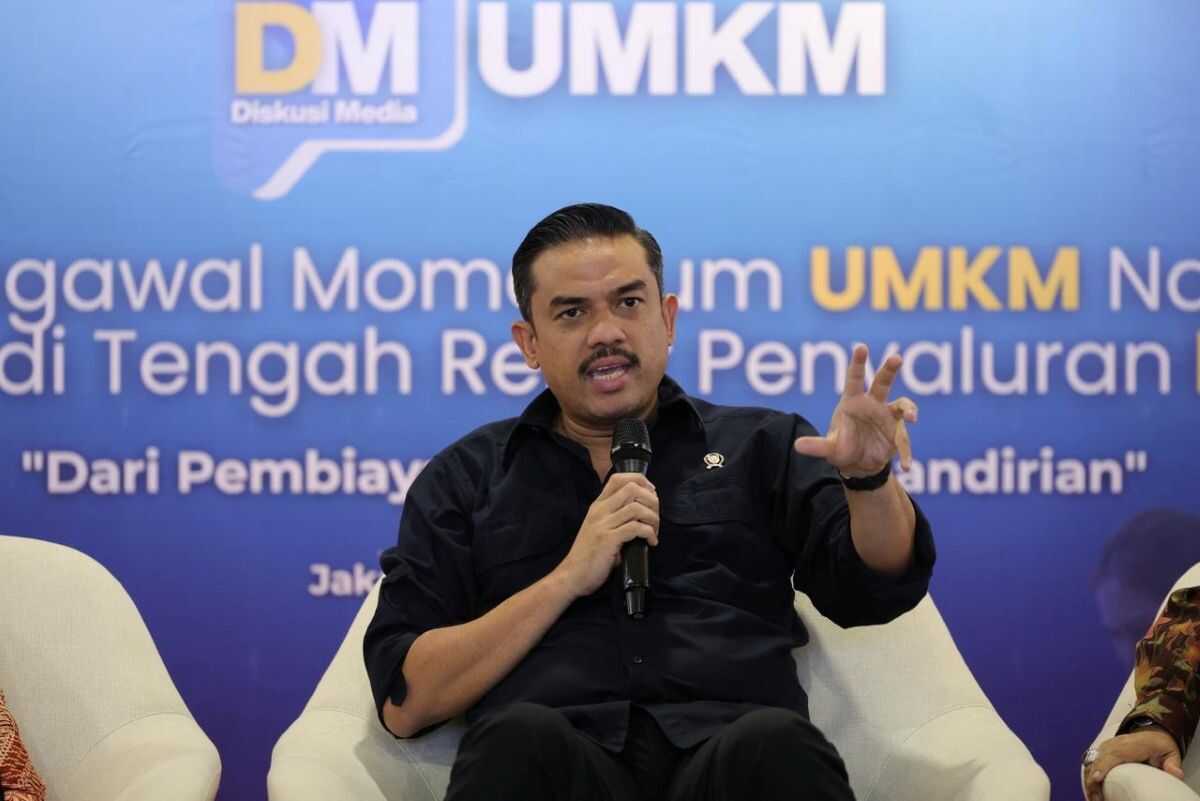
Although KUR disbursement levels have trended upward, SME Minister Maman Abdurrahman acknowledged that the quality of UMKM class upgrading remains suboptimal. He argued that the fundamental problem lies not with financing channels or mentorship access, but with market disruption caused by imported products. The proliferation of imports undermines all government efforts to enhance UMKM capacity.
“Indonesia’s market is muddy, dirty, and filthy. No matter how well we support them to produce, they cannot sell their goods. Our market is flooded with imported products,” Maman said at a media forum in Jakarta on 27 February.
The surge in imports represents the core problem preventing SMEs from advancing economically. Maman called for unified cross-ministry policies involving the Trade Ministry, the Coordinating Ministry for Economic Affairs, and other stakeholders to sterilise the domestic market and restore space for local products. He also raised concerns about high digital platform service fees, which reduce SME competitiveness in online sales.
Maman highlighted a significant imbalance in banking credit allocation: of the Rp8.149 trillion in total national banking credit, Rp6.569 trillion (80.6%) flows to approximately 50 large corporations, while UMKM credit contributes only 19.4% of total national banking credit, falling short of the 25% target.
Nailul Huda, Director of Digital Economy at the Center of Economic and Law Studies (Celios), asserted that SME challenges extend beyond imports to serious financing obstacles. High interest rates and stringent collateral requirements force many SME operators to rely on personal capital. KUR disbursement in 2025, whilst positive, was not a record high compared to 2022. However, KUR has positively impacted rural economic activity, with 72.3% of Indonesian villages now served by the programme. The distribution skew towards trade over industry reflects imbalance.
Edy Misero, Secretary General of the Indonesian UMKM Association (Akumindo), stated that KUR realisation falls short of expectations and creates problems for operators. One obstacle is strict administrative requirements, particularly regarding collateral, despite government regulations stating that credit below Rp100 million requires no guarantee. Banks in the State-Owned Banks Association (Himbara) have not fully implemented regulatory flexibility as required.
“The regulation says no guarantee for 100 million, but in practice they still demand collateral,” Misero said. He urged faster disbursement rather than merely low interest rates, and called on banks to be honest about their capacity constraints. He warned that KUR access difficulties push many SMEs towards fintech and online lending with much higher interest rates.