
Full Holiday Bonus Without Tax Deductions: Is It Possible?
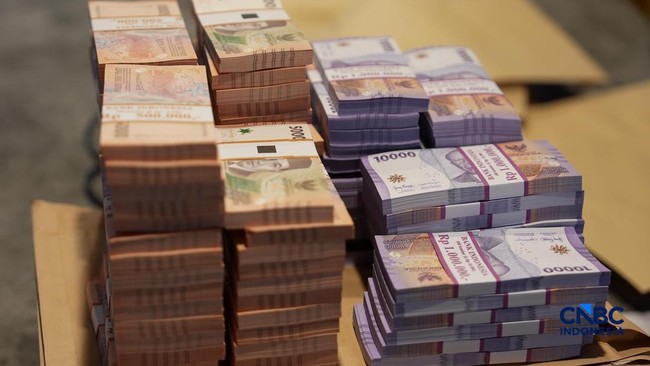
Jakarta, CNBC Indonesia — The payment of Holiday Bonuses (THR) during the Lebaran season is one of the most anticipated moments for Indonesian workers, both civil servants and private sector employees. However, specifically for civil servants, income tax (PPh) on THR is borne by the state. Meanwhile, for private sector employees, the tax can be borne either by the company or the individual.
As a result, private sector employees often find that their THR is not entirely equivalent to their regular salary due to income tax deductions. This is because THR is subject to income tax under Article 21 (PPh Pasal 21).
Nevertheless, there is a policy that companies can implement to allow employees to receive their full salary and THR without tax deductions: the gross up method for calculating PPh Article 21.
What is the gross up method?
According to Anda Puspitarini, an official at the Directorate General of Taxes, the gross up method is a tax calculation mechanism in which a company provides additional income in the form of a tax allowance to employees equal to the tax that should normally be deducted from their earnings.
“In other words, the company adds a new income component with a value equal to the amount of tax that must be paid,” explained Anda in an article titled ‘Full Holiday Bonus Without Tax Deductions? Possible with the Gross Up Scheme for PPh Article 21’ posted on the DJP website.
This additional income is then combined with the employee’s primary income to recalculate the PPh Article 21. As a result, the tax is still calculated and remitted according to tax regulations, but economically the tax burden is borne by the company.
“With this scheme, the amount of income that employees receive after tax deduction will equal the total salary and THR they should receive,” she stated.
For employees, this policy certainly provides significant benefits by allowing them to receive a larger take-home pay, especially in the month when THR is distributed. Thus, employees do not need to worry that their salary and THR will be reduced due to tax deductions. Additionally, this often serves as a form of company appreciation for employees, particularly before the holiday season, when household expenses typically increase—for example, for mudik (returning home), purchasing Lebaran necessities, or sharing with family.
However, Anda explained that the policy of bearing PPh Article 21 through the gross up method will increase company costs, as the company must provide additional expenses in the form of tax allowances to employees.
Nevertheless, this additional cost does not automatically become a fiscally harmful burden for the company. Under tax regulations, costs incurred by a company to pay tax allowances to employees using the gross up method can be charged as deductible expenses against gross income.
However, Anda clarified that such costs can be charged only insofar as they relate to the company’s activities in earning, collecting, and maintaining income.
“This means that the costs incurred by the company to bear employee taxes can be recorded as legitimate operational costs in the fiscal financial statements. This cost will ultimately reduce the company’s taxable profit when calculating corporate income tax,” she stated.
Thus, the application of the gross up method is often considered a win-win solution for both parties. On one hand, employees can receive their full income without worrying about tax deductions when receiving their salary and THR.
On the other hand, the company can still utilise these costs as a reduction against gross income, which affects the company’s tax calculations.
Below is an example calculation using the gross up method:
As an illustration, an employee named Pak Fajar works at PT Umay. Pak Fajar is a permanent employee who is single with no dependents. He receives a monthly salary of Rp7.5 million.
In March 2026, the company provides THR equivalent to one month’s salary, so the total income that Pak Fajar receives that month is Rp15 million, comprising his monthly salary and THR.
If the company does not bear Pak Fajar’s PPh Article 21, then his gross income that month is Rp15 million. Based on the calculation using the effective average tax rate (TER) applicable to this income, the PPh Article 21 that must be withheld is approximately Rp900,000. Thus, the income that Pak Fajar actually receives, or his take-home pay, is Rp14.1 million after tax deduction.
However, Anda noted that the situation would be different if the company applied the policy of bearing PPh Article 21 using the gross up method. Under this method, the company provides additional income in the form of a tax allowance of Rp1,129,032. This addition is included as part of Pak Fajar’s gross income. Therefore, Pak Fajar’s gross income becomes Rp16,129,032.
From this amount, PPh Article 21 is then calculated based on the TER table, so the tax liability is Rp1,129,032. As a result, after tax is deducted, the amount Pak Fajar receives remains Rp15 million because the tax comes from the tax allowance provided by the company.
“This means that Pak Fajar can take home his full salary and THR without any tax reduction,” she stated.
Meanwhile, from the company’s perspective—PT Umay—the tax allowance of Rp1,129,032 provided to Pak Fajar can be recorded as part of the company’s expenses.
This cost can become a reduction against gross income in corporate income tax calculations. In other words, she continued, even though the company incurs additional costs to bear employee taxes, this cost still provides fiscal benefits in the company’s tax calculations.
Through this mechanism, the policy of bearing PPh Article 21 using the gross up method demonstrates how companies can balance employee welfare with tax efficiency.