
Frustration of Business Owners: Illegal "Hotels" Proliferate - Lebaran Profits Unfelt
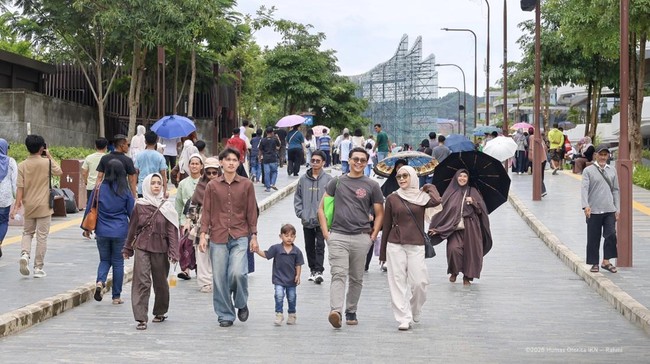
Business owners in the hotel sector have expressed frustration over the challenging conditions this year, despite the extended Eid al-Fitr 1447 H holiday in 2026.
General Secretary of the Indonesian Hotel and Restaurant Association (PHRI), Maulana Yusran, stated that average hotel occupancy on the second day of Eid (H+1), which is typically eagerly awaited due to a sharp rise, remains lower than last year.
“Hotel occupancy on the second day of Eid, especially in cities with popular tourist spots, based on reports from our members, shows no significant increase, with many not reaching maximum levels. Yet, if we look at it, the movement of holidaymakers in tourist areas is quite dense,” Maulana told CNBC Indonesia.
He cited examples from Bali and Yogyakarta, where domestic tourist density is high, but occupancy only reaches 60%-70%.
“From various regions, particularly in Yogyakarta, Bali, and Semarang, many are not achieving optimal results,” he continued.
Maulana added that only a few areas recorded occupancy above 80%, even reaching 100%. For instance, West Sumatra noted 80% occupancy, and Batu in East Java achieved 100%.
“Only a few have occupancy above 80%, such as in West Sumatra and Batu, Malang, East Java, where Batu reached 100%,” he explained.
The reason many hotels in tourist areas have occupancy below 80% is the abundance of unofficial accommodations that do not meet established standards.
“The problem is there are many accommodations not suited to their purpose. This must attract the attention of local governments, because these legal accommodations are not benefiting from the 2026 Eid holiday phenomenon,” he clarified.
Maulana exemplified in Yogyakarta, where many accommodations do not comply, such as homestays that should only have one building but actually have more than one.
“For example, in Yogyakarta, which we’ve observed. There are some, like homestays, but treated like hotels. Homestays are actually supposed to be shared rooms with the owner living in the house itself. But in fact, some are like hotels, even having two buildings, so they’re not homestays,” he said.
He also highlighted the many illegal business units in several tourist areas, including Bali and Yogyakarta, viewing their emergence as a reflection of weak government oversight as a regulator, despite clear licensing regulations.
“It’s like this: in establishing a business in Indonesia, everything has a legal foundation. It’s regulated by laws, government regulations, ministerial regulations. And many ministries/institutions are involved,” he stated.
He emphasised that the most basic aspect in building a business is ensuring business permits are obtained first.
“The context is that building a business requires business permits; that’s the most important thing first,” he said.
According to Maulana, the government has the authority to issue or revoke business permits, as well as responsibility for oversight.
“The government as a regulator holds control in granting or revoking business permits. Then, regarding oversight, it’s the same,” he said.
Therefore, his side requests the government to promptly address the issue so that business competition returns to being healthy.
“That’s why we always convey to the government: please sort this out, because we can never talk about quality tourism or quality destinations if the government is not committed to creating competitiveness in the business sector itself. Because law enforcement is not properly upheld,” he concluded.