
Frontier hospital becomes hope for Southeast Asian patients
Kunming — As morning mist shrouded the Nanxi River, pedestrians carrying bags hurried across the China-Vietnam Bridge spanning the waterway. A Vietnamese woman named Vo Thi Lan Phuong completed customs inspection procedures and headed directly to her destination: Hekou People’s Hospital of the Yao Ethnic Autonomous Prefecture in Honghe Hani and Yi Ethnic Autonomous Prefecture in Yunnan Province, southwestern China.
Located just a few blocks from Lao Cai Province in Vietnam, this “gateway hospital” not only protects the health of local residents but also increasingly benefits patients from Southeast Asia through diverse medical services. “This is my third visit here,” said Vo Thi Lan Phuong.
Despite facing language barriers, medical staff assisted her at every stage, from registration and examination to medication dispensing and consultation. “I feel safe here, like at home,” she remarked.
In the hospital lobby, directional signs in Mandarin, English and Vietnamese were prominently displayed. At consultation desks, staff patiently helped foreign patients navigate various procedures. To overcome language challenges, the hospital is equipped with intelligent medical consultation translation software, offers foreign-language medical guide services, and deploys multilingual doctors to ensure smooth treatment for international patients.
In the Neurology Department, a Vietnamese doctor named Tran Thi Oanh provided consultation to patients in her native language. Her gentle accent put foreign patients at ease. “Thank you to the Chinese doctors. Now I can walk on my own,” said Gao Haitao, director of the Traditional Chinese Medicine Rehabilitation Department, carefully opening a handwritten thank-you letter in Vietnamese from a patient from Lao Cai Province who had suffered cerebral infarction.
During treatment, the patient required a wheelchair and could not move the lower body. After one month of acupuncture and massage therapy, he was able to walk slowly with family assistance when leaving the hospital.
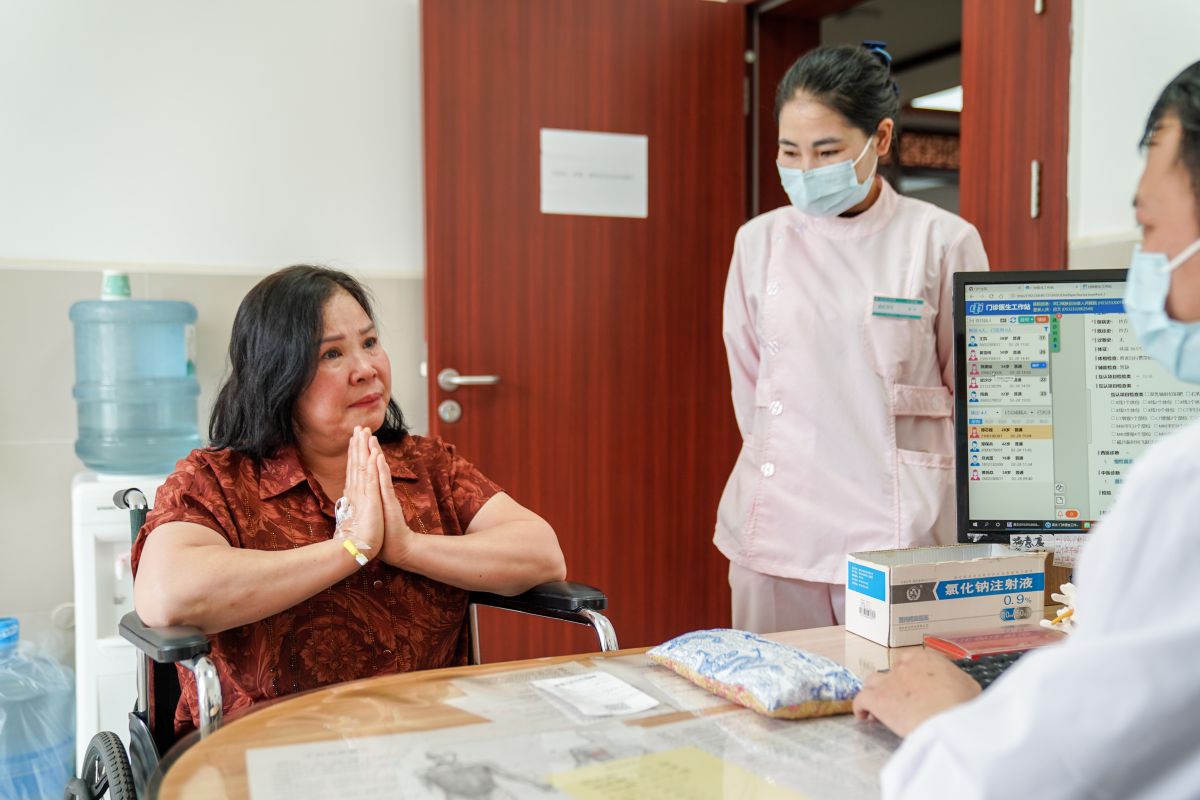
In another consultation room, Vo Thi Lan Phuong was receiving traditional Chinese medicine treatment. The TCM diagnostic method, refined over thousands of years and comprising observation, listening, questioning and pulse examination, combined with modern medical equipment, is a popular choice for many foreign patients.
In the doctors’ office, various certificates and thank-you letters in multiple languages demonstrate foreign patients’ appreciation for Chinese doctors and TCM therapy. In recent years, alongside the expansion of China’s visa-free policy coverage and implementation of facilitated customs inspection measures, Hekou Port has attracted many foreign tourists.
Data from China’s border inspection department show that in 2025, passenger flow (both inbound and outbound) at Hekou Port reached 6.42 million people, increasing 11.9 percent year-on-year, involving more than 90 countries and regions. “As the port becomes increasingly prosperous, demand for medical care among foreign patients has also grown stronger,” said Xu Ankou, president of Hekou People’s Hospital.
As the largest “gateway hospital” with the most comprehensive departments in the Yunnan sector of the China-Vietnam border area, the hospital served more than 10,000 foreign patients from Vietnam, Thailand, Laos and other countries in 2025. This cross-border cooperation has become increasingly valuable, particularly during critical situations.
To facilitate emergency medical treatment for foreign patients, the hospital has established coordination mechanisms with health, customs, border inspection and other relevant departments, and opened a “green channel” for cross-border emergency medical rescue to ensure timely intervention for critically ill patients. From patient consultation at the outpatient clinic, racing against time in emergency care, to warm support in patient wards, people of various languages and nationalities experience the same kindness at this frontier hospital.
Last April, Mr Lv, a Malaysian patient who suffered serious injuries from a car accident, entered China through this “green channel” and received effective treatment in the shortest possible time. Each time he recalls the incident, he feels deeply grateful. “Without this hospital and these Chinese doctors, I dare not imagine my current condition.”
As an important node on the “Southern Silk Road,” Hekou has been a vital exchange route between China and Southeast Asian countries since ancient times, preserving a long history of friendship. Today, this “gateway hospital” in the border city continues to write stories of cross-border friendship in a new era through medical dedication and expertise.