
From Tazakka, Goodness Flows, Strengthening Indonesia in Solidarity
The evening had not fully descended when thousands of people had crowded the courtyard of Pondok Modern Tazakka. The sky over Batang was golden, the wind carried the fragrance of earth and the sound of mutual greetings exchanged.
Among the footsteps of students and invited guests, one question hung quietly in the air: how could a pesantren in a corner of Central Java bring together such a sea of humanity, uniting state officials, religious scholars, and ordinary people on the same prayer mat?
The answer gradually unfolded on Saturday, 1 March. The Grand Gathering of Brotherhood, the breaking of fast during Ramadhan, and Tarawih prayers together with 5,000 Muslims was not merely a yearly agenda. It became an event of unity, a meeting space that erased distinctions of profession, position, and background.
From Islamic scholars, religious leaders, university rectors, heads of Islamic organisations, to madrasah teachers, religious teachers, students, guardians, and the general public, all sat side by side. Government attended, the military and police attended, the community attended. Like small rivers flowing into one ocean of brotherhood.
Among the guests were Zulkifli Hasan, Sudaryono, and Batang Regent Faiz Kurniawan. Also present were the Director of the Muslim World League, Sheikh Abdul Rahman Al-Khoyyat, local legislative leaders, and philanthropic networks such as ASFA Foundation. However, that evening, attention was not solely on prominent names. Rather, attention focused on the current of empathy flowing among them.
The leader of Tazakka, KH. Anang Rikza, stressed that this Ramadhan event was a moment of grand brotherhood amongst the Islamic community, a space to strengthen Islamic and Indonesian values simultaneously. “Across professions, across organisations, everyone is present. This shows Indonesia is in good condition and has strong unity,” he said. That statement was not lofty; it took root in the faces of people greeting one another sincerely.
In the warm atmosphere, state officials spoke about food self-sufficiency, about the direction of national policy, about their commitment to building Indonesia. Prabowo Subianto was mentioned as a leader with pro-people programmes and clear vision. Yet amid those speeches, the message that settled most deeply was simple: remain united, remain together, continue to take part in advancing the nation. That is where the deepest meaning of this event took shape.
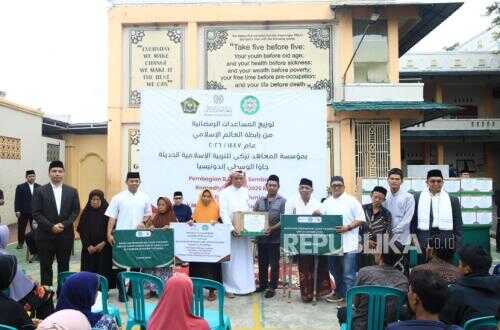
Tazakka not only spread prayer mats and a pulpit, but also extended a hand. As many as 1,750 packages of basic food aid were distributed to the poor, Quranic teachers, religious scholars, mosque leaders, and people with disabilities. That figure is not merely a statistic; it is the faces of those who returned home with a lighter smile, kitchens that began to smoke again, and prayers that rose amid takbir and Quranic recitation.
Islamic philanthropy here did not appear as mere rhetoric, but as concrete action. It strengthens empathy, because those who give learn to feel the pulse of need that those who receive experience. It reinforces brotherhood, because hands both high and low are equally bound in the intention of worship. And more than that, it solidifies unity, because assistance does not ask about one’s faction, but rather answers the call of humanity.
A programme of free health checks and blood donation supported by the Health Service, Indonesian Medical Association, Indonesian Red Cross, Indonesian Muslim Blood Bank, and various other parties further affirmed that Ramadhan is not only about abstaining from food and drink, but also about awakening social concern. The enthusiasm of the community queuing since afternoon serves as evidence that goodness, when facilitated, always finds its way.