
From "Noni Belanda" to National Scandal: The Glamour, Wealth, and Power of Sarifah Suraidah
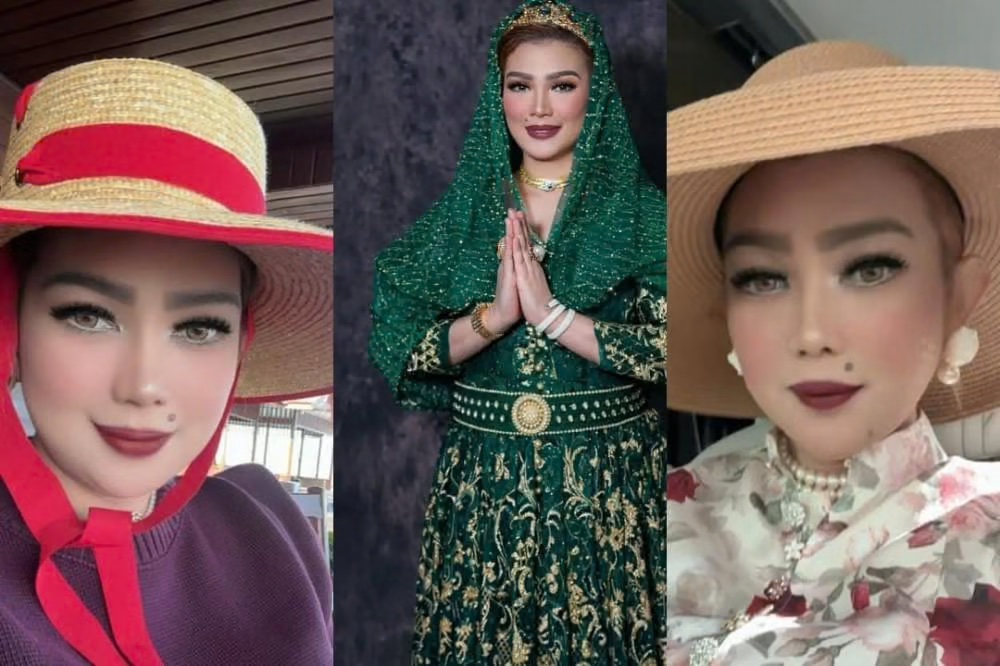
How one woman’s flamboyant colonial-style fashion ignited a firestorm over elite excess and public accountability in Indonesia
In late February 2026, a short video of a woman walking through a PKK community bazaar in East Kalimantan stopped Indonesian social media in its tracks. She wore a wide-brimmed hat, a blue floral dress, pearl earrings, and a statement necklace — unmistakably out of place for a routine government field visit. That woman was Sarifah Suraidah Abidien Harum, a member of Indonesia’s national legislature, and more prominently, the wife of East Kalimantan Governor Rudy Mas’ud. Within hours, millions of Indonesians were talking. Not just about her clothes, but about everything her clothes represented: wealth, power, and a political elite that seems worlds apart from the people it governs.
Indonesia’s political class has long grappled with questions of accountability and lifestyle optics. The Laporan Harta Kekayaan Penyelenggara Negara (LHKPN), or State Officials’ Wealth Disclosure Report, is a key transparency mechanism that requires all public officials to declare their assets. But the existence of a disclosure system does not automatically translate into public trust — especially when the numbers raise more questions than they answer. East Kalimantan, a resource-rich province home to one of Indonesia’s largest coal and palm oil industries, is also the site of the nation’s new capital project, Nusantara. The province is no stranger to big money and big politics. Against this backdrop, the story of Sarifah Suraidah is not merely gossip — it is a mirror reflecting a structural tension at the heart of Indonesian democracy.
The Outfit That Launched a Thousand Threads
It began not with a speech or a policy — but with a hat. When Sarifah Suraidah appeared at a local PKK community bazaar wearing a wide-brimmed vintage hat, a floral blue dress, and conspicuous pearl accessories, Indonesians online took notice immediately. Netizens quickly coined the term “Noni Belanda” — a reference to the Dutch colonial-era European ladies who were once seen strolling through the Indies in exactly such attire — and the label stuck fast. The comparison was loaded with irony: Indonesia fought and bled for independence from Dutch colonial rule, and the image of a sitting legislator’s wife channelling that aesthetic while meeting ordinary constituents did not sit well with many.
By March 1, 2026, the video had gone viral across Instagram, TikTok, and X (formerly Twitter), with hundreds of thousands of users reacting and sharing. Sarifah, via her Instagram account @syarifahsuraidah, addressed the storm head-on that same day, writing: “Hidup cuma sekali, hidup gak bisa diputar lagi. Lakukan apa yang mau dilakukan” — or in English, “Life is only once, it can’t be rewound. Do what you want to do.” She added, “We don’t live just to please others — be yourself.” The response was both defiant and personal, and it only fanned the flames further.
Behind the Style: Who Exactly Is Sarifah Suraidah?
To understand why this story resonated so deeply, it helps to understand who Sarifah really is — not just as the governor’s wife, but as an independent political figure in her own right. Born on January 1, 1981 in Balikpapan, East Kalimantan, Sarifah Suraidah Abidien Harum — affectionately known as “Bunda Harum” — is a product of vocational education, having graduated from Sekolah Perawat Kesehatan Departemen Kesehatan Balikpapan (a Health Department nursing vocational school) in 2000.
Despite her modest educational background, she rose through the political ranks of Golkar, one of Indonesia’s most powerful parties. She became a member of the House of Representatives (DPR RI) for the 2024–2029 term, representing East Kalimantan, effectively replacing her husband Rudy Mas’ud’s parliamentary seat after he successfully ran for governor. In the DPR, she sits on Commission VI, which oversees trade, business competition, and state-owned enterprises. Beyond politics, she previously served as a director at PT Barokah Agro Perkasa in 2014, a palm oil plantation company, and has since been elected chairman of KORMI (Komite Olahraga Masyarakat Indonesia) for East Kalimantan for the 2025–2029 period. She also commands a wide social network known as Bestie Syarifah Suraidah (BSS) across the region — a personal brand that speaks to the scale of her political influence.
The Numbers That Shocked the Nation
What truly supercharged the controversy was not the fashion — it was the money. According to Sarifah’s LHKPN filing submitted on March 22, 2025 for the 2024 reporting period, her declared total net wealth stands at Rp 166,519,280,429 — equivalent to approximately SGD 12.82 million. That figure alone was enough to make headlines. But her declared debts of Rp 112,694,480,000 — roughly SGD 8.68 million — drew just as much attention, raising immediate questions about how and why a legislator carries such an enormous liability load.
Breaking down her reported assets: she holds land and buildings across five properties in South Jakarta, Samarinda, and Penajam Paser Utara valued at Rp 26.5 billion (approximately SGD 2.04 million), with the largest single asset being a property in South Jakarta worth Rp 15 billion (around SGD 1.15 million). Her vehicle assets, by contrast, are modest on paper: a Suzuki X-Over (2007), a Honda Freed (2008), and a Honda CR-V (2010), totalling Rp 250 million or roughly SGD 19,250. Her cash and liquid assets stand at Rp 28 billion (approximately SGD 2.16 million). The sheer ratio of gross wealth to declared debt sparked fierce debate among the Indonesian public and legal observers alike. Indonesia’s Corruption Eradication Commission (KPK), which administers the LHKPN system, has long called for stricter scrutiny of officials whose declared debts approach the scale of their assets — a pattern that can obscure true financial standing and potential conflicts of interest.
The Governor’s Scandal and the Family P