
From Jatiwangi, Those Roof Tiles Still Endure
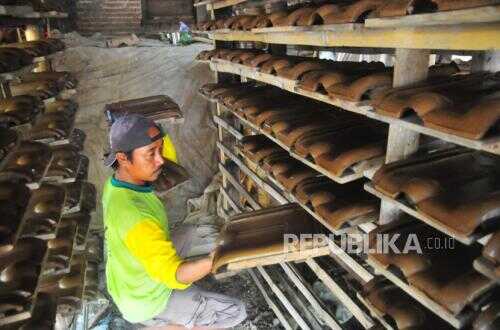
The fingers move with confidence. Three women sit close together at a table, surrounded by bamboo racks filled with raw tiles. With movements trained over years, they smooth the edges of the wet clay, scrape off excess mould, and polish the surface so it is smooth and even. One by one, the newly formed roof tiles are moved to a drying rack at the back of the room, waiting for their turn to be sun-dried, then fired, then become part of someone’s roof somewhere far away. In the production room, the workers’ brief conversations are occasionally heard between the clatter of routine. Someone passes by carrying wet tiles. Others prepare the next mould. The rhythm is not merely a work schedule; it is the heartbeat of a heritage that predates this generation. This is the Jatiwangi roof-tile centre, Majalengka Regency, West Java. Syamsul Maarif stands among the bustle with a calm gaze, the gaze of a factory owner who knows every detail of the process in front of him. In his place, roof tiles are produced almost every day, from Monday to Saturday. Their natural red colour, sturdy shape, a type familiar on Javanese rooftops for decades. “Currently the roof-tile factory in Jatiwangi is still quite busy. There’’s still a lot being made,” he said at the end of February 2026. In one day, his factory can produce around 1,800 to 2,000 matured tiles, counted from those that have passed all stages, from moulding to ready-for-sale. The journey of a tile, it turns out, is not short. The process starts with clay taken from the surrounding area of Jatiwangi. The clay is mixed with additives, ground into a paste, then formed using a moulding machine. The tiles that come out are still wet and soft; this is where the skilled hands of the workers step in, shaping every edge to be precise and neat. After shaping, the tiles are laid on bamboo racks for initial drying for two to three days. If the weather cooperates, sun-drying lasts five to six hours. But if it rains, production schedules are disrupted—nature still has the final say. The tiles that are dried then go into the firing kiln that locals call the hawu. There, the firewood flames bake the clay for eight to twelve hours, until the tiles are completely mature and hard. After cooling and sorting, the tiles are ready to travel; most go to building-material shops in West Java and Central Java, while others are picked up directly by buyers who come with specific needs: to build a house.