
From Clay to Hope: The Story of Hena Gian Hermana's Tile Manufacturing Business Supported by BRI
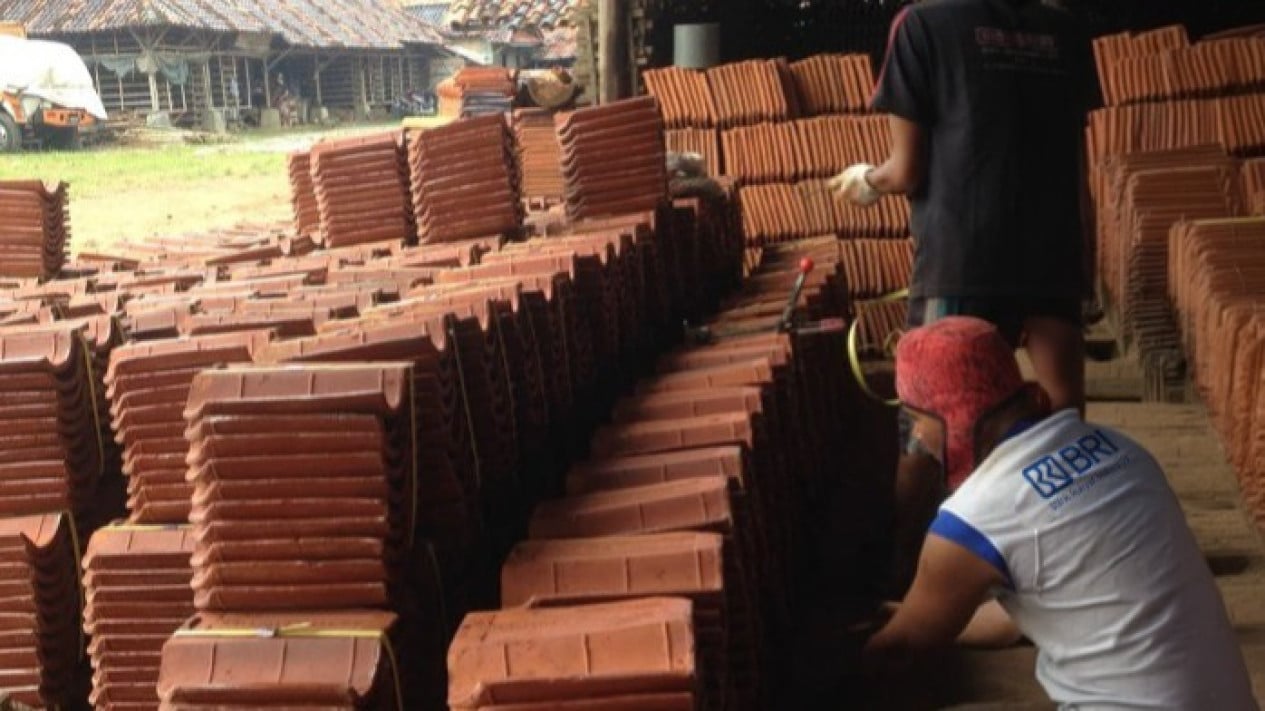
In a corner of a quiet village echoing with the sounds of clay being worked and printing machinery, Hena Gian Hermana’s tile manufacturing business has grown steadily. From a simple home yard, neatly stacked tiles drying under the sun stand testament to the long journey of a small business operator persisting through the dynamics of changing times.
For Gian, tiles are more than just building materials. Behind each piece produced lies a story of dedication, courage in taking risks, and belief that traditional enterprises can develop if managed properly.
He explained that the tile factory, established in 1985, was initially created in response to the high demand for clay roof tiles at that time. Meanwhile, the production capacity of tile factories in the Jatiwangi region was unable to meet the growing market demand.
Unfortunately, this high market demand faced various obstacles including changing times, intense product competition, high production costs, limited raw materials, declining workforce numbers, and capital constraints.
“Speaking about tile factory operations, there are inevitably ups and downs. Changing times, product competition, high production costs, limited raw materials, and declining employee numbers are factors causing many tile factories to fail to survive,” Gian stated.
Gian’s business journey began to change when he became a customer of the Kredit Usaha Rakyat (People’s Business Credit) programme at PT Bank Rakyat Indonesia (Persero) Tbk or BRI. Access to more affordable and accessible financing provided him with room to expand his operations.
The additional capital was used to purchase more modern printing machinery and improve the kiln to be more efficient. The impact was significant. Production capacity increased, tile quality became more uniform, and working time became faster.
“BRI is certainly a key partner for tile factory business operators, because BRI has a low-interest loan facility, the KUR programme, for UMKM business operators like us, so we can continuously produce tiles,” he explained.