
From a Former Factory to a Centre of Civilisation: The Story of Masjid NU At-Taqwa at the End of Japan
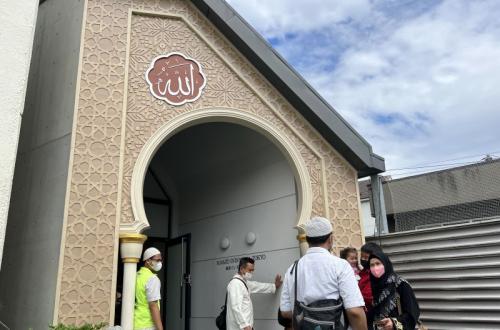
In a quiet corner of Koga City, Ibaraki Prefecture, a building with simple architecture stands firmly. From afar, it looks like an ordinary house in the midst of Japan’s neat residential areas, and that is precisely how it should appear.
When prayer time arrives, the azan echoes only inwards, filling the spaces behind the walls and reaching the ears of the congregation who have been waiting earlier. There are no external loudspeakers, no sounds penetrating the courtyard to greet the neighbours.
In a country that still views Islam as a small minority, amidst an exclusive culture and social harmony maintained very strictly, an azan audible outside the walls could become an unnecessary friction. The mosque’s administrators understand this and choose a wise path: to preach through presence, not noise.
Nevertheless, within those walls, the call to prayer remains loud and full of spirit, summoning souls that long for their homeland. This is Masjid NU At-Taqwa, an oasis for Indonesian expatriates and a silent witness to the struggles of the Nahdliyin community in a foreign land.
On that day, 20 July 2021, coinciding with the festive takbir of Eid al-Adha 1442 Hijriah, the mosque was officially opened. It was not merely an inauguration; it was the culmination of a long-dreamed struggle carried out quietly.
However, before discussing the signboard and its framework, there is something more important to understand first: this mosque was born from two inseparable elements. The first is its physical form, the land and building found with great difficulty by persistent hands.
The second, and this is what truly brings everything to life, is its spirit: a congregation that had already grown, pulsed, and shone long before there was a building they could call their own.
Islam in the Land of the Cherry Blossom: A Seed that Grows Slowly
Before understanding why the presence of Masjid NU At-Taqwa is so meaningful, it is necessary to look at the broader map of Islam in Japan. History records that the presence of Islam in the Land of the Rising Sun began to appear at the end of the 19th century and the beginning of the 20th century, through interactions with traders and intellectuals from the Muslim world. Masjid Kobe, built in 1935, is recorded as the first and oldest mosque in Japan, standing firm even after the onslaught of World War II.
The great wave of Islam was only truly felt from the mid-1980s, when Muslim immigrants and students from Indonesia, Pakistan, Bangladesh, and Iran began arriving. They assimilated, built communities, and established mosques. Now, based on research by Professor Hirofumi Tanada from Waseda University, the number of Muslims in Japan reached around 230,000 souls in 2020 and is estimated to surge to more than 360,000 people by the end of 2024, most of whom are Indonesian citizens.
Data from Japan’s Ministry of Justice records that the number of foreign residents in Japan reached a record high of 3.76 million people at the end of 2024. Among them, according to KBRI Tokyo data as of June 2024, there are approximately 173,000 to 199,824 Indonesian Citizens (WNI), an increase of 34 percent in just one year. The majority of these WNI are Muslim, making them the largest immigrant group from a Muslim-majority country in Japan.
Amid this continuously growing population, the need for places of worship, education, and religious identity becomes increasingly urgent. And in Koga City, Ibaraki, that need finally found its answer.
The Spirit that Arrived First: Majelis Taklim Sakai
A great mosque is not born from concrete and steel alone. It is born from sorrow, from prayers, and from longings that for years found no container.
This story begins with a loss. The passing of a beloved colleague, the late Ali Power, became a turning point that changed everything. His departure left deep grief among Indonesian expatriates in Ibaraki, but at the same time ignited something far greater than sadness: a determination to continue gathering, to continue praying, and to continue supporting one another.
Yasin recitations and tahlil for praying for the deceased were held routinely. Initially simple, in small Indonesian-owned shops and cramped apartments of intern workers that could barely accommodate bodies, let alone longings.
But from that simplicity, the seeds of brotherhood grew. Amid cramped spaces and the cold Japanese nights, prayers were recited with Javanese, Sundanese, and Indonesian accents, a mosaic of voices from the homeland united in the same longing. From sorrow, a congregation was born. From sincere prayers, strength was formed.
Gradually, the activities moved to more spacious places: to factories where Indonesians worked and gathered. One of the most loyal to open its doors was Mr Supri’s (Supriyono) factory, a place that later witnessed how the tradition of gathering became increasingly rooted. There, the congregation gained more freedom, and there, the bonds of brotherhood grew even tighter. And when Ramadan arrives, the congregation swells, and the factory space is no longer sufficient. From there, the awareness crystallised: this community needs a real home.
Long before there was land, before there was an official name, a community called Majelis Taklim Sakai had already become the backbone of this struggle. Among the pioneering figures were Mr Ismail along with Mr Supri, two figures who faithfully built the tradition of study circles from the bottom, from sorrow to prayer, from prayer to movement. Together with other congregants, they moved with one conviction: that being in congregation is a strength that cannot be extinguished by distance or the cold Japanese weather.
Slowly but surely, Majelis Taklim Sakai initiated the establishment of Musholla At-Taqwa in the Bando area, a simple yet meaningful step. For the first time, there was a space that could truly be called a place of worship, a place that did not need to be returned the next morning.