
Free Nutritious Meal Programme in Cilacap Stimulates Local Economy from Farmers to Livestock Herders
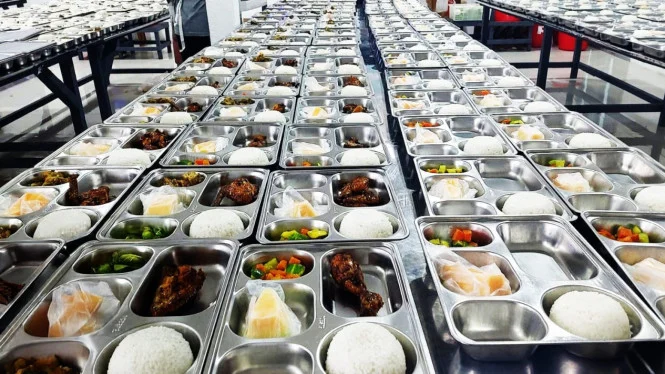
The Free Nutritious Meal Programme (MBG) is claimed to do more than just fulfil nutritional requirements for schoolchildren. In Cilacap Regency, Central Java, the programme is said to be driving the local economy from upstream to downstream.
Yudha Prasetyo, Regional Coordinator of the MBG Programme in Cilacap Regency, stated that the economic effects of the programme are directly felt by farmers, livestock herders, traders, and residents near food service facilities.
“The MBG programme really stimulates the people’s economy, especially for local residents, because if local residents have vegetable fields or anything else, including livestock products, the MBG service point in that area must purchase from them,” he said on Friday, 27 February 2026.
Yudha explained that a single Nutritional Services Unit (SPPG) serving approximately 2,000 students requires large quantities of food supplies every day.
For vegetables alone, the requirement reaches 100 to 160 kilogrammes per day. Meanwhile, animal products such as eggs and chicken meat range from 160 to 200 kilogrammes per day.
“Meanwhile, a single district here can have 6–24 SPPGs. So the economic circulation is extraordinary. Assuming there are just 10 SPPGs, then every day it needs 1–1.6 tonnes of vegetables and 1.6–2 tonnes of eggs or chicken meat,” he said.
With these figures, the cash circulation from purchasing raw materials for MBG kitchens is said to reach tonnes of scale every day within just one district. Food supply requirements are met through a number of goods providers or suppliers.
In a single SPPG, there are on average four to six suppliers involved. Yudha emphasised that payment is made immediately upon goods receipt.
“On average there are 4–6 suppliers per SPPG. The payment scheme is immediate—goods arrive on day 1, and money enters the supplier’s account,” he said.
This scheme is seen as facilitating smooth cash flow for local business operators, particularly small-scale farmers and livestock herders who have previously been hampered by deferred payment systems.
Beyond absorbing agricultural and livestock products, MBG kitchens are also required to empower local residents as operational volunteers. According to Yudha, the composition of volunteers from the local community is already regulated.
“For volunteers, 70% must be from the surrounding community,” he said.