
Free Meal Program Could Add Up to $1.54 Billion to Economy: BRIN - Jakarta Globe
Free Meal Program Could Add Up to $1.54 Billion to Economy: BRIN
Jakarta. Indonesia’s flagship Nutritious Free Meal program (MBG) championed by President Prabowo Subianto could contribute up to Rp26 trillion ($1.54 billion) to the country’s economy, according to a new study by the National Research and Innovation Agency (BRIN).
BRIN estimates the MBG program could add between Rp14.5 trillion and Rp26 trillion to Indonesia’s gross domestic product through increased consumption, investment, and activity in the food supply chain.
The findings are based on a 2025 study conducted in Bangka Belitung and West Java involving 855 participants, using a combination of economic and institutional analysis methods, including Computable General Equilibrium (CGE) and Structural Equation Modeling (SEM).
“MBG has a measurable positive macroeconomic impact. Simulations show an additional GDP increase of Rp 14.5 trillion to Rp 26 trillion,” said Iwan Hermawan, head of BRIN’s MBG research team, during a research seminar in Jakarta on Wednesday.
The program targets schoolchildren and pregnant women and is one of the government’s largest social initiatives. For 2026, the government has allocated Rp 335 trillion from the state budget to fund the initiative.
The program currently serves more than 60 million beneficiaries, with plans to expand coverage to 82 million people nationwide.
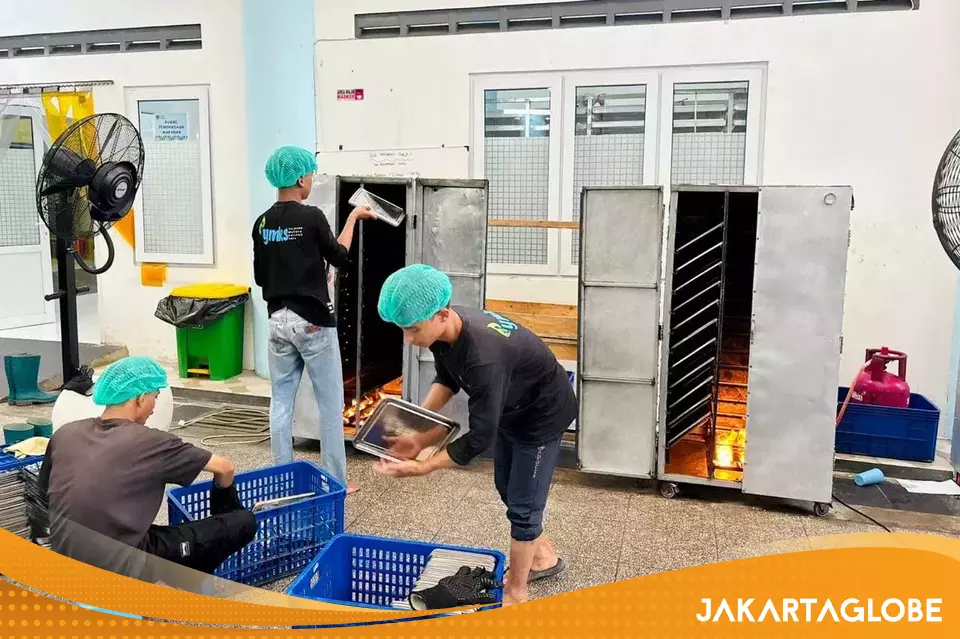
Implementation relies on a vast network of 23,678 community kitchens, known as SPPG units, spread across Indonesia. Sumatra hosts the largest share of beneficiaries, with 12.3 million people, followed by Sulawesi with 4.4 million.
In 2025, the program reached 50.7 million beneficiaries out of a targeted 82.9 million, supported by 17,555 kitchens employing nearly 742,000 workers.
The initiative is managed by the National Nutrition Agency (BGN), which had disbursed Rp 32.1 trillion for the program in early 2026. The spending contributed to total government expenditure of Rp 227.3 trillion as of Jan. 31.
BRIN’s study found the program boosted household consumption by 0.19 percent and investment by 0.24 percent, while inflationary pressures remained relatively contained.
“Consumption and investment account for a large share of GDP, so growth in these areas directly drives economic expansion,” Iwan said. “This supports the government’s goal of achieving 8 percent economic growth by 2029.”
The program’s economic effects extend throughout the food supply chain, researchers said, increasing production in sectors such as rice, processed meat, dairy products, and horticulture.
Employment in the food and food-processing sectors also increased by 0.19 percent, reflecting rising demand for ingredients and meal preparation services.
Public reception to the program has also been largely positive. A survey conducted by the Indonesian Political Indicator Institute found that 72.8 percent of respondents expressed satisfaction with the initiative, including 12.2 percent who said they were very satisfied and 60.6 percent who said they were fairly satisfied.
Despite the positive results, BRIN researchers recommended strengthening program governance to ensure long-term effectiveness.
The agency proposed developing a national output–outcome monitoring dashboard integrating nutrition standards, food safety, distribution systems, and governance indicators in real time.
Iwan also called for risk-based supervision and independent quality assurance to ensure the program maintains consistent service standards nationwide as it expands.
Tags: Keywords: