
Frank Talk with Iranian Ambassador Mohammad Boroujerdi
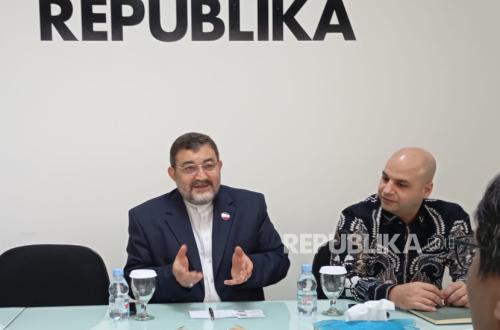
REPUBLIKA.CO.ID, JAKARTA – What could one say? Out of all the Republika staff, not a single one could speak Farsi. Meanwhile, although Mohammad Boroujerdi, the Ambassador of the Islamic Republic of Iran to Indonesia, has been continuously serving in Jakarta for the past three years, he is still not entirely confident speaking Indonesian.
In the end, they were “forced” to converse in the colonial language on that Thursday morning (30/4/2026) at the Republika office. “Trump’s language,” Boroujerdi quipped, eliciting laughter from everyone in the room. Like the amusing posts from the Iranian embassy across the globe lately, such as the Lego animation mocking Donald Trump’s recent arrogance, his sense of humour was no less sharp amid the turmoil back home.
Amid his busy schedule as the 60-year-old envoy of his nation, which is currently facing aggression from the United States and Israel, he made time that day to visit Republika. Indonesia is not a new posting for Boroujerdi. He first came to the country in 1999 as a special staff member to the Director General of Asia-Pacific Affairs at Iran’s Ministry of Foreign Affairs.
“Fried rice,” he answered when asked about his favourite Indonesian food. “Satay too.” Not just food; he is also familiar with Indonesian intellectual thought. “From what I’ve read, Nurcholish Madjid’s ideas on society are similar to those of Iranian philosophers,” he said, recalling the important contemporary Indonesian Islamic thinker who passed away in 2005.
Iran’s Revolution indeed played a significant role in sparking Muslim student activism in Indonesia throughout the 1970s to 1980s. Among those students, many became intellectuals in the 1990s and proposed the concept of civil society, advocating for a more “modern” application of Islam in Indonesian society. That spirit was one of the factors that led to the birth of Republika.
Like most other Iranian officials, he also has impressive academic achievements. “In Iran, I taught master’s and doctoral programmes,” said the graduate of Iran’s Ministry of Foreign Affairs University.
“Now, in most ministries of the Islamic Republic of Iran, they are only allowed to employ people with at least a master’s degree (S2), even for ordinary jobs.” Boroujerdi then had to go back to school after serving in the military during his youth.
Boroujerdi spoke extensively about education in Iran. According to him, it is one of the main messages of Ayatollah Khomeini following the 1979 Islamic Revolution. “Immediately after the Islamic Revolution, the late Imam Khomeini said that if we want to have an advanced country, we must start with education and training. And he said that every literate person who can write and read must teach others,” the Iranian Ambassador stated.
Currently, he said, there is a campus not far from every village in Iran. “Even if the population is only 500 people,” he added.
Before the Revolution, according to Boroujerdi, the illiteracy rate in Iran was around 70 percent. Now, the higher education enrolment rate in Iran reaches 60 percent. Women make up 55 percent of all students in Iran.
Despite decades of economic sanctions from the United States, Europe, and the UN, Iran’s achievements in science and technology are no small feat. Boroujerdi said Iran often ranks high in global standings for research in various fields of science and technology.
Don’t just take the Iranian Ambassador’s word for it; let’s check the data. The National Library of Medicine, a US government agency, records that from 2001 to 2010, Iran’s medical research centres multiplied from 53 to 359 units.
In biotechnology, with 1,111 documents, Iran holds the first rank among Islamic countries in 2024, according to the latest report published by the SCImago ranking institution. The country ranks 11th globally in that category.
Based on articles published from 1996 to 2024, Iran, with 15,188 articles in biotechnology, holds the first rank in the region, followed by Turkey (with 10,973 articles) and Egypt (with 7,947 articles). Iran is in 15th place globally.
Meanwhile, the StatNano nanotechnology research website places Iran in fourth place worldwide in nanotechnology publications. The number of articles indexed in Web of Science (WoS) by Iran in 2022 was 11,473 articles, equivalent to 4.9 percent of the total WoS-based nanotechnology articles in the world.