
Four Unhas Professors Present Strategic Ideas for the Future
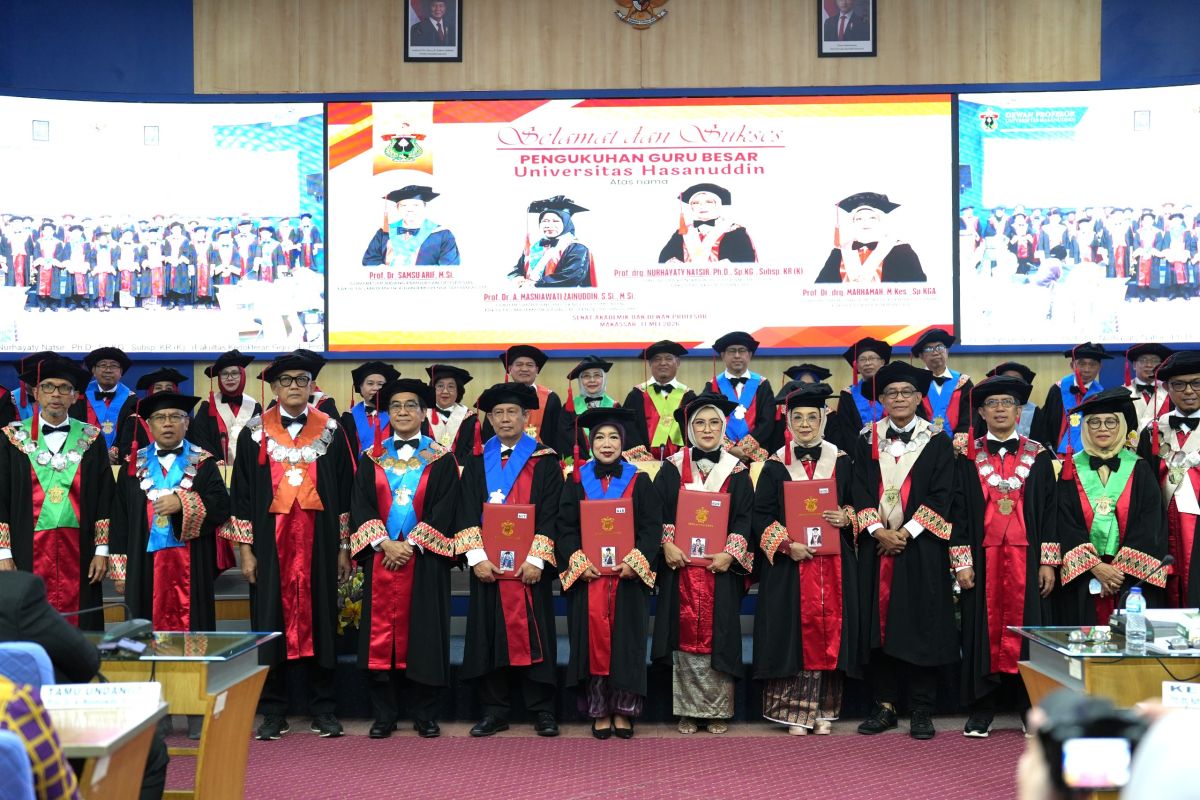
Makassar - Four distinguished professors at Universitas Hasanuddin (Unhas) presented strategic ideas for the future during the inauguration ceremony at the Tamalanrea campus in Makassar on Monday.
Prof Dr Samsu Arif, Professor in Geospatial Modelling from the Faculty of Mathematics and Natural Sciences (MIPA) at Unhas, delivered a speech titled “From Spatial Philosophy to Geo-AI: The Evolution of Spatial Thinking in Sustainable Development”.
Prof Samsu explained that sustainable development cannot be separated from spatial dimensions. Policies without a spatial basis tend to neglect geo-cultural expressions and equitable distribution. Therefore, the Geographic Information System (GIS) serves as a tool for justice, and spatial models act as spokespersons for data truth.
Next, Prof Dr A. Masniawati, Professor in Plant Biotechnology from the Faculty of MIPA, explained that local rice varieties represent potential genetic material as a source of genes for controlling important traits in rice plants.
The high genetic diversity in local rice can be utilised in rice breeding programmes. To reduce the risk of losing genetic resources in local aromas, Prof Masniawati emphasised the need for inventory.
The development of aromatic rice in Indonesia has been market-oriented, initially only on a trial breeding scale. The potential of local aromatic rice is important as part of cultural wealth and agricultural heritage of communities, with each variety having its own local story and history.
Generally, she said, aromatic rice is classified as special rice according to geographical indications, because its quality characteristics and aroma depend on the region.
“In a complete biological system, plants including rice always interact with their environment, especially with microorganisms living around them,” she stated.
The superiority of local rice lies not only in the genetics of the plant but also in the biological networks supporting it. Soil, microorganisms, and plants form a unified dynamic system.
When this system is understood and managed with the appropriate biotechnological approach, local genetic material can be optimised without sacrificing environmental sustainability.
“It is from this need that the idea of a biofactory emerges, which I interpret as an integrated bioconversion approach that combines local rice genetic material, functional microorganisms, and plant physiological processes in one biological system,” she said.
With this approach, she added, food is no longer seen as an end product but as a long process involving biological bioconversion.
In the biofactory perspective, local wisdom is not positioned as knowledge opposing science, but as part of a biological system that needs to be read and understood scientifically.
Next, Prof drg Nurhayaty Natsir, Professor in Dental Restoration Conservation from the Faculty of Dentistry, discussed the paradigm of aesthetic dentistry in modern dental care.
Then, Prof Dr drg Marhamah, Professor in Paediatric Dentistry from the Faculty of Dentistry, delivered a speech titled: “Oral Cavity Disorders in Children Related to Systemic Diseases”.