
Four Unhas Professors Present Innovative Research on Food Quality
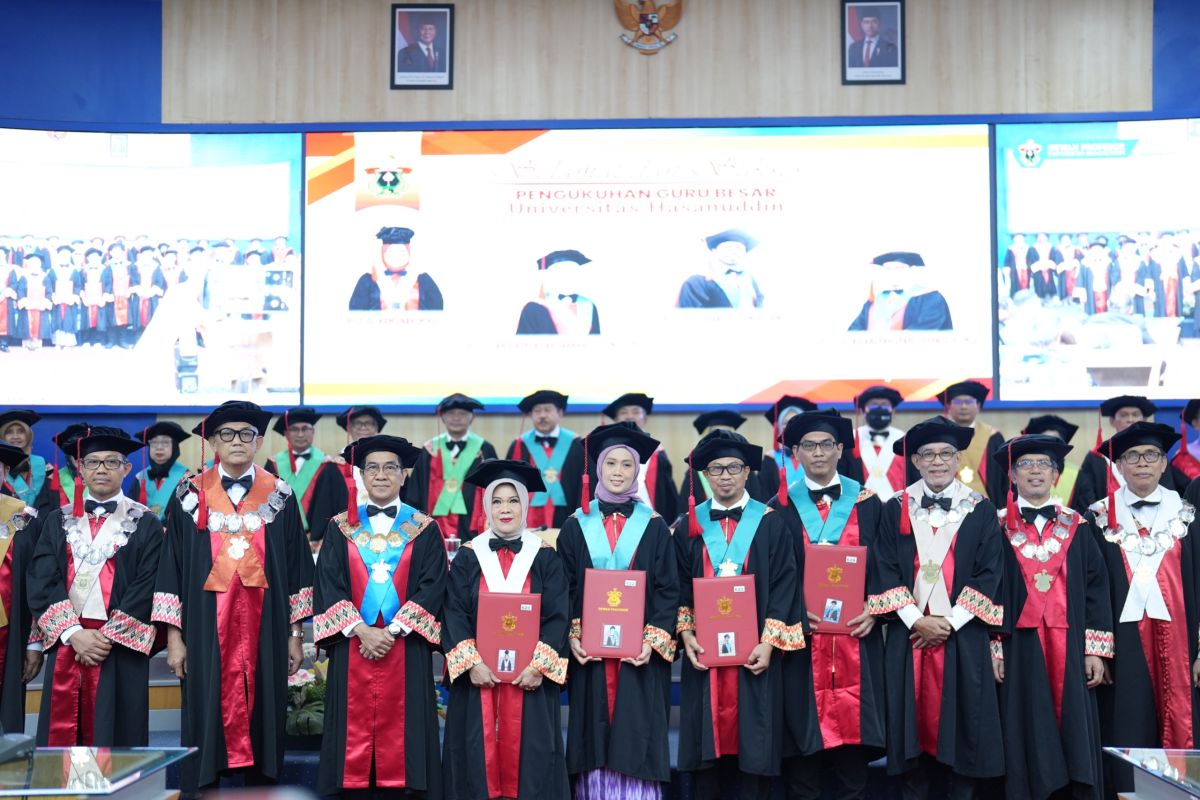
Four professors from Universitas Hasanuddin (Unhas) presented innovative research on food quality during a professorial installation ceremony at Tamalanrea Campus in Makassar on Monday.
Prof Andi Nur Faidah Rahman PhD, Professor of Post-Harvest Processing Technology at Unhas’s Faculty of Agricultural Technology, explained that improper post-harvest handling often leads to high losses, reduced quality, physical damage, and diminished nutritional content in agricultural products. ‘The primary aim is to reduce post-harvest losses, maintain physical and nutritional quality, prevent damage during storage, and enhance the economic value of rice,’ she added. She noted that functional rice contains bioactive compounds that benefit human health. Applying post-harvest technology through germination can increase Gamma Aminobutyric Acid (GABA) levels, a compound that significantly rises during the germination process. Germination triggers significant biochemical changes in grains, boosting bioactive compounds such as vitamins, essential amino acids, and antioxidants. ‘The contribution of this research is the development of innovative methods to enhance rice quality and economic value while supporting the sustainability of Indonesia’s agricultural sector,’ she added.
Prof Dr Iqbal IPM, Professor of Agricultural Equipment and Machinery at Unhas’s Faculty of Agricultural Technology, stated that agricultural machinery (Alsintan) has been a key driver of the Green Revolution, enabling significant yield increases. ‘Our research indicates that using two- and four-wheel tractors positively impacts tillage efficiency, reduces costs, and improves rice plant growth and yield,’ he said. ‘Other studies include modifications and performance tests of compost applicators for rice, sugarcane, and horticulture crops,’ he added.
Prof Dr Adiansyah, Professor of Food Processing and Preservation Technology at Unhas’s Faculty of Agricultural Technology, explained that edible packaging is the third generation of food packaging, categorised into edible films and coatings. ‘This concept extends beyond film or coating production to encompass the entire value chain, from raw material extraction to contributions towards a circular economy,’ he said. ‘It is a complex system involving material complexity, processing technology, regulations, and consumer behaviour. Edible packaging development is increasingly relevant due to plastic waste concerns and demand for eco-friendly packaging,’ Prof Adiansyah explained. The main challenge in edible packaging research is material stability, which determines whether the packaging maintains its protective function during production, distribution, and consumption. This is because edible packaging is made from natural biopolymers such as starch, protein, and polysaccharides, which are inherently sensitive to temperature, humidity, and light.