
Four Months After Sumatra Disaster: Emergency Phase Resolved, Reconstruction Begins
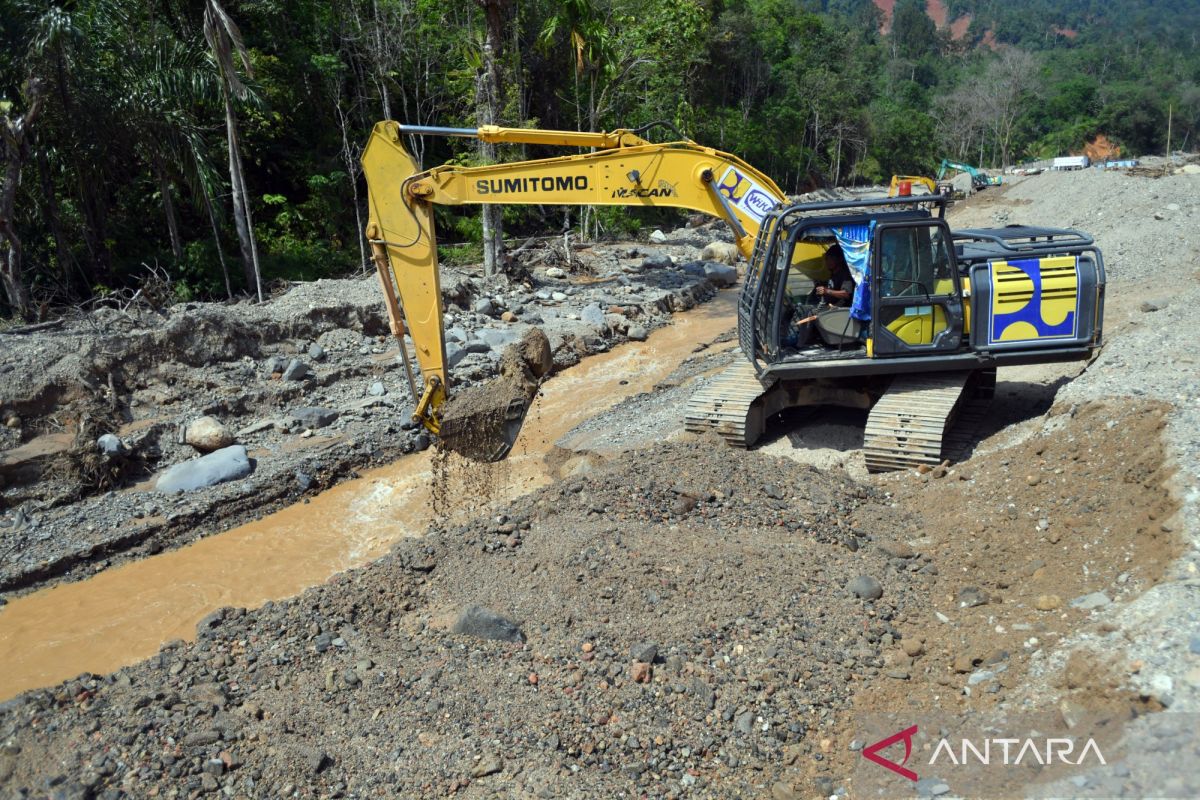
Four months on, the emergency phase has been almost entirely resolved, but the much longer chapter of permanent reconstruction has only just begun.
Jakarta (ANTARA) - The hydrometeorological disaster that struck three provinces in Sumatra at the end of November 2025 is recorded as one of the largest disasters in Indonesia’s history. Within days after floods and landslides hit, more than two million people were displaced in Aceh, North Sumatra, and West Sumatra.
Four months later, the emergency phase has been almost entirely resolved, but the much longer chapter of permanent reconstruction has only just begun.
Data from the Task Force for Accelerating Rehabilitation and Reconstruction Post-Sumatra Disaster reveals two parallel realities. On one hand, emergency indicators show significant recovery figures. On the other, physical reconstruction and permanent housing indicators remain hampered in various areas.
To understand the weight of the recovery challenges, the scale of the disaster must first be considered. Floods and landslides affected 52 regencies/cities, 491 sub-districts, and 4,511 villages across the three provinces. A total of 98,942 housing units were damaged, comprising 39,138 heavily damaged units, 26,044 moderately damaged, and 33,760 lightly damaged.
Affected educational facilities numbered 4,922 units, health facilities 954 units, and places of worship 1,593 units. The total estimated losses and damages reached Rp16.83 trillion based on calculations from the second week of December 2025.
Behind these figures, Aceh bore the heaviest burden. Of the total 98,942 damaged houses, 81,654 units were in Aceh. The initial number of displaced people in Aceh reached 1.46 million out of a total of 2.1 million across Sumatra.
As of 20 March 2026, seven regencies in Aceh still fall under the category of “requiring special attention” in government and community recovery indicators, far more than the two regencies each in North Sumatra and West Sumatra.
In response to a disaster of this magnitude, the government deployed substantial resources. From the start of the disaster until 14 February 2026, a total of 92,158 personnel from 17 ministries and agencies were deployed to the field, including TNI, Polri, BNPB, health workers, student volunteers, and cadets from various civil service academies. As of 24 March 2026, 35,463 personnel remain at the disaster-affected locations.
This massive deployment of personnel has yielded measurable results in responsive and immediate sectors. The number of displaced people still living in tents dropped from 2.1 million at the beginning of December 2025 to just 171 as of 24 March 2026, all located in Aceh Tamiang and Bireuen Regencies.
North Sumatra and West Sumatra no longer have displaced people in tents. National roads in the three provinces have been fully restored at 100 percent. All 867 affected puskesmas and 87 RSUD have resumed normal operations. The telecommunications BTS network has been fully restored. Electricity supply has returned to 99.99 percent of affected customers.
Teaching and learning activities in the 4,922 affected schools have also resumed at 100 percent, although 50 schools are still using tents and six others are temporarily using other buildings. Activation of people’s markets has reached 93 percent of the 210 affected markets. Mud cleaning in 529 target locations is 84 percent complete.
Reconstruction Phase
Beyond the emergency indicators that have begun to recover, the picture shifts to the permanent reconstruction phase, particularly in the housing sector, which still requires collaborative efforts from various parties. This permanent housing sector remains one of the basic needs for affected communities to return to normal life.
However, implementation in the field is not hindered by the size of the budget, which has already been set by the government, but rather by the classic issue of data on affected residents in each region.
As a transition from tent displacement to “homes”, the government has provided temporary housing (huntara) for disaster survivors. Of the target 19,351 huntara units, around 84 percent have been built to allow affected residents to carry out daily activities more comfortably before their permanent homes are fully constructed.
The government targets building 36,669 permanent housing units in the three provinces. Only 110 units have been 100 percent completed as of 24 March 2026, while another 1,359 units are under construction. This means more than 35,000 permanent housing units still need to be realised in the projected rebuilding of disaster-affected areas over the next three years.
The central government has established a clear scheme for housing repair assistance, namely Rp60 million for permanent homes, Rp30 million for moderately damaged houses, and Rp15 million for lightly damaged ones. However, the validation of data at the regency and city levels is now a constraint on the disbursement of these housing repair stimulus funds.
Disbursement can only occur if regions submit complete data on recipients with names and addresses. As of 5 March 2026, BPS has received data from 45 regencies/cities, while seven regions have not submitted any proposals at all.
Of the 75,065 families with damaged houses recorded by BPS, stimulus assistance for the lightly damaged category has only reached 44.92 percent of recipients. The moderately damaged category is slightly better at 63.32 percent.
Pidie Jaya Regency in Aceh is the area with the largest number of damaged houses and one of the most complex to handle, with 18,839 families recorded as having damaged homes there.
This data issue has prompted Interior Minister Tito Karnavian to publicly urge regional heads to promptly complete the data collection. The central government emphasises that it will prioritise the execution of assistance for regions that submit clean data more quickly, and allows regions to submit data in waves to avoid overall delays in the disbursement process.
Three-Year Reconstruction
Beyond housing, the infrastructure sector also reflects the long road ahead. River normalisation has only reached 44 percent for rivers handled by the central government, and 37 per