
Four Agglomeration Areas in Central Java Predicted to Become Traffic Congestion Hotspots During Eid Holiday
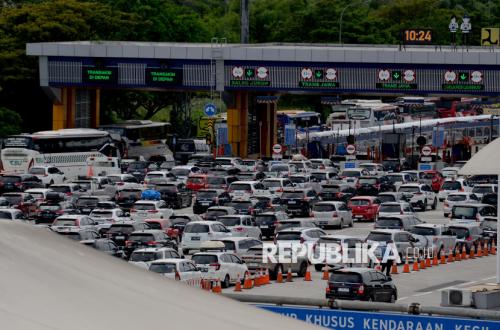
The Central Java Regional Police have identified four agglomeration areas predicted to become sources of congestion during the outbound and return migration periods for Eid 2026. The National Police Chief has predicted two peak periods for both outbound and return traffic during this year’s Eid holiday.
Kombes Pol Artanto, Head of Public Relations for the Central Java Regional Police, stated that the police have prepared a unified command post at the Kalikangkung Toll Gate in Semarang during the migration period. This post will coordinate unified command posts at other regional police headquarters throughout Central Java.
“We are preparing to manage agglomeration areas that are vulnerable points, particularly for traffic congestion during outbound and return migration. We have planned to establish four agglomeration areas where traffic density for outbound and return migration is expected to be quite high,” Artanto said on Tuesday, 10 March 2026.
He identified the first agglomeration area as the Banyumas region, controlled by the Banyumas Police Chief. “The next agglomeration area is the Wonosobo region, where this route is the route from Banjarnegara, then towards Dieng, including towards Magelang, which will be controlled by the Wonosobo Police Chief,” he stated.
The next agglomeration area is the Klaten region towards Yogyakarta, controlled by the Klaten Police Chief. “Finally, the agglomeration area towards Semarang, Ungaran, or Semarang towards Demak and Jepara. This will be controlled by the Semarang Metropolitan Police. The function of the Kalikangkung unified command post, controlled by the Traffic Director, will coordinate these agglomeration areas,” Artanto said.
Artanto noted that although the unified command post is located at the Kalikangkung Toll Gate, traffic monitoring and management will not be limited to toll roads. “Besides the Trans Java Toll, we must also control the north coast arterial route, then the central arterial route, then the south arterial route, and the far south arterial route. All must be monitored and controlled by the Kalikangkung unified command post,” he said.
He stated that the implementation of one-way traffic systems on the Trans Java Toll will be determined by the National Police Traffic Directorate. “We also conduct local one-way traffic operations. These local one-way operations are based on police discretion, where the Traffic Director will monitor traffic density in Central Java,” he added.
Artanto stated that the peak outbound and return migration periods for Eid 2026 are predicted to occur twice. The first outbound peak is estimated for 14-15 March 2026, whilst the second outbound peak is on 18-19 March 2026.
The first return traffic peak is estimated for 24-25 March 2026, whilst the second return traffic peak is on 28-29 March 2026.
“These traffic predictions are influenced by several factors. First, the government’s policy on flexible working hours, which provides quite extended leave of nearly two weeks. Second, the tendency for people to choose different departure times. Unlike recent years with limited spare time forcing limited departure windows, now the timeframe is wider. Moreover, there is a preference for vehicle movement to be spread out rather than concentrated at one time,” Artanto said.