
Fossil Fuels Deemed a Burden on the State Budget, Indonesia Urged to Join Santa Marta Conference
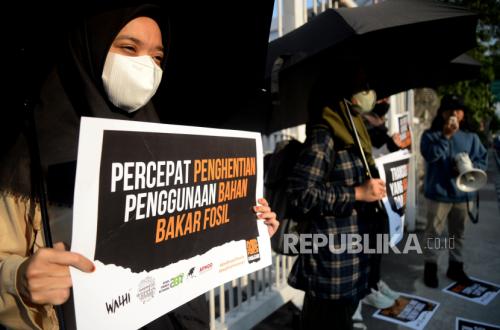
An increasing number of civil society coalitions are urging the Indonesian government to engage and play an active role in the international conference on transitioning away from fossil fuels, known as the First Conference on Transitioning Away from Fossil Fuels (TAFF), to be held in Santa Marta, Colombia. Following AEER, ICEL, Yayasan PIKUL, 350.org, and Greenpeace Indonesia, think tanks CELIOS, INDEF, and Yayasan CERAH are now also calling on the Indonesian government to attend the conference.
The TAFF, scheduled for 24-29 April, aims to initiate a process where coalitions of countries, local governments, and other relevant parties can identify and create progressive pathways for transitioning away from fossil fuels.
“This Santa Marta conference is actually very crucial and represents an important momentum in the current Indonesian context, which is facing global turbulence with implications for many aspects, from national energy supply to economic fiscal matters, because we are still dependent on fossil fuels,” said Imaduddin Abdullah, Director of International Collaboration at the Institute for Development of Economics and Finance (INDEF), in his statement on Friday (17/2/2026).
He explained that fluctuations in global energy prices are causing a surge in fiscal burdens, as energy subsidies are now nearly as large as the allocations for priority sectors, reaching 93 per cent of the health budget, 51 per cent of the infrastructure portion, and 28 per cent of the education budget. Even with high prices, revenues from the fossil energy sector are not stable enough to cover the surge in subsidies and energy compensations over the past two years.
In fact, he added, energy expenditures exceed revenues, with a deficit of Rp 135 trillion in 2022 and remaining negative in 2024-2025. This data shows that fossil energy is a net burden on the state budget (APBN).
“As a result, priority spending such as education, health, and infrastructure is eroded, the fiscal deficit widens, debt increases, and fiscal space narrows. What we also regret is that continued dependence on fossil energy weakens national competitiveness and holds back investment because at the global level, everyone is moving towards a green transition. Meanwhile, one determinant of competitiveness is how far a country can shift to a green transition and promote energy transition,” said Imaduddin.
Media Wahyudi Askar, Director of the Fiscal Justice Center of Economic and Law Studies (CELIOS), added that the current situation implies that the war between the United States-Israel and Iran is not yet over. On the other hand, dependence on fossil energy will trap Indonesia in an energy crisis. This condition should be sufficient reason for Indonesia to support the Santa Marta Conference.
“The role of the Santa Marta Conference is hoped to turn shocks into clear policies. We know that COP does not offer much, it is slow and consensus is not being reached. Santa Marta is hoped to become quick action to address current global needs, accelerate energy transition by locking in fossil fuel phase-out commitments, so that countries have stronger commitments to carry out energy transitions,” said Media.