
Former KPK Employees: Central Information Commission Ruling a Step Forward for Victims' Recovery
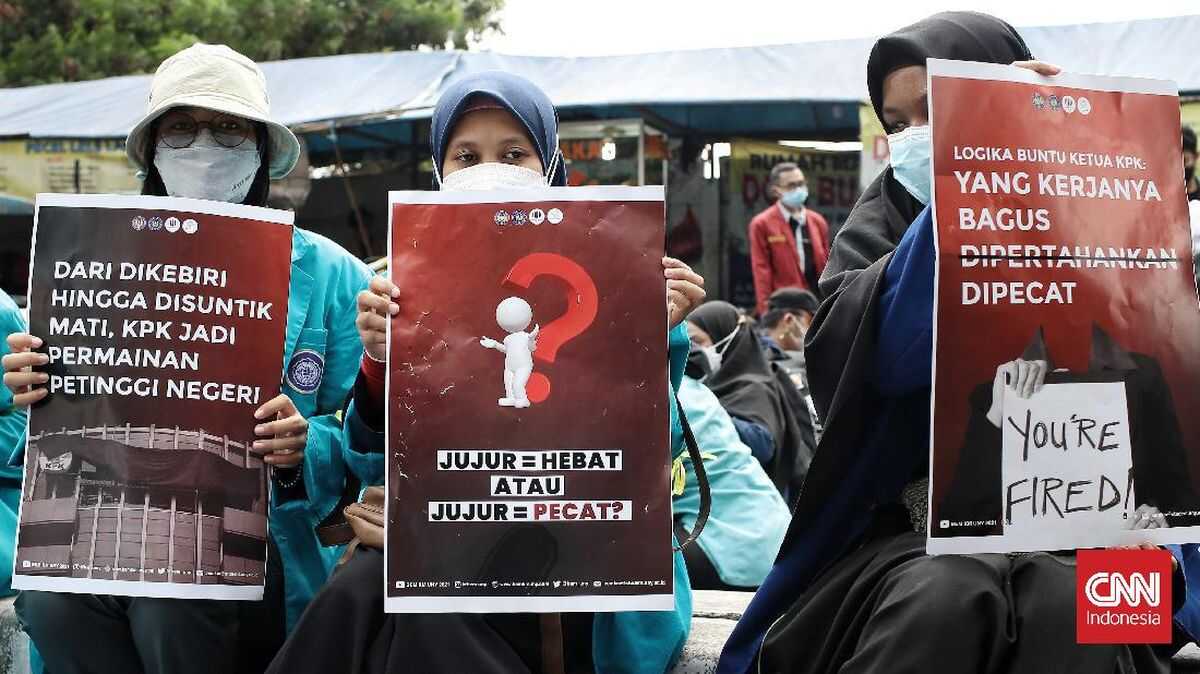
Former Corruption Eradication Commission (KPK) employee Ita Khoiriyah has stated that the Central Information Commission (KIP) panel’s ruling, which partially granted her request, represents a step forward in the recovery process for herself and her colleagues who fell victim to the National Insight Test (TWK) assessment conducted as part of the transition of KPK employees to Civil Service (ASN) status.
“This step is a form of progress in the recovery efforts for KPK TWK victims who have been demanding justice for five years,” said Tata, as she is known, following the reading of the information dispute ruling in case number 043/XI/KIP-PS/2021 on Monday (23 February).
Fellow applicant Hotman Tambunan added that the KIP panel’s ruling constitutes a victory for former KPK employees who were removed on the pretext of failing the TWK assessment.
“This is not merely a victory for TWK victims alone, but a victory against all forms of intimidation and manipulation directed at corruption eradication and democracy,” he said.
Lakso Anindito, chairman of the Indonesia Memanggil (IM57+) Institute, who accompanied Tata and Hotman, explained that the legal action before the KIP was part of a series of advocacy efforts to reinstate 57 former employees to the KPK.
“Through this ruling, it should be increasingly clear that there is no reason to delay the reinstatement of 57 employees to the KPK by the President,” he said.
Another TWK victim and IM57+ Institute founder, Mochamad Praswad Nugraha, added that the partial granting of the request by the KIP panel was not merely an administrative victory but a moment of historical correction.
Praswad stated that all state institutions involved in the implementation of the TWK are obliged to comply with and execute the KIP hearing ruling. The ruling is clear and firm: assessment documents that had been kept secret must be disclosed to the victims. Praswad said there is no longer any room to delay, evade, or narrowly interpret this legal obligation.
“Today’s KIP hearing is our last hope — we, the TWK victims — in seeking justice. For five years, we have been labelled, stigmatised, and treated as though we were the guilty parties. This ruling affirms that the right to information and the right to self-defence must not be stripped away in the name of anything,” Praswad said.
Previously, the KIP panel declared that TWK documents constitute partially open information, and that the applicants may obtain access by redacting the names of assessors in accordance with the mechanism for granting information access under Article 22 paragraph 7 letter e of the KIP Act in conjunction with Articles 50 paragraphs 2 and 3 of the KIP Regulation on Public Information Service Standards (Perki SLIP).
“The information requested by the Applicant as referred to in paragraph 4.28 is declared Partially Open Information solely for the Applicant, provided it does not contain personal information of other parties as described in Article 17 letter h numbers 4 and 5 of the KIP Act,” said KIP Panel Chair Rospita Vici Paulyn whilst reading the ruling in case number 043/XI/KIP-PS/2021 at Wisma BSG Annex Building, Central Jakarta, on Monday (23 February).
The information dispute was adjudicated by KIP Panel Chair Rospita Vici Paulyn with members Arya Sandhiyudha and Samrotunnajah Ismail. The substitute registrar was Sri Mulyani Sutar.
The KIP panel annulled the designation by the Information and Documentation Management Officer (PPID) of the National Civil Service Agency (BKN), Number 2 of 2021, concerning the Classification of Exempt Information.
The KIP panel ordered BKN to provide the information requested by the Applicant as referred to in paragraph 6.3 solely to the Applicant, in accordance with the information provision mechanism stipulated in Article 22 paragraph 7 letter e of the KIP Act in conjunction with Articles 50 paragraphs 2 and 3 of Perki SLIP — namely by redacting or obscuring exempt information material concerning the personal information of other parties.
“The Respondent (BKN) is ordered to provide the information requested by the Applicant as referred to in paragraph 6.4 to the Applicant after this ruling has obtained permanent legal force (inkracht van gewijsde), with copying costs to be borne by the Applicant,” the judge said.