
Former KAI Commissioner Views Bekasi Train Accident as Not Solely Human Error
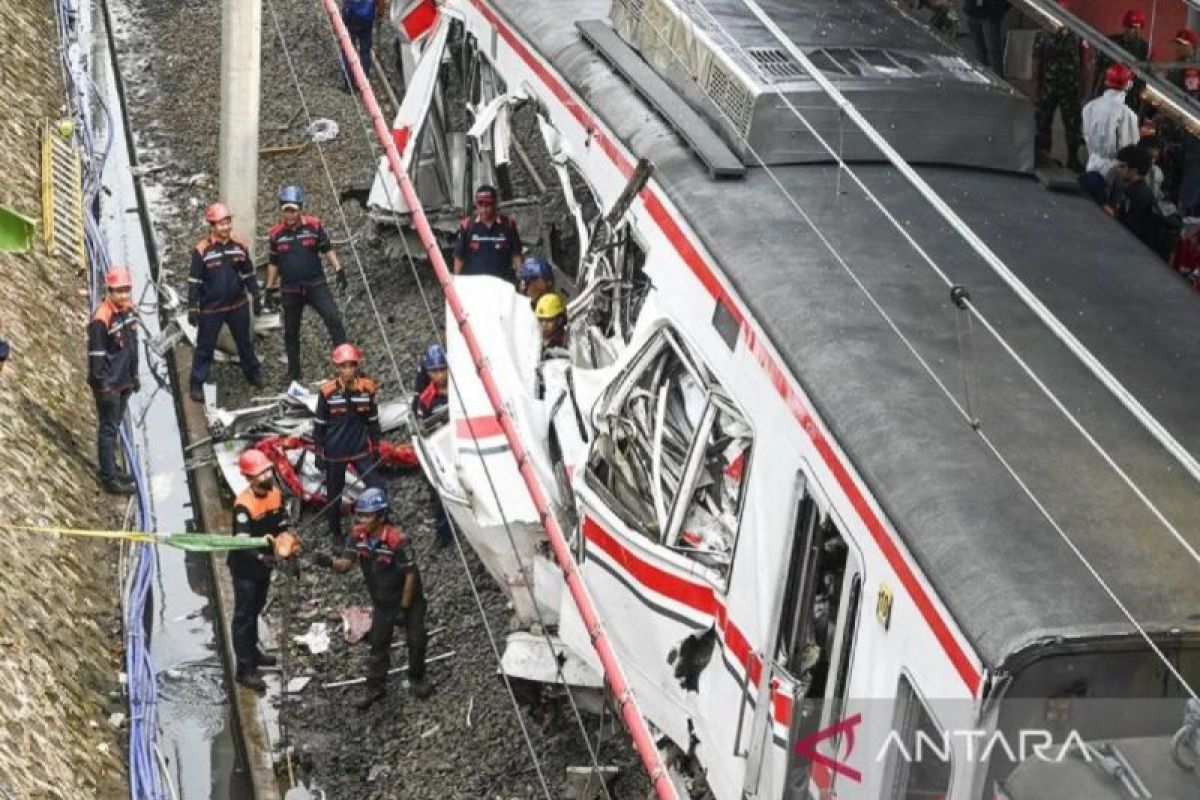
Jakarta (ANTARA) - Former Commissioner of PT Kereta Api Indonesia (Persero) or KAI, Riza Primadi, assessed that the train accident at Bekasi Timur Station, West Java, was not solely caused by individual negligence (human error).
“Who is the human error? The driver? The train consists need a minimum distance of 500 metres if at a speed of only 60 km/h,” said Riza when contacted in Jakarta on Monday.
Riza assessed that the cause of the accident cannot be viewed simplistically. He explained that long-distance train consists (KAJJ) have significant weight and require long braking distances.
He also assessed that the driver had attempted to brake. This can be seen from the collision impact that did not destroy the entire consist.
“If there was no braking, it could have hit more than two to three KRL trains,” he said.
Therefore, he emphasised that this accident more reflects issues with operational systems and infrastructure rather than individual errors in the field.
According to Riza, operationally, mixing long-distance train (KAJJ) and KRL journeys on one track has high potential to cause accidents. Differences in stopping patterns and speeds are crucial factors that cannot be ignored.
He explained that the Argo Bromo Anggrek (ABA) train travelling from Gambir to Cirebon has high speed and only stops at certain stations, unlike the KRL which stops at almost every station.
According to him, this condition makes the potential for “overtaking” unavoidable. Thus, he views this accident as a form of systemic failure.
Meanwhile, transportation observer Ki Darmaningtyas assessed that the implementation of GPS-based sensor technology is an important step to prevent train accidents.
“Use GPS-based Intelligent Transportation System (ITS) technology to improve train operational safety,” said Darmaningtyas.
He explained that this technology allows the driver to know the track conditions ahead, including the presence of other trains or disruptions.
“If all PT KAI facilities are equipped with GPS that can detect disruptions one or two kilometres ahead, it can minimise accidents,” he said.
Darmaningtyas cited the accident involving the KA Argo Bromo Anggrek, which he believes could have been minimised if such technology were available.
He assessed that this system is more effective than sudden braking, which poses risks to journey safety.
“Sudden braking is also dangerous for the train,” he said.
With a combination of DDT resolution and GPS technology implementation, he is optimistic that train accident risks can be significantly reduced.
Previously, the Metro Jaya Police had taken statements from 31 witnesses to uncover the train accident incident at Bekasi Timur Station, West Java, on Monday (27/4).