
Former Head of Police Education and Training Discusses Plan to Transform STIK into Unipol: To Safeguard the Nation
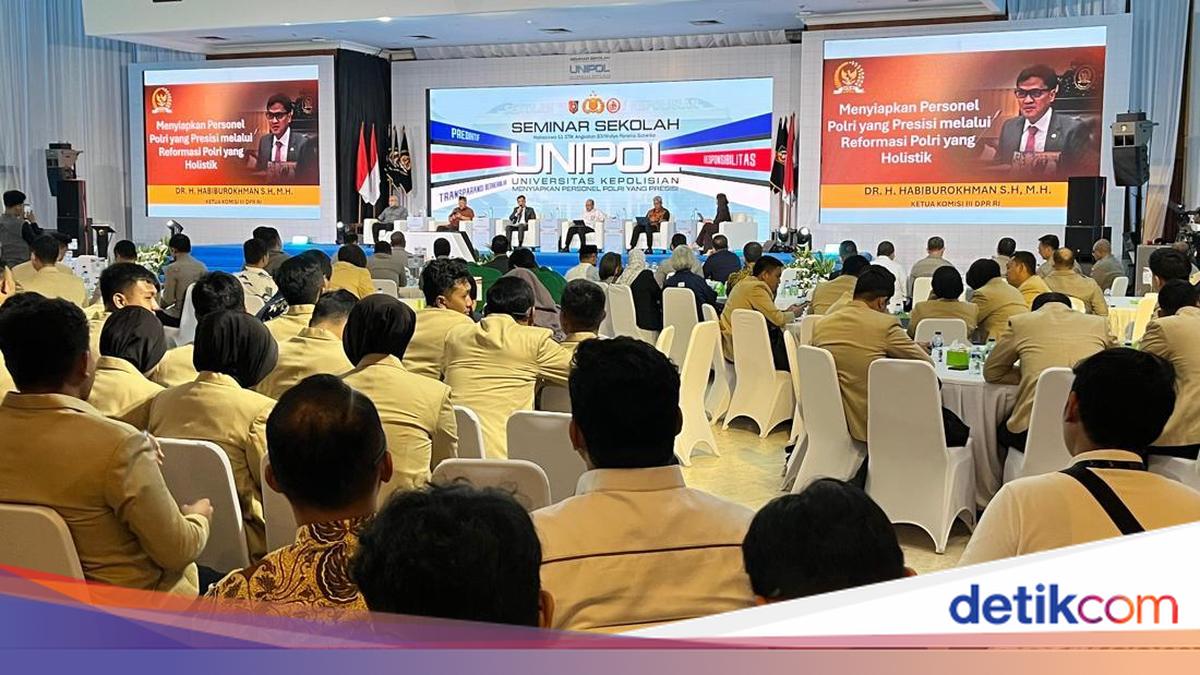
Former Head of the National Police’s Education and Training Agency (Kalemdiklat), Inspector General Chryshnanda Dwilaksana, discussed the plan to transform the Police College (STIK) into the Police University (Unipol). This effort aims to develop policing sciences in order to enhance capabilities and professionalism.
Chryshnanda conveyed this during a seminar titled ‘UNIPOL: Preparing Precision Indonesian National Police Personnel’. He stated that the struggle to turn STIK into a university is a long process to strengthen policing sciences.
“The police are a reflection of the nation’s civilisation. In a civilised country, the democratic context involves the supremacy of law, protection of human rights, transparency, and moral and social accountability,” said Chryshnanda at the Mutiara Auditorium of STIK/PTIK Polri, South Jakarta, on Monday (13/4/2026).
Chryshnanda quoted Romo Magnis Suseno’s statement that the nation’s future depends on education. He also likened the Education and Training Agency to ‘Little Polri’ or a ‘safe house’ for the police institution, both in tangible and intangible terms.
“The Education and Training Agency is Little Polri. If you want to see Polri, look at its Education and Training Agency. This is Polri’s safe house, both tangible and intangible,” said the 2023 Hoegeng Awards nominee.
According to him, policing science is an interdisciplinary field studying social issues, order, law, justice, up to contemporary and transnational crime. Therefore, police must be guardians of life, builders of civilisation, and fighters for humanity.
In the digital era full of uncertainties, Chryshnanda stressed the importance of the Indonesian National Police being one step ahead of changes. He encouraged the development of electronic policing and forensic policing to remain relevant to the times, including facing challenges from artificial intelligence (AI).
“If the police are just like that, it won’t connect. What if the police don’t connect? Of course, they won’t be taken seriously and will be complained about continuously. But this is where, in a democratic context, we open a dialogue of civilisation,” explained the three-star general.
“And because STIK becoming a university is not merely for the police’s interest, but to keep this nation sovereign, resilient, capable of countering, and even competitive,” he continued.
Chryshnanda explained that the Police University plan is not a new idea, but a development from the implementation of existing policing sciences since 1946. He also mentioned that Unipol will be open to the general public in the future.
“What is called scientific knowledge is open to anyone,” he said.
However, he added, the realisation of establishing the higher education institution is still awaiting government approval. “So far, we have been waiting for political will, and also need thinking on the structure, instruments, lecturers, and including the budget,” added Chryshnanda.
On the same occasion, the Chairman of STIK of the Police Education and Training Agency, Inspector General Eko Rudi Sudarto, explained the administrative process for forming Unipol. He stated that the green light from relevant ministries has already been obtained.
“In 2023, the Ministry of Education, Culture, Research, and Technology already allowed us to operationalise the Police University. Now, we are in the process of obtaining initiative permits from Dikti as well as from the Ministry of Administrative and Bureaucratic Reform,” explained Eko.
Eko added that after the ministerial process is complete, the next step is the issuance of a presidential regulation (perpres).
“Then there will be a perpres from the president. Once again, the concern for academic education at the university or at STIK currently becomes one of the gateways to transformation,” concluded Eko.