
Former Constitutional Court Chief Reveals Reasons Why Military Courts Are Difficult to Reform
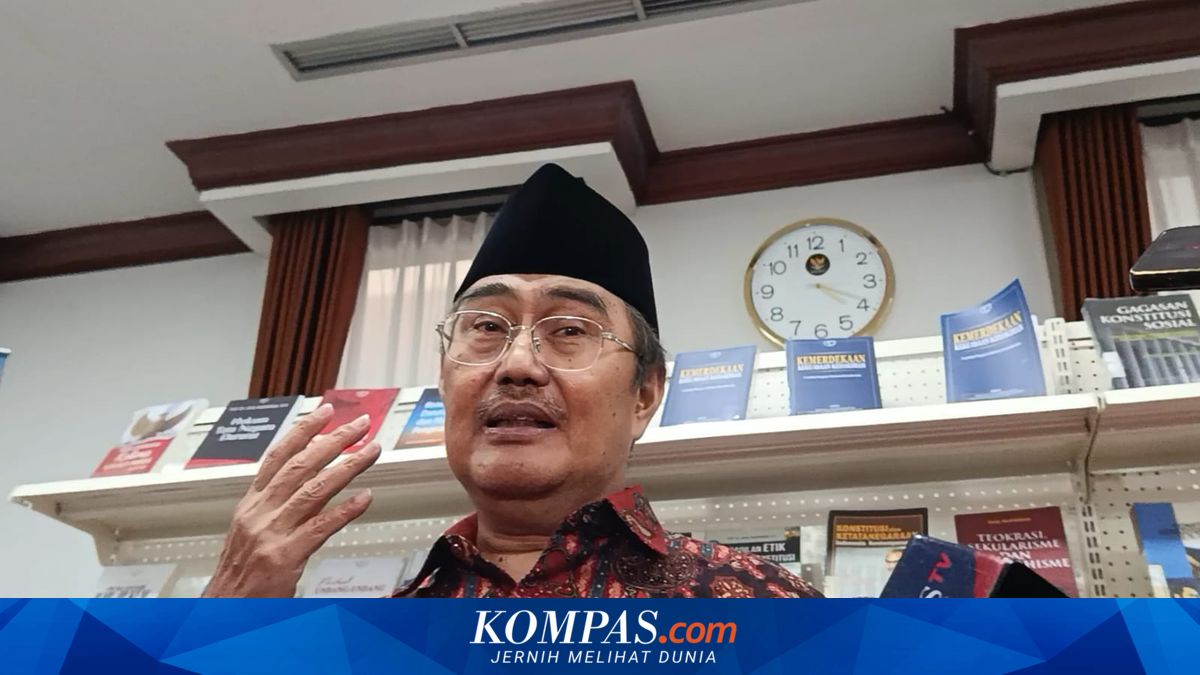
Former Constitutional Court Chief Jimly Asshiddiqie stated that there are several reasons why the structure of military courts is difficult to alter. This is evident from the existence of military courts in the 1945 Constitution (UUD 1945) to their presence in Indonesian history.
“As long as it concerns the constitution (the Constitutional Court has the authority to regulate it), what the Constitutional Court handles is the constitution. Unfortunately, military courts are in the Constitution. So, it’s difficult,” said Jimly Asshiddiqie, when providing testimony after the launch of the book “Kemerdekaan Kekuasaan Kehakiman” as well as his 70th birthday celebration, at the Constitutional Court Building, Jakarta, on Friday (17/4/2026).
Article 24 of the 1945 Constitution affirms that there are four judicial environments under the Supreme Court (MA), namely general courts, religious courts, military courts, and administrative courts.
“It can take over the functions of religious courts, the functions of district courts if the district courts cannot operate. Religious court judges are reassigned. Then, when there was a divorce case, who would judge it? The military court,” he said.
However, if the state is not in a state of emergency, theoretically, military courts cannot encroach on the domain of general courts.
Nevertheless, Indonesian history records several events where military courts were used as venues to try civilians.
After the Old Order, Indonesia established four scopes of judiciary, namely general courts, religious courts, state administrative courts (TUN), and military courts.
This is enshrined in Law Number 14 of 1970. However, the PTUN itself was only established in 1987.
Meanwhile, from 1965 to 1970, military courts were widely used to try civilians, especially those suspected of being part of the Indonesian Communist Party (PKI).
“Military courts during those 5 years from 1965-1970 were the most famous courts in Indonesia. They appeared in newspapers, TV, and radio every day because they were trying PKI cases,” said Jimly.
“The Judicial Power Law was meticulously formulated into the wording of Article 24A. The Supreme Court oversees the four judicial environments: general courts, religious courts, TUN, and military courts,” said Jimly.
This strengthens the position of military courts as one of the pillars of the judiciary.
Jimly stated that this legal status makes the Military Courts Law difficult to change, even though it relates to civilian cases.
For example, the acid attack case against Deputy Coordinator of KontraS, Andrie Yunus.
“Well, that’s difficult because it has already been incorporated structurally. Now, it’s just about how to regulate the details,” he added.