
Former BAIS Chief: Attack on Andrie Was Not an Intelligence Operation, It Was Misconduct
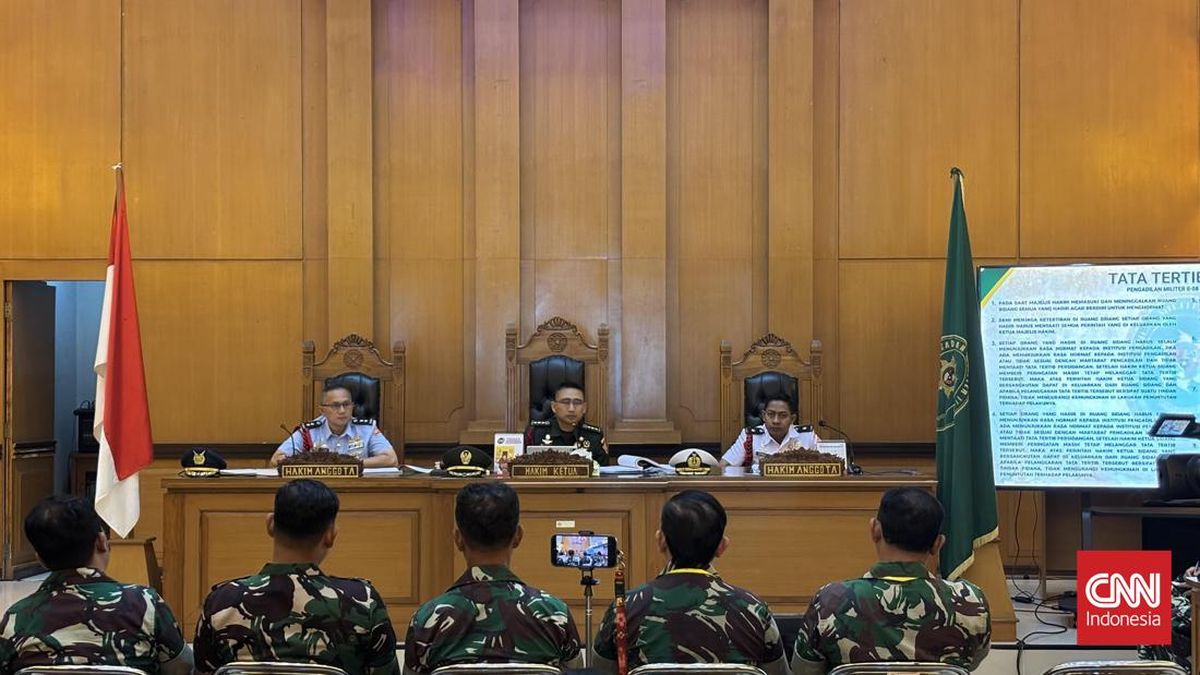
Former Head of the Indonesian Armed Forces’ Strategic Intelligence Agency (BAIS) TNI, Soleman B. Ponto, stated that the acid water attack on KontraS activist Andrie Yunus by four personnel from the BAIS TNI Headquarters Detachment (Denma) was merely an act of mischief.
Appearing as an expert witness in the trial at the Military Court II-08 Jakarta, Soleman assessed the case as not constituting an intelligence operation, but rather simple misconduct.
The defendants are Sergeant Two Edi Sudarko, First Lieutenant Budhi Hariyanto Widhi, Captain Nandala Dwi Prasetyo, and First Lieutenant Sami Lakka.
“According to the expert, what the defendants did, does it fall under the category of an intelligence operation or not? What the witness has known and seen so far,” said the legal counsel for the defendants during the trial at the Military Court II-08 Jakarta on Thursday (7/5).
“It is not an intelligence operation at all. If I were the BAIS chief at the time, or even now if I were their superior, I would see it as misconduct. We would view it as misconduct,” said Ponto.
“That is the mischief of selected, educated, trained individuals. When they encounter a trigger, as the second expert mentioned earlier, we don’t know what is stirring in their hearts. But when they find a trigger, ideas of mischief like this emerge,” he continued.
Ponto explained that in military intelligence doctrine, an intelligence operation is not a spontaneous or emotional action, especially not carried out individually without a command structure.
A military intelligence operation is an activity designed systematically, in stages, measured, and based on national strategic objectives.
In the TNI environment, particularly BAIS, he clarified, every intelligence operation fundamentally has several inseparable core elements.
Such as clear strategic objectives related to national security and defence interests, strategic stability, protection of vital national assets, counter-intelligence, or specific military operational interests.
“Therefore, actions born solely from personal emotions, personal grudges, or individual spontaneous reactions fundamentally do not meet the characteristics of strategic intelligence operations,” he said.
In addition to strategic objectives, intelligence operations also involve a chain of command and authorisation. There are orders, control, task division, and structural accountability.
Furthermore, Ponto said, intelligence operations always involve planning.
“Strategic intelligence operations are not carried out crudely or uncontrollably. Before execution, data collection, target analysis, risk assessment, impact simulation, preparation of communication lines, evacuation routes, personnel security, identity protection, and post-operation control are usually conducted,” stated Ponto.
“In other words, modern military intelligence operations work based on thorough calculations, not momentary emotional actions,” he added.
There is also the principle of operational success with minimal risk. In military intelligence doctrine, he explained, operational success is measured not only by achieving targets but also by the ability to control legal, political, media, and security impacts.
“Therefore, strategic intelligence operations tend to avoid actions that easily reveal the perpetrators’ identities,” he said.
Agreement on military court jurisdiction
On that occasion, Ponto stated his agreement that the acid water pouring case against Andrie Yunus should be examined and tried in military court.
Ponto assessed that the Authorised Superior (Ankum) had appropriately handled the acid water pouring case involving the four TNI personnel.
“If I were their Ankum and the public prosecutor requested them, if I didn’t hand them over, what would happen? It couldn’t. It couldn’t. What would happen? De facto impunity,” said Ponto.
“So, if someone requests today that these individuals be handed over to the public court, and when the military court takes over, it is seen as us taking over, actually we are placing it on the proper track,” he added.
Contrary to most opinions, Ponto stated that impunity would actually occur if this case were brought to the public court.
To strengthen his argument, Ponto cited the example of former Air Force Chief of Staff (KSAU) Marshal (Ret.) Agus Supriatna, who escaped legal proceedings in the corruption case involving the AW-101 helicopter procurement.
“We can take an example. The former KSAU, could he be brought to public court to this day? No, because Ankum has 100 percent authority to hold back. The prosecutor cannot force Ankum. Only the Main Military Court can order Ankum,” said Ponto.
Four TNI personnel are charged with pouring acid water on Andrie Yunus on the night of 12 March 2026.
They are Sergeant Two Edi Sudarko, First Lieutenant Budhi Hariyanto Widhi, Captain Nandala Dwi Prasetyo, and First Lieutenant Sami Lakka.
The motive, according to the prosecutor, was that the defendants harboured a grudge against Andrie for successfully interrupting a parliamentary meeting discussing revisions to the TNI Law held at the Fairmont Hotel in South Jakarta in March 2025.
“With that incident, the defendants considered Andrie Yunus to have insulted the TNI institution, even trampling on the TNI institution,” said the prosecutor when reading the indictment in a previous hearing.
The defendants are charged with violating Article 469 paragraph 1 subsidiary to Article 468 paragraph 1 further subsidiary to Article 467 paragraph 1 in conjunction with paragraph 2 in conjunction with Article 20 letter c of Law Number 1 of 2023 on the Criminal Code.