
Food Task Force of West Java Police Monitors Traditional Markets to Prevent Hoarding
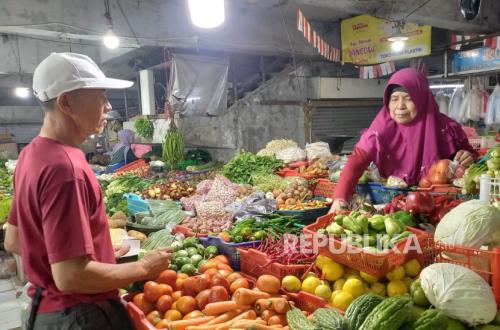
BANDUNG – The Food Task Force of West Java Regional Police has stepped up oversight of essential commodity distribution ahead of the 2026 Eid holiday to prevent hoarding practices that could trigger price increases in the marketplace. Surveillance is being conducted directly at traditional markets to ensure that the supply chain remains uninterrupted and prices comply with government regulations.
Kombes Pol Wirdhanto, Director of Special Criminal Investigation at West Java Regional Police, stated that field surveillance is essential to verify the sources of essential commodities being traded by merchants. The Food Task Force also monitors distribution routes to prevent hoarding by certain parties.
“It is important for us to conduct direct field oversight so that we know where they are obtaining their goods,” Wirdhanto said while checking prices of essential commodities at Kosambi Market and Caringin Central Market on Saturday (14/3/2026).
He emphasised that the supply chain for essential commodities must be maintained to prevent shortages that could trigger price increases. The Food Task Force also urged merchants to ensure that supplies come from official distribution channels.
“We advise merchants not to source goods online, because clearly this cannot be controlled for pricing, and we do not know where they originate from and so forth,” Wirdhanto said.
According to him, unclear distribution has the potential to increase costs for merchants, which ultimately impacts price increases for consumers. For this reason, surveillance is being conducted to ensure that commodity prices remain in accordance with the maximum retail price (HET) and government reference prices.
The Food Task Force also inspected prices of several key commodities including beef, chicken, cooking oil, and various types of vegetables. The inspection results showed that most commodities were still being sold in accordance with government reference prices.
“We ensure, particularly with beef—beef specifically—that sellers are still selling in accordance with government reference prices, which stand at Rp 130,000 and Rp 140,000 for the front and rear cuts respectively,” Wirdhanto said.
He added that prices may be higher if meat is sold in cleaned condition or as a premium category. Meanwhile, for other commodities such as cooking oil, some merchants are still awaiting additional supplies.
“We will directly assist with licensing procedures so that cooking oil can be supplied directly from Bulog, ensuring the price truly aligns with the maximum retail price,” Wirdhanto said.
For other commodities such as chicken, prices remain around Rp 40,000 per kilogram. Several vegetable commodities such as shallots and garlic also remain relatively stable at traditional markets.