
Food Supplies Remain Secure and Stability Strengthens Post-Eid
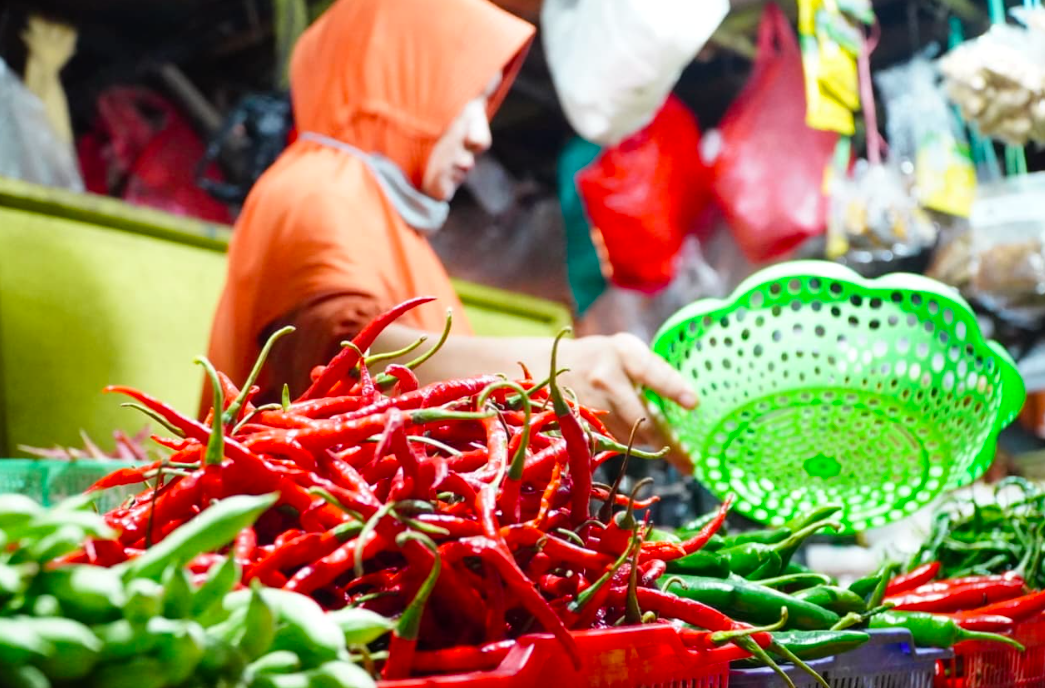
Trading activities for strategic staple foods are beginning to return to normal following the Idulfitri celebrations, although some traders have yet to reopen their stalls. Based on monitoring by the National Food Agency (Bapanas) on Thursday (26/3) at Rawamangun Market in Jakarta and Ciputat Market in South Tangerang, prices for several commodities, particularly poultry and horticultural products, were observed to be in fairly good condition.
“We visited two markets today, namely Rawamangun Market in Jakarta, followed by Ciputat Market in Tangerang. In Rawamangun earlier, there weren’t many traders yet, so prices weren’t fully stable. Then I visited Ciputat Market, where the prices are very good,” stated Deputy for Food Availability and Stabilisation of Bapanas, I Gusti Ketut Astawa, on Thursday (26/3).
At Ciputat Market, the price of broiler chicken meat was recorded at around Rp35,000 per kilogram (kg), still below the government’s Consumer Reference Selling Price (HAP) of Rp40,000 per kg.
Horticultural commodities also showed significant price improvements. The price of red bird’s eye chillies, which had surged during Ramadan, has now dropped to around Rp60,000 per kg, approaching the consumer HAP of Rp57,000 per kg. Meanwhile, shallots were recorded at around Rp40,000 per kg and curly red chillies at around Rp40,000 per kg.
“Then shallots at Rp40,000. Red bird’s eye chillies around Rp60,000, which has dropped very nicely. Curly red chillies around Rp40,000 even. This means the prices here are relatively very good,” added Ketut.
The government is targeting for prices of strategic staple foods to continue moving towards stable conditions post-Eid. This optimism is supported by the strengthening capacity of domestic supplies to meet public food needs.
“I’m here buying directly and can immediately know the prices, so hopefully with this condition, the relatively good prices can remain stable going forward. So post-Eid, prices can stay good,” concluded Deputy Ketut.
Previously, in the second week of March or ahead of Eid al-Fitr, food prices experienced fluctuations, although generally still within controlled limits. Data from the Central Statistics Agency (BPS) shows an increase in the Price Development Index (IPH) for several commodities in various regions.
For broiler chicken meat, the IPH increase was recorded in 192 districts/cities, with 123 of them still within the HAP range of Rp40,000 per kg. Meanwhile, the IPH increase for red bird’s eye chillies occurred in 198 districts/cities, but 48 districts/cities still recorded prices in line with the HAP limit of Rp57,000 per kg. As for shallots, the IPH increase was in 143 districts/cities, with 96 districts/cities remaining within the HAP corridor of Rp41,500 per kg.
Separately, the government emphasises that national food management aims to bring welfare to all actors, from upstream to downstream.
“We want everyone to smile. Farmers smile because their harvest prices are good, traders smile because goods are available and can be sold, and the public also smiles because food prices are affordable. That is the government’s goal in safeguarding food,” said Head of Bapanas Andi Amran Sulaiman, who is also the Minister of Agriculture.
“If production is surplus and distribution is smooth, then prices will be stable. That’s what we continue to maintain, from upstream to downstream. Food prices must not be too high because it burdens the public, but also not too low because it harms farmers. The government must maintain that balance,” added Amran.