
Food Security as the Frontline Defence Against War, Climate, and Technological Revolution
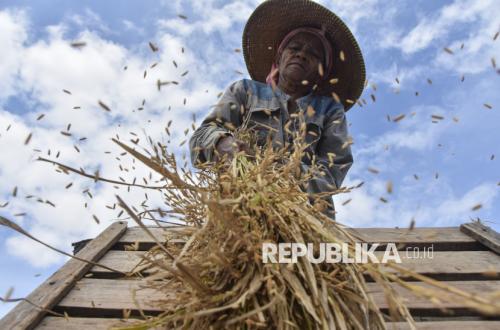
REPUBLIKA.CO.ID, JAKARTA - Food security constitutes a primary pillar of national resilience amid various global challenges such as war, climate crises, and technological disruptions. Food is no longer merely an economic matter but has become the foundation of a nation’s politics, society, and security.
Marine expert and national figure Rokhmin Dahuri asserted that a nation capable of ensuring food for its people will be stronger in facing global shocks.
“A nation that can guarantee food for its people will be stronger in facing global shocks, whether in the form of war, climate change, or technological disruption,” he stated.
According to him, out of the five basic human needs—food, clothing, shelter, health, and education—food is the most vital. This is because food greatly determines the quality of human resources and a nation’s competitiveness.
“A person’s intelligence is determined by nutritional intake. Without sufficient food, a nation will lose its competitiveness,” said Rokhmin.
He welcomed President Prabowo Subianto’s step in placing food self-sufficiency as the top priority of national development. This policy is seen to align with the thinking of Indonesia’s first President, Soekarno, who once stated that food is the life and death of a nation.
Quoting research from the Food and Agriculture Organization (FAO), he explained that countries with large populations that still rely on food imports will find it difficult to become advanced, prosperous, and sovereign nations.
“Countries with populations exceeding 100 million that depend on food imports will struggle to become advanced, prosperous, and sovereign,” he said.
He explained that the current global situation is increasingly uncertain due to geopolitical conflicts and the impacts of climate change, which reduce agricultural productivity and disrupt the global food supply chain. This condition requires every country to strengthen domestic production and national food reserves.
Rokhmin also noted that national rice production shows a positive trend and is in a surplus state. However, future challenges are not just about production but also ensuring equitable and widespread access to food for all Indonesian society.
“Alhamdulillah, our rice is already in surplus. Production reaches around 34 million tonnes, while national needs are about 32 million tonnes. But the issue is not just production, but equitable and widespread access to food for the people,” said Rokhmin.
Rokhmin explained that several strategic commodities such as corn, salt, and chillies have achieved self-sufficiency. Meanwhile, other commodities like wheat, soybeans, garlic, and beef still rely on imports and are continuously being worked on to increase their production.
Additionally, Rokhmin highlighted the importance of technological innovation in the food sector as a response to global challenges. Agricultural digitalisation, biotechnology, and artificial intelligence are seen to improve production efficiency, distribution, and food consumption in the future.
However, he reminded that technology must be integrated with policies that favour farmers, fishermen, and small communities so that its benefits can be felt equitably.
He also warned that food crises do not only impact the economy but can also trigger political and social instability in various countries. “Food is not just an economic issue, but also political. If imports are disrupted, fertiliser and food prices could soar, the people suffer, and national stability is threatened,” he said.
Rokhmin conveyed the message that food security is a nation’s last fortress.
“Food security is the last fortress that determines a nation’s resilience. Without sufficient, healthy, and affordable food, national resilience will be fragile in facing global storms,” stated Rokhmin.
In line with that, Agriculture Minister Andi Amran Sulaiman affirmed that the government continues to strengthen the agricultural sector through increased production, land optimisation, construction and rehabilitation of irrigation, provision of fertiliser, agricultural modernisation, and strengthening of national food reserves.
According to Amran, food security is not just an agricultural sector programme but a grand national strategy in maintaining economic, social, and political stability.
“Food security is a nation’s last fortress. If our food is secure, the country is secure. If food is disrupted, stability can be disrupted. Therefore, production must continue to increase, agriculture must advance, and we must strengthen national food reserves,” said Amran.
The Agriculture Minister added that food security must become a collective movement of all elements of the nation because food is a determining factor in Indonesia’s sovereignty and future.