
Food Coordinating Minister Ensures Smooth Supply of Subsidized Fertilizer in Banyuwangi
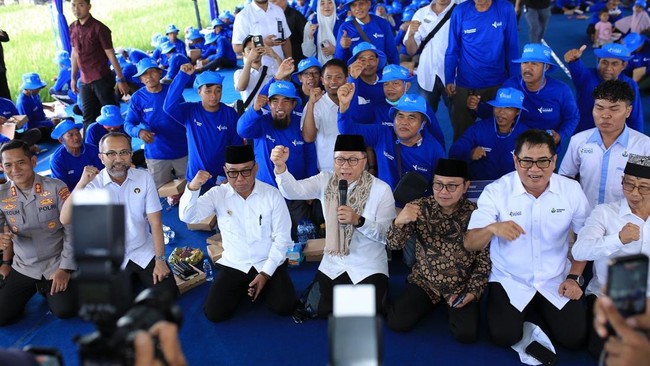
Jakarta, CNBC Indonesia - The Coordinating Minister for Food Affairs of the Republic of Indonesia, Zulkifli Hasan (Minister Zulhas), directly inspected the distribution of subsidized fertilizer in Banyuwangi, East Java, which has been running smoothly. The monitoring was carried out through a “Farmers’ Dialogue” event in Karangbendo Village, Rogojampi District, Banyuwangi Regency, on Thursday (May 14, 2026).
Zulhas stated that he had received direct instructions from President Prabowo Subianto to ensure that the distribution of subsidized fertilizer runs well in the field. Based on the inspection results, the fertilizer distribution is considered smooth and provides tangible benefits for farmers.
“I was asked by the President to check on the fertilizer. Thank God, the fertilizer supply is smooth, and the price also has a 20 percent discount,” said Zulhas in a statement on Friday (May 15, 2026).
This field inspection aims to directly see the implementation of the government’s new policy in managing the distribution of subsidized fertilizer. These include simplifying regulations from 145 rules to one main regulation, namely Presidential Regulation (Perpres) Number 6 of 2025 concerning the Management of Subsidized Fertilizer, which was then refined with Presidential Regulation 113/2025. In addition, there is also Minister of Agriculture Regulation (Permentan) Number 15 of 2025, which partially implements the regulations.
Through this simplification effort, subsidized fertilizer can be redeemed from the beginning of the year, or it can be obtained before farmers start planting. As a result, agricultural productivity has increased.
Through this simplification, subsidized fertilizer can be redeemed from the beginning of the year. In other words, it can be obtained before farmers start planting, so that agricultural productivity increases.
Another change that the government has made is to lower the Highest Retail Price (HET) of subsidized fertilizer since October 2025 by 20 percent. This first reduction in HET in the history of fertilizer subsidies applies to all types of subsidized fertilizer.
According to Zulhas, the smooth distribution of fertilizer and the more affordable price policy have a positive impact on farmers’ welfare. This is reflected in the increasing Farmer’s Terms of Trade (NTP) nationally.
“The farmer’s terms of trade have increased. Last year it was at 116, now it is 125. This means that our farmers are more prosperous,” he added.
Zulhas emphasized that the government continues to be committed to maintaining the availability of subsidized fertilizer, strengthening the national food sector, and ensuring that farmers have easy and affordable access to production facilities. The Farmers’ Dialogue in Banyuwangi is also a forum for dialogue between the government and farmers to absorb aspirations and ensure that various food programs run effectively in the region.
Meanwhile, the President Director of Petrokimia Gresik, a member of the Pupuk Indonesia holding company, Daconi Khotob, expressed his gratitude for the government’s support for the performance of Pupuk Indonesia and its group in distributing subsidized fertilizer more efficiently. The facilities provided by the government for farmers, he said, make the absorption of subsidized fertilizer more optimal.
Specifically for the province of East Java, the government allocated 2,038,387 tons of subsidized fertilizer in 2026. This figure consists of 1,005,145 tons of Urea, 884,868 tons of NPK Phonska, 255 tons of Special Cocoa NPK, 114,309 tons of organic Petroganik fertilizer, 10,987 tons of ZA, and 22,823 tons of SP-36.
Meanwhile, for Banyuwangi, the subsidized fertilizer allocation set by the government in 2026 is 90,096 tons. This figure consists of 47,401 tons of Urea, 42,035 tons of NPK Phonska, and 652 tons of organic Petroganik fertilizer, as well as 7 tons of ZA fertilizer.
The redemption carried out by farmers in East Java at the beginning of this year was quite high, namely 866,215 tons. The realization of distribution until May 12, 2026, is about 42.5 percent of the allocation.
A higher percentage of redemption occurred in Banyuwangi. Farmers in Banyuwangi in the same period have absorbed subsidized fertilizer of 51.8 percent, or about 46,685 tons.
“The absorption at the beginning of this year is quite high. This is inseparable from the facilities provided by the Government through changes in the management of subsidized fertilizer distribution,” said Daconi.
To support optimal absorption, Pupuk Indonesia also prepared a stock of subsidized fertilizer in East Java of 147,643 tons. The stock as of May 13, 2026, consists of 88,273 tons of Urea, 27,691 tons of NPK Phonska, 318 tons of Special Cocoa NPK, 11,609 tons of organic fertilizer, 2,778 tons of ZA, and 16,973 tons of SP-36.
On the other hand, the availability of subsidized fertilizer in Banyuwangi is currently 3,357 tons, namely 2,224 tons of Urea, 1,108 tons of NPK Phonska, 22 tons of Special Cocoa NPK, and 3 tons of ZA.
The smooth distribution of subsidized fertilizer was confirmed directly by a farmer from Banyuwangi, Muhammad Saidi, who attended the Farmers’ Dialogue. He said that currently there are no complaints from farmers in Banyuwangi regarding the availability of subsidized fertilizer.
“Everything is smooth, in the past the frequent complaints were because fertilizer was not available when needed, now everything is smooth,” said Saidi.
(rah/rah)